49 works in this view — arrow keys or swipe to move between them.
Dance in Art
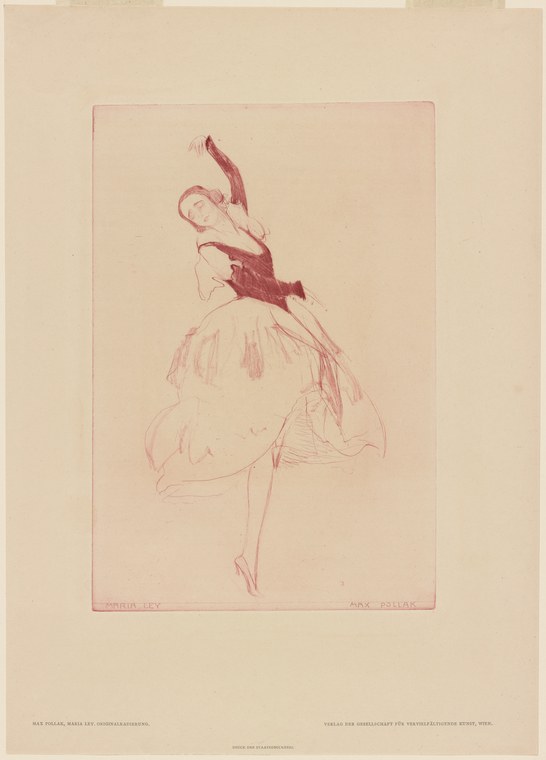
Maria Ley
Unknown artist
- Collection:
- Prints depicting dance
- Source:
- New York Public Library
- Rights:
- Public domain — free to use, share and adapt.
- Recorded as:
- Public Domain
This work documents a moment in the history of how ballet looked to artists: the pose, the costume, the bodily ideal. It also testifies to the intensity of interest in ballet during the period when it was at the height of its cultural prestige. For a historian or dancer, it offers evidence of how the arabesque was understood and valued.
What you are looking at
A single female dancer in a tutu is captured mid-movement against a plain cream ground. She is tilted sharply backward in an extended arabesque or similar classical pose, her upper body arched and one leg raised behind her, her body creating a dramatic diagonal line across the composition. Her arms are raised and extended, following the arc of her torso. The tutu is rendered in loose red-pink strokes that suggest lightness and movement. The figure occupies the full height of the composition, drawn in a delicate preliminary style with visible underdrawing and minimal color—mostly red-pink line work with selective darker shading in the torso and upper arms. The drawing technique is economical and sketch-like rather than finished, the kind of study that captures the essential line of the pose.
The dancing
The dancer's weight is thrown onto her supporting leg (stage left), with her free leg extended high behind her in a characteristic classical extension. Her torso is arched backward in a dramatic lean, and both arms follow the line of the movement, raised and extended. The pose suggests strength and control even as it reads as flowing and organic. The body is slender and elongated in the drawing style, exaggerating the verticality of the classical dancer's line. There is only one figure; the entire image is devoted to the intensity and clarity of this single pose.
The dance depicted
This is a classical ballet study, almost certainly of a principal ballerina. The arabesque or similar extended pose is fundamental to ballet vocabulary, and the tutu—rendered as a knee-length or mid-thigh classical tutu—is the costume of theatrical ballet. The pose shows the hallmarks of late nineteenth or early twentieth-century performance style: the extreme arch of the back, the lifted and extended free leg, the raised arms that frame the movement without breaking its line. The technical confidence required to hold this lean and extension suggests a dancer of considerable rank, and the artist has chosen a moment of apparent effortlessness that conveys the illusion ballet aims at.
How it was made
This is a drawing in red chalk or red ink on cream paper, executed with light, economical line work and selective shading. The technique appears to be preliminary—an artist's study rather than a finished artwork for independent circulation. The minimal palette and sketch-like execution suggest it may be a rehearsal study or a study for a larger work. The simplicity of the technique means the focus is entirely on the accuracy and clarity of the pose, and the artist has succeeded in conveying both the physical geometry of the movement and something of its grace.
About this work
This is a sketch of a classical ballet dancer in arabesque, likely dating to the late nineteenth or early twentieth century when ballet was establishing itself as a major theatrical form in Europe. The drawing captures the essential line of the classical ballet pose: the backward arch, the extended leg, the raised arms, the sense of controlled flow. The artist has chosen not to finish the work in detail, leaving it as a study of line and movement. The holding institution identifies this as a print (an engraving or etching), though the image itself reads primarily as a drawing. The work belongs to a tradition of dance notation through visual art—the attempt to capture on paper not just the existence of a performance but something of its quality and physical character.
How to look at it
Attend first to the line of the body: follow the arch from the head through the extended free leg, noting how the artist has exaggerated the backward tilt to emphasize the curve and the sense of control. Look at the arms and how they frame the movement without breaking the line of the back. Notice the economy of the technique—how much information about the pose is conveyed with how little mark-making. The moment chosen is one of apparent suspension, the dancer caught in the middle of the movement rather than at its beginning or end, which gives it a sense of timelessness characteristic of classical ballet imagery.
The artist
The artist is not recorded in the catalogue. The signature or mark visible on the drawing is not legible in the image, and attribution remains uncertain. The technical competence evident in the drawing—the accurate capture of the pose, the clear understanding of the ballet body—suggests someone with firsthand knowledge of professional dance, either a ballet instructor, a dancer-artist, or a visual artist who worked regularly with dancers.
The period
This sketch dates from an era when ballet was one of the most fashionable spectacles in European culture, particularly in Paris and London. The classical ballet tradition established by dancers like Marie Taglioni and refined by the Imperial Russian Ballet was at the height of its artistic achievement. Artists across media were drawn to ballet as a subject, seeing in it an ideal form of beauty, athleticism, and grace. The late nineteenth and early twentieth centuries saw an explosion of visual art devoted to dance—prints, paintings, photographs, lithographs—as part of a broader fascination with movement and the dancing body.
Where it lives
The work is held in the New York Public Library's collection of prints depicting dance. It appears in their catalogue with minimal identification, as is typical for works of this kind; many such prints were circulated widely during the period and their individual histories are often difficult to trace.
Dance in this work
Questions about this work
What is an arabesque?
An arabesque is a classical ballet position in which the dancer stands on one leg with the other leg extended behind the body, typically at or above hip height. The arms are arranged to frame and balance the movement. It is one of the fundamental positions in ballet vocabulary and appears in choreography across all eras and styles.
Who is Maria Ley?
The catalogue record provides no information about Maria Ley beyond the title of this work. She is likely either the dancer depicted or the subject of the study, but her identity and career remain unrecorded in the current documentation.
Is this a finished artwork or a study?
The work appears to be a preliminary study or sketch rather than a finished artwork. The light, economical line work and selective shading suggest that the artist was exploring the pose and capturing its essential qualities rather than creating a polished, detailed print for independent circulation.
When was this made?
The catalogue record gives no date. Based on the style of the tutu, the costume conventions, and the aesthetic of the drawing, the work likely dates to the late nineteenth or early twentieth century, but without further documentation this cannot be established with certainty.
More dance artwork





