49 works in this view — arrow keys or swipe to move between them.
Dance in Art
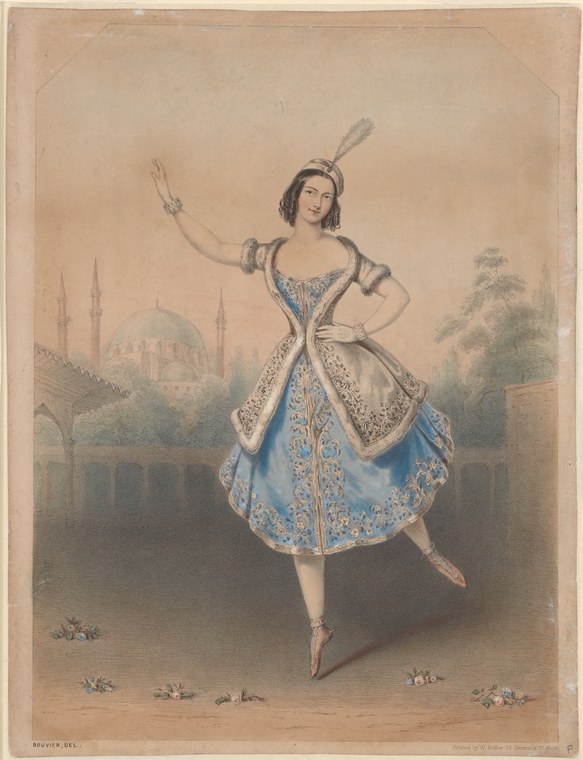
Fanny Cerrito. La Lituana
Unknown artist
- Collection:
- Prints depicting dance
- Source:
- New York Public Library
- Rights:
- Public domain — free to use, share and adapt.
- Recorded as:
- Public Domain
Fanny Cerrito was a major creative force in Romantic ballet—not only a great dancer but also a choreographer and creator of roles. Images like this are among the only visual records of how these works actually looked on stage and how specific dancers moved through them. The print also reveals the commercial infrastructure of 19th-century theater: the way theatrical imagery was mass-produced, distributed, and consumed as souvenirs, allowing fans to own a piece of the spectacle.
What you are looking at
A young woman in Romantic-era ballet costume stands alone on a stage, posed mid-leap or suspension with her left leg extended upward and her right arm raised in a graceful arc. She wears a fitted bodice in white or cream silk with blue silk trim, and a voluminous skirt of layered blue silk with ornate white embroidered or appliquéd decoration—characteristic of the short, bell-shaped tutus of 1840s ballet. She sports a feathered headdress and holds what appears to be a feathered fan or plume in her raised right hand. The background is hazy and atmospheric, rendered in soft browns and greens, depicting a romantic landscape with Eastern architectural elements: domed buildings with minarets suggest an Ottoman or Near Eastern setting. Small flowers or scattered stage properties lie on the ground at her feet. The overall composition freezes a moment of ethereal weightlessness, with the dancer appearing to float above the stage.
The dancing
The dancer's body expresses pure verticality and lift: her supporting left leg is straight and appears to be rising onto pointe or demi-pointe, while the right leg extends high in a développé or battement. Her upper body remains upright and composed; both arms are raised in the soft, rounded port de bras typical of Romantic ballet, with the right arm higher and the left arm slightly lower, creating a balanced line from fingertip to toe. Her head is held high, gaze directed upward or into the distance. This is the vocabulary of elevation and grace fundamental to mid-19th-century ballet technique.
The dance depicted
This is Romantic ballet of the 1840s, the era of Giselle, La Sylphide, and Les Sylphides. The title identifies the subject as Fanny Cerrito, one of the most celebrated dancers of the period. Cerrito was known for her technical brilliance—particularly her jumps and elevation—and her ability to embody both human and supernatural characters. The Eastern setting and costume suggest this may depict her in a specific role, possibly from a ballet such as La Lituana (if the title refers to a Lithuanian character or theme) or one of the exotic or fantastical works popular in this era. The image captures the Romantic aesthetic: weightlessness, grace, otherworldliness, and the illusion of defying gravity that was central to ballet's appeal in this period.
How it was made
This is a hand-colored lithograph, a medium that allowed rapid reproduction and distribution of popular theatrical imagery. The lithograph process, which uses grease and water to separate image and blank areas on stone, produced this soft, atmospheric effect, with color applied by hand after printing—visible in the subtle gradations of the background and the delicate shading of the fabrics. The technique was particularly suited to capturing the ethereal quality of Romantic ballet and allowed multiple copies to be sold as popular prints, making images of famous dancers widely accessible to middle-class audiences who attended the theater. The artist's signature (illegible in reproduction) appears at lower left.
About this work
This hand-colored lithograph documents Fanny Cerrito, one of the finest Romantic ballet dancers of the 1840s, in an unidentified role—possibly from La Lituana or another exotic ballet of the period. It is a theatrical souvenir print, the kind that circulated as a commercial product in the 19th century, capturing both Cerrito's legendary elevation and the Romantic ballet aesthetic that dominated European theaters in the decades following 1830. The image is historically valuable as a record of specific costume, technique, and staging practice of a lost performance tradition.
How to look at it
Observe the extreme verticality of the pose: the dancer is not shown mid-turn or in a lateral arabesque, but rising upward, with the supporting leg appearing to lift her entire frame skyward. This captures the defining ambition of Romantic ballet—the denial of weight. Note the careful balance of the raised arms: they are soft and rounded, never rigid or angular, enacting the balletic ideal of effortlessness. The feathered headdress and Eastern setting are signals of an exotic or supernatural character, common in Romantic plots. The theatrical lighting and hazy background emphasize the stage as a space of illusion, not reality.
The artist
The artist is not recorded. The print was likely produced by a commercial lithography house specializing in theatrical imagery—a common practice in the 1840s–1850s. Such houses in Paris, London, and other major theater centers employed teams of artists and colorists to produce portraits of celebrated performers. Attribution is often lost, as these were commercial products rather than fine-art works. The signature visible at lower left would have identified the artist or the publisher, but it is not legible in reproduction.
The period
The Romantic era (roughly 1830–1850) saw ballet at its artistic and commercial peak. Fanny Cerrito danced alongside other legendary figures—Marie Taglioni, Carlotta Grisi, Lucile Grahn—in an era when ballerinas were international celebrities and their images were as sought-after as those of film stars in the 20th century. Lithographic printing, perfected in this period, made such images affordable and widely circulated. Simultaneously, Romantic ballet was moving toward more spectacular stagecraft: exotic settings, supernatural themes, the illusion of weightlessness achieved through pointe work and elevation. The medium of hand-colored lithography was ideal for marketing this spectacle to audiences and preserving the memory of performances that existed only in real time.
Where it lives
This is a hand-colored lithographic print from the New York Public Library's collection of prints depicting dance. Such prints were mass-produced theatrical souvenirs sold in foyers and distributed to fans; they survive in large numbers in theater collections and museums worldwide.
Dance in this work
Questions about this work
Who was Fanny Cerrito?
Fanny Cerrito (1817–1909) was an Italian-born dancer and choreographer who became one of the most celebrated ballerinas of the Romantic era. She was known for her extraordinary technical skill, especially her elevation and jumping ability, and for her intelligence as a choreographer. She created many of her own roles and works, making her rare among dancers of her time—most were dependent on male choreographers. She performed across Europe and was a star of the Paris Opéra.
What does 'La Lituana' mean?
The title translates as 'The Lithuanian Woman,' suggesting the role depicted a Lithuanian character. Cerrito danced in many story ballets with exotic or nationalist themes, which were popular in the 1840s. It may refer to a specific ballet, but the work is not securely identified in the print or record.
How were Romantic ballerinas able to appear weightless?
They used pointe work and elevation—the ability to jump and land almost silently—to create the illusion of defying gravity. The ethereal effects were enhanced by costume (the light tulle skirt and pale silks), lighting (gas lamps that softened shadows), and choreography that emphasized sustained poses and seemingly effortless flight. This was the central technical and aesthetic innovation of Romantic ballet.
Why were lithographic prints of dancers so popular?
In the 19th century, before photography was widespread and affordable, lithographic prints were the primary way to own an image of a favorite performer. They were inexpensive, widely distributed, and hand-colored to make them look like paintings. Fans collected them as we now collect posters or merchandise; they were both artwork and celebrity merchandise.
More dance artwork





