49 works in this view — arrow keys or swipe to move between them.
Dance in Art
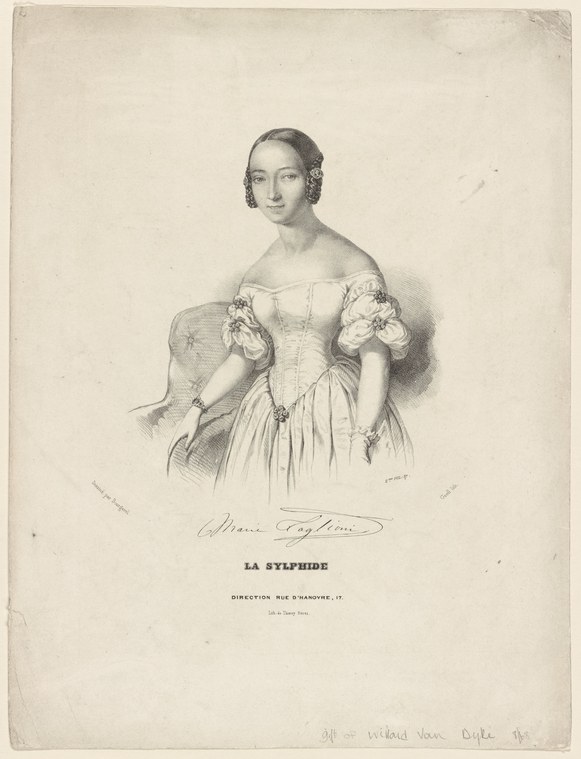
Marie Taglioni [facsimile signature] La sylphide
Unknown artist
- Collection:
- Prints depicting dance
- Source:
- New York Public Library
- Rights:
- Public domain — free to use, share and adapt.
- Recorded as:
- Public Domain
This portrait shows us how the Romantic period visualized the female dancer: weightless, ethereal, draped in pale silk, the body at rest in perfect classical carriage. Taglioni's image became the template for how ballet dancers—and what audiences expected of them—would be imagined for decades. Understanding Romantic ballet aesthetics requires seeing how the era chose to depict its heroines, and this widely circulated print shaped public memory of what Taglioni was and what the Sylphide meant.
What you are looking at
A young woman stands in three-quarter pose against a plain background, her body angled slightly to the left. She wears a pale romantic-era ball gown with off-shoulder sleeves gathered at the forearm and a fitted bodice; the skirt falls in soft folds to the floor. Her dark hair is parted centrally and swept back smoothly. She holds her arms in an open, graceful position at roughly waist height, palms visible, in the relaxed posture of a dancer at rest rather than mid-movement. The drawing is executed in fine pencil with subtle tonal shading; the face is delicately modeled, the fabric rendered with light parallel strokes that suggest silk rather than describe it in detail. The composition is frontal and formal, presenting the figure as a portrait of a named performer rather than as narrative action.
The dancing
The single figure is shown in a posed, balletic stance: feet in a closed position, weight evenly distributed, the body held upright with gentle control. The arm positions—one slightly forward, one to the side—suggest the preparatory or closing frame of classical training rather than an active step. The posture conveys ease and training; there is no tension or exertion visible. The open hand positions and the general carriage of the body are consistent with early 19th-century ballet technique, where graceful repose was valued as much as movement.
The dance depicted
This is a portrait of Marie Taglioni, the Swedish-Italian ballerina whose name appears below in facsimile signature. Taglioni is remembered as the creator and first dancer of the role of the Sylphide in *La Sylphide* (1832), the Romantic ballet that defined her career and the era. The image records her as that character: the pale dress, the soft arm positions, and the ethereal bearing are hallmarks of the Romantic sylph. The drawing does not capture her in mid-performance but as the figure she became—an icon of weightlessness and purity that the Romantic period imposed on female ballet dancers. This is a commemorative image, a celebrity portrait, not a document of choreography.
How it was made
This is an engraved or finely drawn portrait print, most likely a lithographic stone drawing or engraving transferred to paper; the quality of line and the capacity to render subtle tonal gradations suggest skilled reproductive technique rather than a direct sketch. The delicate modeling of the face, the fine hatching on the dress, and the precision of the signature all point to a professional printmaker. Such prints were mass-produced and circulated widely among middle-class collectors and opera-goers in the 1830s–40s, making Taglioni's image one of the most reproduced dancer likenesses of the early 19th century. The print would have been affordable and collectable, and its presence in the New York Public Library's collection reflects the significant audience for such imagery in America.
About this work
This is a named portrait of Marie Taglioni as the Sylphide, the role that made her the most celebrated ballerina of the Romantic era. The print commemorates both the dancer and her most famous character: the ethereal spirit who embodied the new aesthetic of weightlessness and otherworldly beauty that defined 1830s ballet. Taglioni was not merely a performer of this role but its creator, dancing the premiere of *La Sylphide* in Paris in 1832. The image entered circulation as a celebrity portrait and souvenir, available to admirers across Europe and beyond. It belongs in a dance gallery because it captures the visual ideal of Romantic ballet as it was understood and remembered: not as a document of technique but as the image of a dancer that the period chose to make iconic.
How to look at it
Look at the pose: Taglioni is not caught mid-leap or mid-turn, but standing still, the body perfectly vertical, the arms soft and open. This stillness is itself a statement of Romantic aesthetics—the dancer as a creature of supernatural grace rather than athletic virtuosity. The pale dress, the smooth hair, the delicate face, the repose: every element says 'ethereal,' 'pure,' 'otherworldly.' Notice too what the print does not show—no stage setting, no character context, no other dancers. This is a portrait of Taglioni herself, or at least of Taglioni-as-Sylphide, a conflation of person and role that was central to the celebrity of the Romantic era.
The artist
The artist is not recorded in the catalogue, but the professional quality and the facsimile signature of Taglioni suggest this was an authorized or at least sanctioned portrait, likely commissioned or produced in Paris or another major opera center during Taglioni's peak fame (1830s–40s). The print's presence in the NYPL collection suggests it was published for commercial circulation, part of the thriving market in performer portraits that grew as lithography made such images affordable and reproducible.
The period
*La Sylphide*, premiered at the Paris Opéra in 1832, was a watershed work in ballet history. It established the vocabulary of Romantic ballet: the supernatural heroine, the pointe technique (then newly developed), the pale tulle dress, the choreography of weightlessness. Taglioni's performance and her body became synonymous with this new ideal. In the 1830s–40s, portrait prints of celebrated performers—opera singers, dancers, actors—became a major art form and commodity, circulated like today's publicity photography. Taglioni's image was reproduced in dozens of versions across Europe and America, making her the first truly international ballet superstar whose likeness was known beyond theater audiences.
Where it lives
This print is held by the New York Public Library's Prints depicting dance collection. It is part of a broader holding of 19th-century performer portraits and theatrical imagery. The presence of such prints in major American libraries reflects how widely Taglioni's fame and image circulated in the transatlantic world.
Dance in this work
Questions about this work
Who was Marie Taglioni and why is she important?
Taglioni (1804–1884) was a Swedish-Italian ballerina who created and premiered the role of the Sylphide in *La Sylphide* (1832), the ballet that defined the Romantic era. She is remembered as the first great ballerina of the Romantic period and the dancer who most embodied its aesthetic ideals of weightlessness, ethereality, and otherworldly beauty. She was the first international ballet superstar and the first whose image became widely known through printed portraits.
What is *La Sylphide* and why does it matter?
*La Sylphide* (1832) is a landmark ballet in which a supernatural spirit (the Sylphide) seduces a young man away from his earthly bride. It established the core vocabulary of Romantic ballet: the pale tulle costume, the pointe technique, the ethereal female figure, the otherworldly setting. Every major Romantic ballet that followed—*Giselle*, *Swan Lake*—owes its aesthetic to *La Sylphide*. Taglioni's performance in the role defined what the Sylphide should look like.
How were these prints made and circulated?
This is most likely a lithographic or engraved print, techniques that allowed multiple copies to be made from a single stone or plate. Such prints were manufactured and sold in shops, much as publicity photographs are today, and were collected by theater-goers and Taglioni admirers. The existence of many versions and variations of this portrait suggests it was popular and profitable, making Taglioni's likeness one of the most recognizable images of the 19th century.
More dance artwork





