49 works in this view — arrow keys or swipe to move between them.
Dance in Art
Fanny Elssler
Unknown artist
- Collection:
- Prints depicting dance
- Source:
- New York Public Library
- Rights:
- Public domain — free to use, share and adapt.
- Recorded as:
- Public Domain
Fanny Elssler was one of the two greatest ballerinas of her age (alongside Marie Taglioni) and was unique in bringing Spanish dance vocabulary—particularly the cachucha and tarantella—into the ballet repertory, thereby expanding the expressive range of Romantic ballet. This portrait is not a record of her technique, but it is a crucial artifact of her celebrity and of how the Romantic ballerina was constructed as an object of desire and fascination in popular culture.
What you are looking at
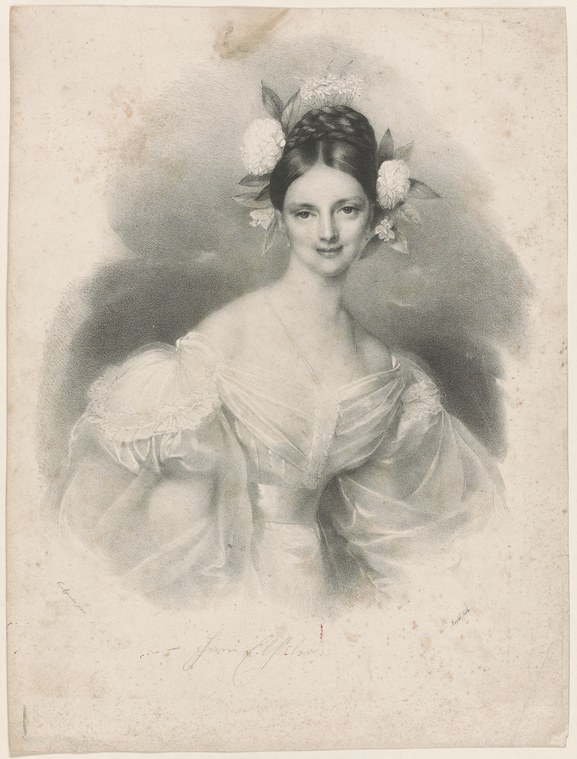
A half-length portrait of a woman in early 19th-century dress, rendered in delicate stippled tones with soft shading that gives the figure an ethereal quality. She is positioned slightly turned toward the viewer, her bare shoulders emerging from a gauze-draped bodice of gossamer whiteness. The neckline is wide and off-shoulder, revealing the collarbone and upper chest in the neoclassical manner. Her dark hair is arranged with two pale flowers (likely roses or peonies) nestled among the locks, one on each side. The background is a soft wash of gray and white, creating a halo effect around the figure's head and shoulders. The overall impression is one of refined femininity and balletic grace—the costume and pose suggest a dancer en déshabillé, or perhaps a portrait of a dancer in informal dress rather than stage costume. The work has the character of a formal portrait engraving or lithograph, not a scene of active dancing.
The dancing
The sitter is depicted from the shoulders up, her posture upright and dignified. Her head turns slightly to the left, with a composed, almost dreamy expression. The shoulders are relaxed and dropped, accentuating the long lines of the neck and the sculptural quality of the upper torso—a characteristic pose in portraiture of the era that was especially favored for dancers and performers. There is no dynamic gesture or movement implied; this is a study in repose and beauty rather than action.
The dance depicted
This is a portrait of Fanny Elssler, the Austrian ballerina who was one of the most celebrated dancers of the Romantic era (1810–1884). She is shown not in a dancing pose but in the formal portrait mode typical of theatrical celebrities of the 1830s–1840s. Elssler was renowned for her technical brilliance, her dramatic intensity, and her signature roles in ballets such as *La Sylphide* and *La Tarentule*. The softness of the rendering and the idealized beauty of the image reflect the Romantic cult of the ballerina as an otherworldly figure—ethereal yet sensual. The flowers in her hair reference the floral crowns and garlands that decorated the hair of Romantic-era dancers both on and off stage.
How it was made
This is a lithograph or stipple engraving, executed in grayscale tones with careful cross-hatching and dotted shading to model form and create atmospheric effects. The technique—likely lithography, given the soft tonal gradations and the absence of sharp linear definition—was ideal for the mass production of theatrical celebrity portraits in the early 19th century. Such prints were highly collectible and were sold to the public as mementos of popular performers, allowing the image of a dancer to circulate far beyond those who could attend performances. The quality and finish suggest this was a significant portrait, possibly executed by a recognized artist of theatrical scenes.
About this work
This is a lithographic portrait of Fanny Elssler, the most celebrated ballerina of the Romantic era, shown in the formal portrait mode customary for theatrical celebrities of her time. Rather than capturing her in a moment of dance, the artist presents her as an idealized figure of beauty and refinement, dressed in the gossamer drapery and floral adornment that signaled both her profession and her status as a romantic icon. The work is a document of how the ballerina was marketed, consumed, and mythologized during the height of Romantic ballet—not as an athlete or technician, but as an ethereal, almost supernatural being. For historians of dance, the image reveals the visual conventions through which female dancers of this period were represented: the emphasis on whiteness, delicacy, and an almost passive beauty that contrasted sharply with the technical demands and physical power their performances actually required.
How to look at it
The portrait is composed to emphasize the dancer's neck, shoulders, and face—the parts of the body most visible in ballet costume and most prized in the aesthetic of the period. The soft, almost shadowless rendering gives the figure a timeless, idealized quality; this is not a document of how Elssler actually looked, but rather how she wished to be remembered and how her admirers wished to imagine her. The flowers in her hair are a small but significant detail: they reference both the stage costume and a kind of poetic, naturalized beauty that was central to Romantic ideology. Note the complete absence of anything dynamic or muscular in the pose—the ballerina is presented as a object of contemplation rather than as an athlete or performer in motion.
The artist
The artist is not recorded in the catalogue. However, the quality and style of the lithograph suggest it was executed by a skilled theatrical portraitist, possibly working in Paris or Vienna in the 1830s–1840s when Elssler was at the height of her fame. Such portraits were often unsigned or credited only to the printer, and many have been lost or misattributed over time.
The period
This portrait dates to the Romantic era of ballet, when the female dancer emerged as a central figure in European high culture. The 1830s–1840s saw the triumph of ethereal, supernatural-themed ballets such as *La Sylphide* (1832) and *Giselle* (1841), in which the ballerina was costumed in white tulle and positioned as an unattainable, otherworldly being. At the same time, the theater industry of Paris, London, and Vienna was rapidly expanding, and the technologies of mechanical reproduction—lithography and engraving—made it possible to mass-produce images of stars for a growing middle-class audience. Fanny Elssler's career spanned the transition from the classical to the Romantic ballet, and she was one of the first dancers to achieve international celebrity status through such printed portraits.
Where it lives
The work is held in the New York Public Library's prints collection, part of a larger body of theatrical prints and celebrity portraits from the 19th century. As an unsigned lithograph in a public collection, it represents the documentary and archival approach to preserving images of theatrical history.
Dance in this work
Questions about this work
Who was Fanny Elssler?
Fanny Elssler (1810–1884) was an Austrian ballerina and one of the two greatest dancers of the Romantic era. She was celebrated for her technical brilliance, dramatic intensity, and her distinctive style, which blended classical ballet with Spanish and Italian folk dance. She was a rival of Marie Taglioni and achieved international stardom, touring Europe and America to great acclaim.
Why is this just a portrait and not a dance scene?
In the early 19th century, theatrical celebrity portraits were often composed to emphasize the performer's beauty and refinement rather than to capture them in action. This reflected the culture of the period, in which the ballerina was idealized as a romantic, almost supernatural figure. Such portraits were sold as souvenirs and hung in homes, so they were designed to be contemplative and aesthetically pleasing rather than documentary.
What is the technique? Is this a painting?
This appears to be a lithograph or stipple engraving, a printmaking technique that allowed for mass production and wide circulation. The soft tonal gradations and the absence of sharp lines are characteristic of lithography, a technology that was central to the spread of theatrical celebrity culture in this period. It is not a painting, but a reproducible print.
What do the flowers mean?
The flowers (likely roses) woven into Elssler's hair are a reference to both the stage costume of the period and to the Romantic aesthetic of natural beauty. Dancers of the era often wore floral crowns and garlands as part of their stage costume, and these motifs carried symbolic meaning related to youth, beauty, and the supernatural or transcendent qualities associated with the Romantic ballerina.
More dance artwork





