49 works in this view — arrow keys or swipe to move between them.
Dance in Art
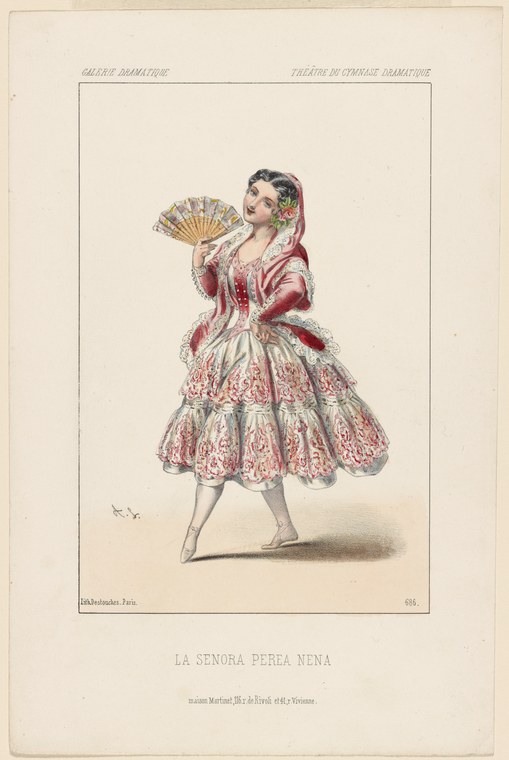
Théâtre du Cymnase [sic] Dramatique. La Senora Perea Nena
Unknown artist
- Collection:
- Prints depicting dance
- Source:
- New York Public Library
- Rights:
- Public domain — free to use, share and adapt.
- Recorded as:
- Public Domain
The work illustrates the celebrity culture of Romantic-era theatre and the central role of the female dancer's body and costume in that economy of display. It also documents a specific performer of the 1840s–1850s whose work might otherwise be wholly forgotten, preserving her image and professional identity in a medium designed for that purpose.
What you are looking at
A single female dancer is pictured against a plain background, posed in a moment of theatrical display. She wears an elaborate mid-nineteenth-century costume: a crimson or deep red silk bodice with long fitted sleeves, a white chemisette, and a voluminous skirt of pale silk decorated with large-scale floral or botanical prints in red and cream. The skirt is caught and lifted asymmetrically, revealing the dancer's legs and the understructure of the garment—a technique of exposure common to Romantic-era theatrical dance. Her posture is upright and composed, weight on one leg, the other bent slightly. She holds an ornate folding fan in one hand, raised near her face in a gesture of flirtation or modest display. Her hair is styled in the fashion of the 1840s–1850s, and her expression is directed toward the viewer in a moment of acknowledged performance. The figure is rendered in colour lithography with fine linework and delicate hand-colouring.
The dancing
A single dancer in a pose of elegant repose rather than active movement. Her weight appears settled on her back leg, with the front leg relaxed and slightly bent—a posture that suggests either a moment between steps or a held position for display. The fan is deployed as an accessory of social gesture rather than as a prop of movement; her free arm hangs naturally. The silhouette is upright and composed, with the head held level and directed toward the viewer. The entire frame suggests stillness and presentation rather than kinetic momentum.
The dance depicted
This is a souvenir of a theatrical performance—likely a opera or ballet from the 1840s–1850s, as indicated by the costume, lithographic technique, and text below the figure. The title identifies the performer as "La Señora Perea Nena," a dancer of that period. The work represents the star of a production, captured in a moment of stage costume rather than in the midst of choreography. The theatrical role appears to involve a character in European Romantic dress, rather than any recognizable contemporary social dance. Without further documentation, the specific ballet or opera cannot be identified, but the image is consistent with mid-nineteenth-century theatrical-ballet costume and the conventions of portrait lithography used to promote performers.
How it was made
This is a colour lithograph, hand-coloured, printed and distributed as a portrait souvenir of a theatrical performer—a common format for promoting dancers and opera singers in the 1840s–1850s. The medium allowed for wide circulation in small format, affordable to a theatre-going public. The technique is competent but not exceptional: the principal figure is drawn with care and coloured with restraint, while the background is left plain to focus attention on the costume and figure. The imprint "L. Sabattier, Paris" at the lower left indicates a Parisian publisher, confirming the work as a commercial theatre souvenir of European origin.
About this work
This is a theatrical souvenir portrait in colour lithography of a mid-nineteenth-century dancer, La Señora Perea Nena, in the costume of an opera or ballet role. The work documents both the performer and the Romantic-era aesthetic of theatrical dress: the voluminous patterned skirt, the fitted bodice, and the exposure of the leg through strategic lifting of the fabric—all hallmarks of the ballet blanc and the emerging conventions of Romantic-era spectacle. The image survives as evidence of a specific performer and a moment in the history of theatrical dance, preserved in the format in which it was originally circulated to audiences and fans. It belongs in a dance gallery as a document of how performers were promoted and how their bodies and costumes were commodified and displayed.
How to look at it
The artist has chosen not a moment of dynamic movement, but a pause—a moment of presentation and display. The lifted skirt, which might suggest a movement or pirouette in progress, is instead held and posed for the viewer's gaze. Note the fan, deployed as an accessory of flirtation and social performance rather than balletic gesture. The colour lithography technique emphasises the costume above all: the pattern of the skirt, the depth of the red bodice, the delicacy of the chemisette. The eye is drawn to the clothing and the body it frames, rather than to the action of dancing itself.
The artist
The work is credited to L. Sabattier, a Parisian lithographic publisher active in the mid-nineteenth century, known for producing theatrical portrait souvenirs. The publisher's name appears as a mark of commercial production rather than individual artistic authorship; such prints were often drawn by studio artists and coloured by hand in the publisher's workshop. The work is typical of a significant commercial enterprise in Paris during the 1840s–1860s: the mass production of affordable portrait lithographs of theatrical stars.
The period
The mid-nineteenth century saw the zenith of the Romantic ballet in Paris, with works like *La Sylphide* (1832) and *Giselle* (1841) establishing new aesthetic ideals of the ethereal, tragic female dancer. At the same time, theatrical portraiture became a significant commercial practice. Lithography, perfected in the early nineteenth century, made it possible to produce affordable, coloured prints in quantity, creating a visual culture around theatrical celebrities. This portrait of Perea Nena belongs to that moment when the dancer's image became a commodity as valuable as her stage appearances.
Where it lives
The work is held in the New York Public Library's collection of prints depicting dance. It is a commercial lithographic souvenir, published in Paris by L. Sabattier, and was designed for sale to theatre-goers and collectors of theatrical ephemera.
Dance in this work
Questions about this work
Who was La Señora Perea Nena?
She was a stage performer in European theatre during the 1840s–1850s, but detailed biographical information about her has not been preserved. This print is one of the principal surviving documents of her professional existence and the roles she performed.
What dance is she performing?
The work does not depict choreography in progress, but rather a theatrical costume and role. Without access to the original playbill or programme, the specific ballet or opera cannot be identified. The costume suggests a Romantic-era theatrical production, likely European.
Why is her skirt lifted in this way?
In Romantic-era ballet, the lifting or swinging of the skirt was both a practical necessity (it allowed visibility of the legs and footwork) and an aesthetic convention designed to display the dancer's body. This pose was standard in portraiture of the period, signalling both movement and theatricality.
What is the significance of the fan?
The fan is an accessory of social performance and feminine display, not a balletic prop. Its presence suggests a role involving social interaction or romantic intrigue, typical of mid-nineteenth-century operatic or ballet narratives.
More dance artwork





