49 works in this view — arrow keys or swipe to move between them.
Dance in Art
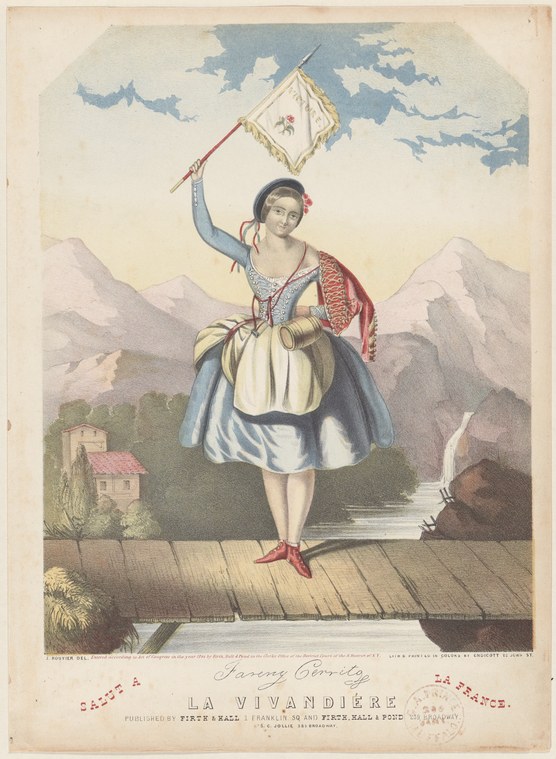
Fanny Cerrito [facsimile signature], salut à la France, La vivandière
Unknown artist
- Collection:
- Prints depicting dance
- Source:
- New York Public Library
- Rights:
- Public domain — free to use, share and adapt.
- Recorded as:
- Public Domain
Fanny Cerrito was one of the four supreme Romantic ballerinas alongside Taglioni, Grisi, and Essler; her image in theatrical costume documents both her celebrity and the visual conventions through which mid-19th-century dance was publicised and remembered. The vivandière was a role that showcased the era's appetite for spectacular, character-driven ballet, and this print captures how theatrical identity and national symbolism were woven into Romantic stagecraft.
What you are looking at
A young woman in mid-19th-century costume stands on a wooden bridge or platform spanning a river, set against a mountainous landscape with a fortress visible on the left bank. She wears a white chemise, a layered skirt in pale blue and cream, a red velvet bolero jacket, and a white bonnet trimmed in pink. Her right arm is raised high, holding aloft a small decorative flag or standard bearing French colours. Her left arm is relaxed at her side, and her weight appears to be on her right leg in a stable, frontal pose. The figure is identified by a facsimile signature as Fanny Cerrito, the renowned Romantic-era dancer. The landscape setting and the woman's costumed stance suggest a theatrical or narrative moment—possibly a scene from a stage production—rather than a ballroom or social dance setting.
The dancing
A single female figure dominates the composition, posed frontally with her weight settled rather than in active motion. Her raised right arm extends skyward in a gesture of triumph or patriotic salute, holding the flag high. The left arm hangs naturally. The body is upright and stable, the torso facing forward. There is no visible turnout of the legs, no elevation, and no indication of pointe work or the balletic positions that define Romantic ballet technique. The pose suggests pageantry or ceremonial gesture rather than dance movement.
The dance depicted
This is a theatrical costume print rather than a depiction of choreographed dance. The inscription identifies this as related to Fanny Cerrito and "La Vivandière" (The Vivandière), a popular character role in Romantic ballet. Cerrito was one of the supreme Romantic ballerinas of the 1840s–1850s, celebrated for technical brilliance and dramatic presence. The vivandière—a woman who followed an army to supply provisions and entertainment—was a stock character in Romantic ballet, often allowing for spectacular mime, character dance, and patriotic display. This print likely documents Cerrito in character costume rather than capturing an active dance moment; it serves as a souvenir or advertisement of her performance in the role.
How it was made
This is a hand-coloured lithographic print, characteristic of theatrical publicity and costume documentation from the 1840s–1850s. The pale toning, delicate outlines, and soft colour application are typical of lithography's ability to produce multiple copies for wide distribution. The inscription and facsimile signature indicate this was a commercial product intended for fans and theatre-goers. Lithography allowed rapid, affordable reproduction, making such prints a primary means by which celebrated performers' images circulated beyond the theatre itself. The technique privileged clear, recognisable representation of costume and physiognomy over anatomical subtlety.
About this work
This is a hand-coloured lithographic print documenting Fanny Cerrito, one of the greatest Romantic ballerinas, in the theatrical costume of the vivandière character. Rather than depicting choreographed movement, it presents Cerrito in character and costume as a souvenir or publicity image, using patriotic and theatrical iconography—the raised flag, the alpine setting, the military-influenced dress—to evoke the narrative context of the role. The print is a document of Romantic ballet's visual world and its celebrity culture, showing how performers' images were packaged and circulated to fans and the theatre-going public.
Cerrito's vivandière became a celebrated vehicle for her talents, and this image preserves both the costume and the performer's identity at a moment when theatrical lithography was the primary medium through which dancers' fame was visualised and distributed beyond the stage.
How to look at it
Attend to the costume detail: the way the bolero, chemise, and layered skirt are rendered shows the aesthetic priorities of Romantic dress, and the vivandière's distinctive silhouette. The landscape backdrop is theatrical convention—a painted drop—not a naturalistic setting. Note the facsimile signature and the high-quality hand-colouring, which would have made this a premium product. The figure's stillness and frontal pose is key: this is not action captured but character presented, a commercial image designed to fix a celebrated performer's image in the viewer's memory.
The artist
The artist is not identified in the catalogue record. The inscription credits publication to Liepmannssohn of Berlin and lists London and Paris addresses, indicating a commercial theatrical print business operating across major European cities. Such firms employed skilled lithographers and colourists to produce costume and portrait prints of celebrated performers for sale to theatre patrons, creating a visual archive of 19th-century performance.
The period
This print dates to the 1840s–1850s, the height of the Romantic ballet era. Fanny Cerrito came to prominence in the 1840s, and by the early 1850s was one of the most celebrated dancers in Europe. The vivandière character type belongs to a tradition of romantic ballet that drew on literary and historical subjects, often with military or nationalistic themes. Lithographic prints of celebrated dancers in costume became a booming commercial enterprise during this period, as newly developed printing technology made images affordable and accessible to a widening middle-class audience. Such prints served as both souvenirs and publicity, cementing dancers' celebrity in visual form.
Where it lives
This is a hand-coloured lithographic print from a collection of theatrical dance imagery held by the New York Public Library. The inscription indicates it was published by a commercial theatrical print firm with locations in Berlin, London, and Paris, likely in the 1840s–1850s. Such prints were mass-produced souvenirs sold to theatre audiences.
Dance in this work
Questions about this work
Did Fanny Cerrito really perform in a ballet called La Vivandière?
Yes. The vivandière character appeared in several Romantic-era ballets, and Cerrito performed such roles. These were popular vehicles for showcasing technical brilliance and dramatic character work. The role allowed dancers to perform mime, character-based movement, and sometimes even acrobatic feats alongside conventional ballet technique.
Why is this print stopping the action rather than showing her dancing?
This is a costume and celebrity portrait, not a documentation of choreography. Commercial theatrical prints of the 1840s–1850s typically presented performers in character and costume in a posed, recognisable format. Such images were mass-produced souvenirs for fans, designed to be framed or kept as mementos, not as records of actual movement.
How do we know this is Fanny Cerrito?
The inscription includes a facsimile of her signature. The name, the character identification, and the publication details all point to her; such prints were a major form of celebrity documentation in the 19th century, and attribution was a key selling point.
What was a vivandière?
Historically, a vivandière was a woman who followed an army to supply food, drink, and morale support. In Romantic ballet, the type became a theatrical stock character—costumed in military-influenced dress, often performing patriotic or comic scenes. The role allowed for spectacular costume, mime, and character dancing distinct from classical ballet technique.
More dance artwork





