49 works in this view — arrow keys or swipe to move between them.
Dance in Art
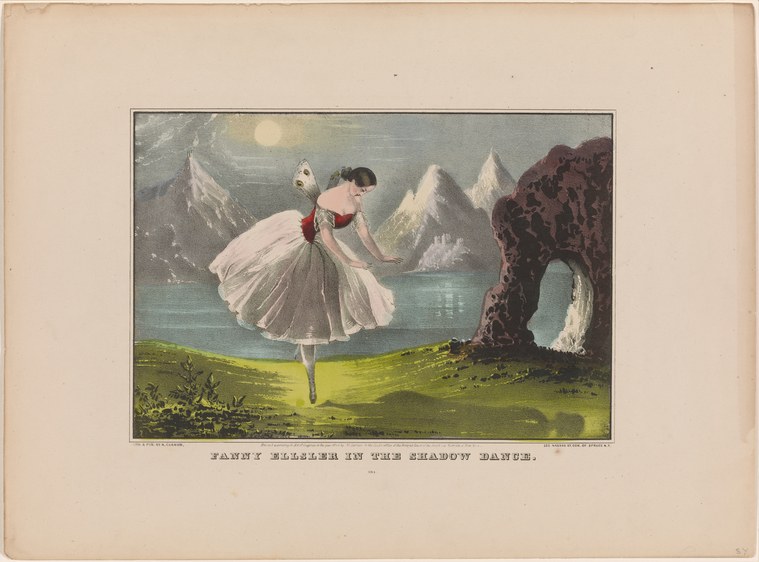
Fanny Ellsler [sic] in The shadow dance
Unknown artist
- Collection:
- Prints depicting dance
- Source:
- New York Public Library
- Rights:
- Public domain — free to use, share and adapt.
- Recorded as:
- Public Domain
Fanny Elssler was a transformative figure in ballet history, and images of her in signature roles are rare and valuable records of how Romantic ballet was actually danced and publicly imagined. The *Shadow Dance* poses a direct question about narrative and abstraction in early Romantic choreography—whether the dance told a story or simply inhabited a mood—and this image is evidence of how the public understood that work.
What you are looking at
A young woman in a pale tulle skirt and corseted bodice with a red ribbon at the waist dances alone in a moonlit alpine landscape. She is captured mid-movement on a grassy meadow beside a glacial lake, her body angled in profile as she executes what appears to be an arabesque or extended leg position. The setting is romantic and fantastical: jagged snow-capped peaks rise in the distance, a full moon illuminates the scene from above, and a dark rocky arch frames the right side of the composition. The woman wears a fitted pink bodice, and her arms are positioned to balance her extended line. The scale of the landscape dwarfs the solitary figure, emphasizing the ethereal, otherworldly quality of the moment. The hand-coloured engraving or lithograph renders the scene with soft tonal gradations in the sky and water, while the foreground grass remains bright green.
The dancing
The dancer stands on one leg in what appears to be an arabesque or attitude position, her working leg extended behind or to the side at approximately hip height or higher. Her torso is erect and her arms are raised and extended to maintain balance and line, consistent with early Romantic-era ballet vocabulary. The pose suggests considerable strength and control, with the supporting leg appearing straight and engaged. There is a single dancer, isolated against the landscape with no partners or ensemble.
The dance depicted
This is a Romantic-era ballet scene, almost certainly depicting a moment from a narrative work. Fanny Elssler was one of the pre-eminent ballet dancers of the 1830s–1840s, celebrated for her charisma, technical virtuosity, and dramatic presence. The title *The Shadow Dance* suggests either a scene in which the character dances with her own shadow (a Romantic device) or a balletic moment designed to showcase ethereal, moonlit qualities. The pose—a single leg extended in balance—is the fundamental vocabulary of early 19th-century ballet technique, and the isolated figure against a supernatural landscape is quintessentially Romantic in aesthetic and narrative logic.
How it was made
This is a hand-coloured print—likely an engraving, aquatint, or lithograph based on the fine linework and the manner in which colour has been applied in discrete tonal areas. The technique was common for theatrical portraiture and dance imagery in the 1830s–1840s, allowing for mass production and wide circulation among audiences and theatre-goers. Hand-colouring was labour-intensive but affordable enough to make such prints accessible to middle-class collectors and students. The soft handling of the sky and water, combined with the precise rendering of the figure and landscape details, suggests a skilled technician working from a theatrical design or a dancer's portrait.
About this work
This is a theatrical dance print documenting Fanny Elssler in a moment from a Romantic ballet, likely *The Shadow Dance*, a work that exploited the aesthetic possibilities of moonlight, solitude, and the supernatural—core themes of Romantic choreography. The image captures the central vocabulary of early 19th-century ballet: the vertical line, the extended leg, the graceful arm position, and the ethereal solo female dancer. The hand-coloured print format placed images of celebrated dancers into homes and studios, making them tangible souvenirs of performance and teaching tools for aspiring dancers. Elssler's prominence and this work's apparent popularity (given its survival in multiple copies) indicate its significance in the visual culture of Romantic ballet.
How to look at it
Notice the moment the artist chose: not a moment of transition or ensemble spectacle, but a single, held pose—the extended leg, the balanced torso, the raised arms. This freeze-frame captures what audiences came to see in Romantic ballet: the illusion of effortlessness and the ethereal line. The landscape is not incidental decoration but integral to the meaning—the dancer is not in a theatre but in a supernatural realm, answering to the Romantic conviction that true beauty belonged to nature and the imagination, not to society or artifice. The hand-colouring emphasizes the cool, luminous quality of moonlight, a technical choice that deepens the sense of otherworldly beauty.
The period
This print belongs to the height of the Romantic ballet era (c. 1830–1850), when narrative, emotion, and the supernatural dominated choreographic taste and when the ballerina—not the male dancer—became the visual and emotional centre of the art form. Fanny Elssler achieved international celebrity comparable to modern performers, and prints of her were collected and traded as eagerly as photographs of film stars later would be. The moonlit, mountain-scape setting reflects a broader Romantic preoccupation with nature, solitude, and the liminal zones between the real and the imagined. The technical vocabulary visible in the pose—the arabesque, the raised arms—was still relatively new and marked a departure from earlier, more grounded classical technique.
Where it lives
This hand-coloured print is held in the New York Public Library's collection of dance-related prints and represents a common form of theatrical and dance documentation in the 19th century. Such prints were produced and sold during and after a performer's run in a role, serving as both ephemeral souvenirs and as more lasting records of celebrated performances.
Dance in this work
Questions about this work
Who was Fanny Elssler?
Fanny Elssler (1810–1884) was an Austrian-Italian ballerina who became one of the most celebrated performers of the Romantic era. She was known for her dramatic presence, technical precision, and charisma, and toured internationally. She rivalled Marie Taglioni for pre-eminence during the 1830s–1840s and was admired both for classical roles and for character dances drawn from folk traditions.
What was the Shadow Dance?
The Shadow Dance was likely a choreographic work created to showcase the dancer's ability to suggest emotion and narrative through pure movement and physical presence, set against an imagined supernatural backdrop. Such works typified Romantic-era ballet, which valued psychological depth and atmospheric setting over plot or spectacle. Without surviving choreographic records, its exact structure cannot be confirmed from the image alone.
Why does the dancer stand alone in a landscape?
The isolation and the natural setting reflect core Romantic values: the idea that authentic beauty and emotion exist outside society, in nature or the imagination, and that the solitary individual—especially the solitary female figure—was the ideal vehicle for expressing deep feeling. This aesthetic dominated visual culture and choreography throughout the 1830s–1840s.
How was this print made and why does it matter?
This is a hand-coloured print, a labour-intensive but affordable method for reproducing images of celebrated performers. It allowed theatregoers to own a souvenir of a performance they had seen, and dancers and students to study and copy the poses. The circulation of such prints shaped how ballet was understood and practised outside the theatre.
More dance artwork





