49 works in this view — arrow keys or swipe to move between them.
Dance in Art
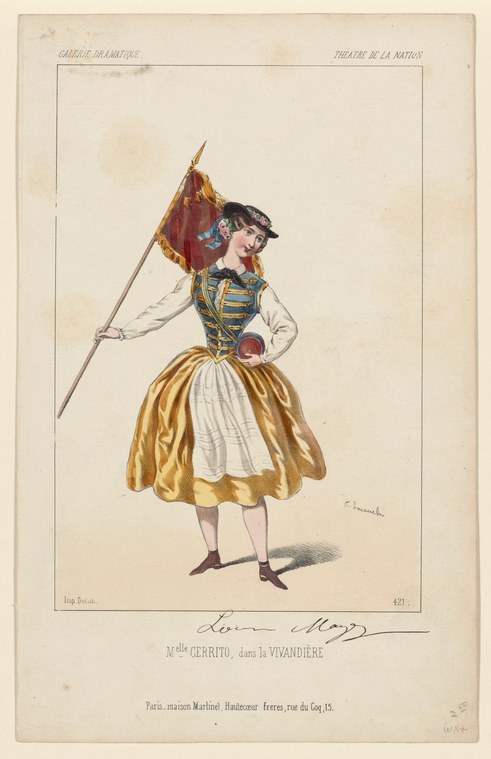
Melle Cerrito, dans La vivandière
Unknown artist
- Collection:
- Prints depicting dance
- Source:
- New York Public Library
- Rights:
- Public domain — free to use, share and adapt.
- Recorded as:
- Public Domain
Fanny Cerrito was one of the four greatest Romantic-era ballerinas, and this print documents her in a character role that was central to her repertoire. The vivandière costume and character type reveal how mid-19th-century ballet used military and folk references to create a specific flavor of Romantic femininity—coquettish, patriotic, and visually spectacular. For historians of ballet costume, celebrity culture, and theatrical practice, this image is primary source material.
What you are looking at
A young woman in theatrical costume stands alone against a plain background, holding aloft a regimental flag or standard. She wears a short-skirted costume of the mid-19th century: a fitted blue-green corsetted bodice with gold military frogging and white collar, pale pink stockings, and dark shoes. Her full skirt—the outer layer golden-brown silk, the underskirt white—reaches to mid-calf and shows the voluminous cut fashionable in the 1840s. She has dark hair arranged in ringlets, a fashionable face, and an air of theatrical presentation rather than naturalistic portraiture. The flag she carries is deep red or maroon with gold detail. The entire figure is rendered in hand-coloured lithography with fine detail and soft modeling. This is a costume study or character portrait from a theatrical production, not an action scene.
The dancing
The dancer stands upright with her weight evenly distributed, presenting herself to the viewer as if in a moment of display or introduction rather than active dance. Her right arm is raised and extended to hold the flag staff; her left arm hangs naturally. The posture is formal and static, with no indication of elevation, weight shift, or the spatial energy of dancing. This is a frontal presentation pose—the stance of a theatrical costume portrait rather than a captured moment of movement.
The dance depicted
This is a costume study for Mlle. Cerrito in the role of a vivandière (a cantinière, or camp follower selling provisions to soldiers). The *Vivandière* was a popular character role in mid-19th-century Romantic ballet, notably in works like *La Vivandière* choreographed for Fanny Cerrito herself. The vivandière costume—military-influenced, short-skirted, with regimental colours—was worn by female dancers in roles that combined flirtation, patriotic display, and coquetry. The image captures the theatrical character and costume rather than a specific choreographed movement, serving as a record of stage dress and performance identity.
How it was made
This is a hand-coloured lithograph, a commercial print medium that allowed rapid reproduction and distribution. The image is printed in black line and tinted with watercolour or gouache, a technique that preserved fine detail in costume while allowing the soft, flattering finish necessary for publicity and souvenir portraits. The medium suggests wide circulation among theatre-goers and a commercial purpose—this was a popular print sold to audiences attending the ballet. The style and quality indicate production by a Parisian publisher, likely Martinet, whose name appears in the printed text at the bottom.
About this work
This is a hand-coloured theatrical lithograph of the celebrated Romantic-era ballerina Fanny Cerrito (fl. 1840s–1850s) in costume as a vivandière, a character role favored in the ballet-pantomimes of the period. The print documents both a specific theatrical costume and the international celebrity of one of the Romantic era's most acclaimed dancers. Such prints served multiple purposes: documentation of stage spectacle, advertisement of the dancer and the production, and a souvenir object for the paying public. The vivandière character—a flirtatious camp follower in military dress—allowed for a particular kind of theatrical femininity and coquetry, and the short skirt visible here marks a shift toward the shorter ballet skirts that would become standard in later Romantic ballet.
The work belongs in a dance gallery because it is an essential artifact of 19th-century theatrical dance documentation and celebrity culture. Before photography became widespread, lithographs like this were the primary visual record of how celebrated dancers looked on stage, how they dressed, and how they performed specific roles. It preserves information about the costumes, body types, and visual language of Romantic-era ballet that cannot be recovered from written sources alone.
How to look at it
The artist chose a static presentation pose rather than capturing movement. Notice the perfectly frontal stance, the still lifted arm holding the flag, and the symmetrical composition—all designed to display the costume and the dancer's face and figure clearly to the viewer. This is not a moment frozen mid-leap or mid-turn; it is a formal presentation, like a fashion plate or an official portrait. The soft modeling and the attention to textile detail—the silk sheen of the skirt, the gold braid, the precise rendering of the stockings—indicate that the primary purpose was to document stage costume and the dancer's appearance, not to convey choreographic action. Pay attention to the shortness of the skirt: this was still relatively recent and daring in female ballet costume, and the lithographer has carefully rendered it as part of the character's appeal.
The artist
The lithograph is credited to an artist whose signature appears on the stone, but the catalogue record does not record it. It was published by Martinet, a Paris-based music and theatrical print publisher active in the 1840s–1850s. Martinet was a major producer of coloured theatrical portraits and costume studies, and his prints were sold at theatres and to the theatre-going public as souvenirs and documentation of current productions. The quality of draftsmanship and the soft, flattering finish are consistent with the better-quality productions from this firm.
The period
This print dates to the height of the Romantic ballet era, roughly 1840–1850. The *Vivandière* was a character type with deep roots in European theatrical tradition, but it became especially popular in the 1840s as ballet began to incorporate more dramatic, character-based roles alongside pure dance spectacle. Fanny Cerrito's engagement with such roles—alongside her celebrated performances in classical works—exemplified the versatility expected of the greatest Romantic ballerinas. In visual culture, the lithographed theatrical portrait was at the height of its popularity in this decade, before photography displaced it. Martinet's prints of leading dancers were widely collected and helped establish the celebrity culture around the Romantic ballet.
Where it lives
The print is held in the New York Public Library's collection of prints depicting dance. It was published in Paris by the firm of Martinet and sold to theatre audiences in the 1840s. This entry in a library collection indicates its value as a historical document of theatrical practice and celebrity.
Dance in this work
Questions about this work
Who was Fanny Cerrito?
Fanny Cerrito (1817–1909) was an Italian-born dancer who became one of the four most celebrated ballerinas of the Romantic era, alongside Marie Taglioni, Carlotta Grisi, and Lucile Grahn. She was known for her brilliant technique, her choreographic gifts (she created her own dances), and her versatility in both classical and character roles. She performed across Europe and was a particular favorite in London and Paris.
What is a vivandière?
A vivandière or cantinière was a woman who followed armies to sell food, drink, and provisions to soldiers. In 19th-century theatre and ballet, the vivandière became a stock character type—typically a young, flirtatious woman in military dress, loyal to the regiment but coquettish and dramatic. The role allowed for a mix of dance, pantomime, and theatrical comedy.
Why was this print made?
Theatrical lithographs like this served multiple purposes. They were sold to audiences attending the ballet as souvenirs, helping to build the celebrity and marketability of star dancers. They also served as documentation of what the performer and the costume actually looked like on stage. Before photography became widespread, these prints were the primary visual record available to the public of how famous dancers performed.
What does the costume tell us about ballet in this period?
The short skirt, military styling, and character-based design show that Romantic-era ballet had evolved beyond pure classical technique into a richer theatrical vocabulary that included dramatic roles, folk and national references, and specific character costumes. The visible leg and the fitted bodice also show the gradual shift toward the shorter, more revealing costumes that would define later 19th-century ballet aesthetics.
More dance artwork





