49 works in this view — arrow keys or swipe to move between them.
Dance in Art
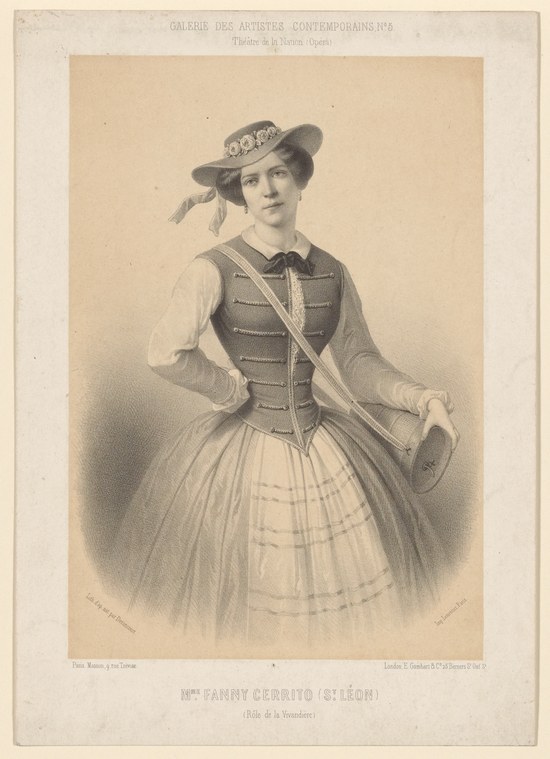
Mme. Fanny Cerrito (St. Léon) (rôle de la Vivandière)
Unknown artist
- Collection:
- Prints depicting dance
- Source:
- New York Public Library
- Rights:
- Public domain — free to use, share and adapt.
- Recorded as:
- Public Domain
Fanny Cerrito was one of the greatest ballet dancers of the Romantic era, and this image documents not the abstract purity of classical ballet but the narrative and character dimension of professional dance in this period—the ability of elite dancers to embody dramatic roles, period dress, and theatrical character. The vivandière role itself is historically important as a type of female character that occupied a complex social space: she could wield weapons, move with freedom, and assert agency, even as her costume and role were deeply bound up in male military fantasy.
What you are looking at
A young woman in mid-nineteenth-century dress stands in three-quarter view against a plain background, posed with the formal elegance of a theatrical portrait. She wears a fitted corset-style bodice in a darker fabric with horizontal ribbing, laced or buttoned at the front, over a white chemise with full sleeves that extend to the wrist. Her skirt is voluminous and gathered, rendered with careful crosshatching to show its weight and volume—characteristic of the 1840s silhouette. She holds a large hat trimmed with feathers in her right hand at waist level, and in her left hand she carries what appears to be a long rifle or musket, angled casually across her body. Her pose is confident and frontal, with her weight seemingly balanced on both feet, her gaze direct and composed. The inscription below identifies her as performing the role of 'la Vivandière'—the camp follower or sutler's daughter of French military tradition.
The dancing
The dancer stands in an upright, neutral stance with no visible turn-out or characteristic ballet positioning. Her arms are relaxed and naturalistic rather than codified—one hand holding the prop hat, the other supporting the rifle. There is no partnering or ensemble; this is a single-figure portrait study. Her posture and carriage suggest dignity and composure rather than the elevated épaulement or lengthened spine of formal ballet training, though the quality of the line drawing suggests professional theatrical training of some kind.
The dance depicted
This is a character role from the Romantic ballet, specifically the vivandière (sutler's daughter) character type that became popular in the 1840s, particularly in French theatrical dance. The vivandière was a stock figure in military-themed ballets and operas, representing a camp follower who danced, flirted, and occasionally fought alongside soldiers. The inscription identifies the dancer as Fanny Cerrito performing this role, likely in a specific production, probably created in the 1840s when such character dances were fashionable. The rifle and martial dress place this squarely in the realm of character ballet rather than classical ballet, suggesting a narrative or demi-caractère context rather than pure dance technique.
How it was made
This is a lithograph or engraving, rendered in black ink with careful cross-hatching and tonal gradation to model the figure and fabric. The technique allows for fine detail in the face and hands while maintaining bold, clear outlines of the silhouette and costume. The printing method permitted mass circulation in the form of sheet prints, which would have been sold individually or in collected series—common practice for theatrical portraits of celebrated dancers in the nineteenth century. The quality of the draftsmanship and the scale suggest a commercial print aimed at theatre-goers and fans of the dancer.
About this work
This is a theatrical character portrait of Fanny Cerrito, one of the most celebrated ballet dancers of the Romantic era, captured in the costume and pose of a vivandière—a character role that belonged to the genre of character or demi-caractère ballet. The vivandière was a stock figure in French theatre representing a camp follower, combining elements of comedy, flirtation, and martial swagger. The print dates to the 1840s or early 1850s, when such roles were fashionable and when Cerrito was at the height of her fame across Europe. It preserves not the formal classical ballet technique but rather the theatrical character and martial costume that formed part of the Romantic ballet repertory.
How to look at it
Attend to the costume and props first: this is not a classical ballet dress but a military character costume, telling you immediately that this is theatrical character dance rather than pure ballet technique. The pose is direct and frontal, neither the ethereal arabesque of celestial beings nor the turned-out positions of classical technique. Instead, observe how the artist has chosen a moment of rest and confidence, the dancer holding her props casually, suggesting that this role combined elements of comedy, flirtation, and action. The careful rendering of the fabric and the solidity of the figure ground the image in the material world of theatre—costumes, props, and character types—rather than in the abstraction of the classical vocabulary.
The artist
The artist is not recorded in the catalogue. The style and technique are consistent with the commercial print trade of the 1840s–1850s. The inscription and publication information (if present on the original) would likely identify the printer or publisher and any engraver or lithographer involved. Many such prints were issued anonymously or with only a publisher's mark.
The period
This print emerges from the height of the Romantic ballet era in France, when Paris was the capital of European dance. The 1840s saw a flourishing of character roles and exotic subjects in ballet—orientalism, nationalism, and military adventure were popular themes. Cerrito danced alongside Marie Taglioni and other stars of the period, and the vivandière became a staple of the mid-nineteenth-century theatrical repertory, appearing in ballets such as *La Vivandière* (choreographed for other dancers) and similar vehicles. The print format itself reflects the role of theatre prints as mass-market souvenirs and instruments of celebrity culture.
Where it lives
The print is held in the New York Public Library's collection of prints depicting dance, a major research collection formed over decades. Such theatrical portrait prints were typically issued in large numbers for sale to the theatre-going public, making them accessible ephemera of the period. The record provides minimal information, but the collection itself is well-established as a resource for theatre and dance history.
Dance in this work
Questions about this work
Who was Fanny Cerrito?
Fanny Cerrito (1817–1909) was an Italian ballet dancer who became one of the leading prima ballerinas of the Romantic era, performing across Europe in the 1840s and 1850s. She was celebrated for her technical brilliance, her beauty, and her ability to perform both classical roles and dramatic character parts. She danced with the greatest choreographers and dancers of the period, including Jules Perrot.
What is a vivandière?
A vivandière (French) or vivandiera (Italian) was historically a woman who followed an army to sell provisions and supplies to soldiers. In theatrical dance, the vivandière became a stock character—usually young, flirtatious, and spirited—who appeared in military-themed ballets and operas. The role allowed dancers to move beyond the ethereal, otherworldly characters of classical ballet and to embody wit, action, and earthly desire.
Is this a ballet, or what kind of dance?
This is a theatrical character role within the ballet tradition, specifically a demi-caractère or character role rather than classical ballet proper. Character dances in the nineteenth century were part of the full evening's entertainment and allowed for more naturalistic movement, comic action, and narrative specificity than the abstract classical vocabulary. The rifle and military dress confirm this is a dramatic character type, not a sylphide or classical heroine.
How was this print made?
This appears to be a lithograph or steel engraving, a mass-production printing method that allowed multiple copies to be pulled from a single prepared stone or plate. Such prints were sold individually as theatrical souvenirs, often at the stage door or through print shops, making them affordable and widely circulated. They served as promotional images and fan merchandise for celebrated dancers.
More dance artwork





