49 works in this view — arrow keys or swipe to move between them.
Dance in Art
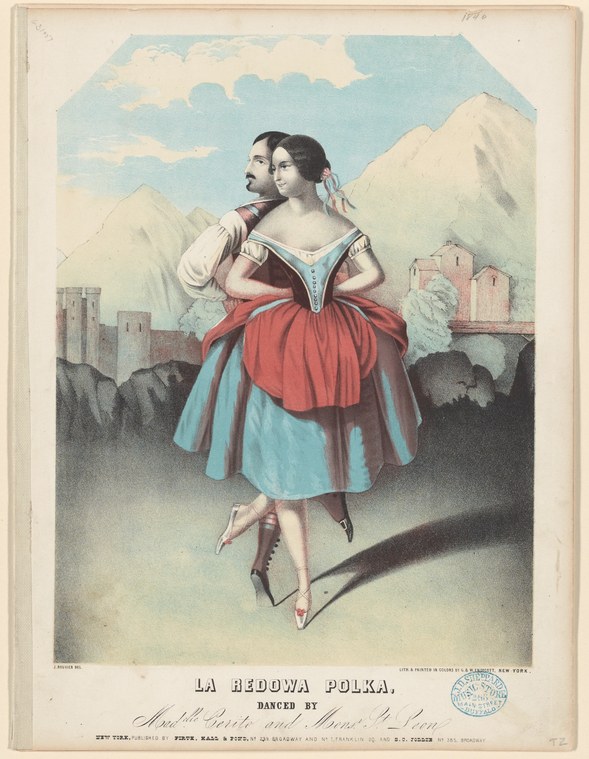
La Redowa polka danced by Madelle Cerito and Monsr. St. Leon
Unknown artist
- Collection:
- Prints depicting dance
- Source:
- New York Public Library
- Rights:
- Public domain — free to use, share and adapt.
- Recorded as:
- Public Domain
The Redowa was a historically significant moment when salon and ballroom dances entered the professional theatrical stage, blending folk and vernacular forms into Romantic ballet spectacle. This print documents that crossover and names the artists responsible, making it traceable evidence of a performance that shaped the repertoire of mid-19th-century theater. For historians of social dance and theatrical history, such prints are often the only visual record of works that left no notation and survive only in contemporary reviews.
What you are looking at
A colored lithograph presents a theatrical dance scene in classical costume against a mountainous Alpine backdrop. Two figures occupy the composition: a male dancer in the background, partially obscured, wearing light breeches and a shirt, and a female dancer in the foreground facing left, her body in a graceful contrapposto. She wears a pale blue bodice with a low, off-shoulder neckline and a voluminous red skirt caught mid-motion, with a blue wrap or shawl draped over her arms. The setting includes crenellated fortress walls and stone towers to the right, rendered in muted reds and browns, while mountains rise pale and substantial behind them. The sky is bright blue with white clouds. The female figure is drawn with romantic elongation and delicate proportions; her pose suggests a moment of pause or preparation within the dance, with weight centered and arms framing the body in an attitude of modest display.
The dancing
The female dancer is the focal point, depicted in a relaxed contrapposto stance with her body turned slightly toward the viewer, weight on one leg, the other released. Her arms are softly positioned, one raised to frame her face and neck, the other hanging naturally. The pose is characteristic of Romantic-era ballet presentation, emphasizing verticality and ethereal lightness rather than active movement. The male figure behind is less prominent, his exact position and hold with the woman unclear from the composition. The overall frame suggests a formal theatrical pose rather than a moment of active dance engagement between partners.
The dance depicted
The work depicts a Redowa (or Redowa polka), a Bohemian dance of the mid-19th century that became fashionable in theatrical and ballroom contexts. The title attributes the choreography to Mademoiselle Cerito and Monsieur St. Léon, prominent dance artists of the 1840s–1850s. The Redowa was a rotating couple dance in three-quarter time, related to the mazurka and waltz, and was sometimes incorporated into romantic ballets of the era. The image captures the dance in a staged, posed moment rather than showing active turning or progression—a convention of theatrical prints that prioritize the visual display of costume and the dancer's elegant figure over the documentation of movement itself.
How it was made
This is a hand-colored lithograph, a reproductive process that allowed wide distribution of theatrical imagery in the 19th century. The stone-printed base (established from the fine line work and tonal areas) has been hand-tinted with watercolor or gouache, evident in the bright, flat blues and reds of the costume and sky. Lithography was the dominant medium for dance publicity and theatrical souvenir prints from the 1830s onward, offering cheaper, faster production than engraving while maintaining fine detail. The hand-coloring varied by print and maker, making each copy unique in hue intensity—this impression shows well-saturated, vivid color typical of theatrical prints made for a paying audience.
About this work
This is a mid-19th-century theatrical publicity print documenting a performance of the Redowa polka, a European ballroom dance adapted for the stage. It commemorates two major dancers of the Romantic ballet era—Fanny Cerito and Jules Perrot (or another St. Léon dancer)—and captures both the costume aesthetic of Romantic ballet and the popularity of exotic European dance forms among theater audiences. The work is a primary visual document of how theatrical dance was marketed, advertised, and consumed in the era before photography. It belongs in a dance archive both as a record of an actual performance tradition and as evidence of how dance was framed and sold as spectacle to urban audiences in the mid-1800s.
How to look at it
The viewer should notice the posed, frontal presentation of the female dancer—she is not in the middle of a turning or partnered phrase, but rather in a moment of stillness designed to display her figure and costume. The fortress setting and mountain backdrop suggest a theatrical narrative (likely a Bohemian or Eastern European story), a common visual device in Romantic ballet prints. The treatment of the male figure—secondary, partially hidden—is typical of prints that centered the female dancer as the primary spectacle. The delicate, elongated proportions of the female body and the soft colors signal the aesthetic values of the era: beauty, refinement, and ethereal distance from everyday physicality.
The artist
The lithograph is unsigned by a visual artist, which was common for theatrical prints of this era—they were often produced by print houses and colored by workshop hands rather than credited individual artists. The choreographic credit to Cerito and St. Léon is the primary authorship claim. Fanny Cerito (1817–1909) was a celebrated Italian-French ballerina of the Romantic era known for her technical brilliance and starring roles; Jules Perrot (if the "St. Léon" attribution is uncertain) was a choreographer and dancer active in Europe and Russia. Such prints were commissioned by theaters or dance celebrities themselves as promotion and souvenir merchandise.
The period
The 1840s–1850s were the height of Romantic ballet in Europe, when exotic and folk dances—mazurkas, polkas, tarantellas—were incorporated into stage spectacles as divertissements. The Redowa arrived in Western European salons and theaters from Bohemia in the 1830s and became fashionable alongside the polka and waltz. Theatrical prints and lithographed portraits of famous dancers were mass-produced and sold as souvenirs and advertisements, creating a celebrity culture around dance performers. The costume in this print—the romantic tutu, the off-shoulder bodice, the pale blue and red palette—aligns with the visual language of Romantic ballet, which used costume and setting to evoke emotion and exoticism.
Where it lives
The work is held in the New York Public Library's prints collection, a major institutional archive of 19th-century theatrical imagery. It is one of thousands of lithographed dance and theater prints produced for commercial sale and institutional collecting in the 19th century. Such prints were typically issued by print publishers in Paris, London, New York, and other major cultural centers, often in series or as single promotional sheets.
Dance in this work
Questions about this work
Who were Mademoiselle Cerito and Monsieur St. Léon?
Fanny Cerito (1817–1909) was one of the most celebrated ballet dancers of the Romantic era, known for her technical skill and dramatic presence. Monsieur St. Léon may refer to the choreographer and dancer Michel St. Léon, or another performer of that name active in the 1840s–1850s. Both were major theatrical figures whose names alone would have attracted audiences to see the Redowa.
What is a Redowa?
The Redowa is a Bohemian couple dance in three-quarter time that became fashionable in European ballrooms and theaters in the 1830s–1840s. It resembles a waltz or mazurka but with a distinctive rhythm and rotation. Like many European folk and ballroom dances, it was adopted by theatrical choreographers and incorporated into ballets as a divertissement or specialty number.
Why are theatrical dance prints like this important?
Before photography became widespread, lithographs and engravings were the primary visual records of dance performances and costumes. They document which dances were performed, by whom, and how they were presented to audiences. For historians, they are primary sources on the costume, staging, and cultural value of dance in the 19th century, often providing the only visual evidence of works that left no other trace.
Why does the female dancer look so posed and still?
Theatrical prints typically captured a single moment of display rather than the middle of active movement. This served multiple purposes: it showcased the dancer's figure and costume clearly, it was easier for the lithographer to render, and it created an iconic, timeless image suitable for framing and sale as a souvenir. The pose was a convention of the medium, not a limitation.
More dance artwork





