49 works in this view — arrow keys or swipe to move between them.
Dance in Art
Fanny Cerrito; Theatrical portraits [on mount with review and reproductions]
Unknown artist
- Collection:
- Prints depicting dance
- Source:
- New York Public Library
- Rights:
- Public domain — free to use, share and adapt.
- Recorded as:
- Public Domain
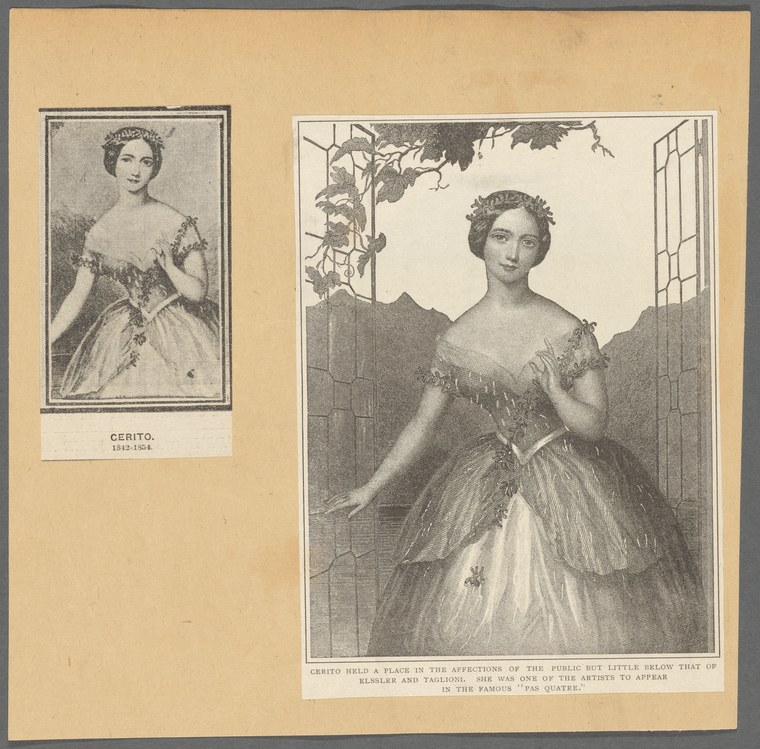
Cerrito was a major creative force in Romantic ballet—a dancer, choreographer, and innovator who created roles and works that challenged the era's conventions. This print preserves visual evidence of how she appeared on stage and how the Romantic silhouette was constructed and presented. For historians of dance and of women's performance, it is a primary document of how a celebrated female performer was publicly represented and marketed to audiences.
What you are looking at
This page pairs a small engraved portrait head with a larger, more elaborate theatrical portrait. The small portrait (labeled CERITO, 1823-1909) shows a young woman in three-quarter view with an elaborate upswept hairstyle adorned with what appears to be a tiara or ornament, wearing a low-shouldered dress with short puffed sleeves typical of mid-nineteenth-century formal wear. The larger portrait depicts the same woman in a more theatrical context: she stands in an interior space with a window visible behind her, wearing a voluminous skirt in what appears to be gauze or tulle, pulled up at one hip to display the garment's construction and movement. Her upper body is bare-shouldered, and she wears her hair in a similar upswept style. Vining foliage hangs above her. The composition emphasizes the fabric of her skirt through dramatic chiaroscuro, with deep shadows on the pleated understructure and bright highlights on the gauze overlay. The caption beneath the larger image indicates this depicts a scene "below that of slessler and tagliont," suggesting this is a record of a theatrical role or scene. The overall effect is of a documentation of a celebrated stage performer in costume, using engraved portraiture to capture both her likeness and the spectacular silhouette of her stage dress.
The dancing
The figure in the larger portrait stands in a relaxed contrapposto pose, her weight on one leg while the other is slightly bent, her torso angled gently to reveal the fullness of the skirt. Her arms hang naturally at her sides, one slightly forward. The pose is that of a standing woman at rest or in conversation rather than in active movement. The small portrait emphasizes the face and head with refined engraver's technique; the larger portrait prioritizes the costume and silhouette, with the body treated more schematically to showcase the dress itself.
The dance depicted
This is a record of Fanny Cerrito (1823–1909), one of the most celebrated ballerinas of the Romantic era. The theatrical portrait documents her in costume, likely from one of her major roles, and the reference to Slessler and Taglioni positions this within the hierarchy of Romantic ballet dancers—Taglioni being the era's supreme authority. The image itself does not show active dance movement; rather, it preserves the spectacular visual presentation that was central to Romantic ballet, with emphasis on the tulle skirt that became the defining garment of the period. The engraver has captured the technical marvel of the costume—the layered, pleated construction beneath the translucent overskirt—which was integral to the visual effect of Romantic ballet performance.
How it was made
This is an engraving, a relief-printing technique that allowed for precise rendering of detail and wide circulation via multiple prints. The engraver has used fine cross-hatching and line work to create tonal gradation, particularly evident in the shadows of the larger portrait's tulle skirt, where tight parallel lines create the illusion of volume and translucency. Engraving was the primary medium for theatrical portraiture and dance documentation in the nineteenth century before photographic reproduction became standard, making such prints the primary visual record of how performers and costumes appeared to audiences of the era.
About this work
This print documents Fanny Cerrito, one of the Romantic era's greatest ballerinas, at the height of her fame. It pairs a formal portrait head with a theatrical costume portrait that emphasizes the voluminous tulle skirt that defined Romantic ballet's visual aesthetic. The engraving is not a record of dance in motion but rather a celebration of the performer and the costume as objects of spectacle—a function central to how Romantic ballet was documented and circulated to the public. Such theatrical portraits were essential to a dancer's celebrity and to the visual culture of dance in an era before photography made such images commonplace.
How to look at it
Attend to how the engraver has represented the tulle skirt—the layered construction is made visible through the handling of light and shadow, with the gauze overlay rendered nearly transparent through fine parallel lines, while the pleated understructure is deeply shadowed. This technical achievement mirrors what audiences would have seen in the theater, where the play of light on layers of tulle created the distinctive silhouette of Romantic ballet. The pose itself is theatrical but not dance-specific: it is the pose of a woman displaying a magnificent dress, which was itself the point of Romantic ballet spectacle.
The artist
The engraver is not identified in the catalogue record. Theatrical portraiture was a specialized and high-volume practice in the nineteenth century, with multiple engravers working in major cities to meet the demand for images of celebrated performers. Such prints were sold at theaters, through print shops, and by mail, creating an economy around the circulation of star performers' images. The quality of execution here—particularly the sophisticated rendering of the tulle skirt—suggests an engraver experienced in theatrical work.
The period
This dates from the height of Romantic ballet in the 1840s–1850s, when the tulle skirt became the signature garment of the genre and when dancers like Taglioni, Cerrito, and Grisi were international celebrities. The reference to Taglioni in the caption reflects the competitive hierarchy of the Romantic stage, where dancers' reputations were positioned relative to one another. Romantic ballet placed intense emphasis on the visual spectacle of the dancer's body and costume, and engraved theatrical portraits were the primary medium through which this spectacle reached the broader public and was preserved for posterity.
Where it lives
This is held as part of the New York Public Library's collection of prints depicting dance. It appears to be a page from a bound collection or scrapbook, pairing a biographical portrait head with a theatrical costume portrait, suggesting it may have been compiled as a record of celebrated dancers of the era.
Dance in this work
Questions about this work
Was Fanny Cerrito a major ballet dancer?
Yes. Cerrito (1823–1909) was one of the most celebrated ballerinas of the Romantic era, comparable to Taglioni and Grisi. She was a virtuoso dancer, a significant choreographer who created many of her own roles, and an innovator who challenged conventions of female performance on the Romantic stage. She performed internationally and was a star of major European opera houses.
Why does this print show the costume rather than the dancer in motion?
The tulle skirt was central to Romantic ballet's visual identity and was as much a subject of spectacle as the dancer's movement. Theatrical portraiture of the era often prioritized the costume because it was integral to how audiences experienced and remembered performances. The print preserves visual evidence of how the costume was constructed and how it appeared in performance.
What is the significance of the reference to Taglioni and Slessler in the caption?
It positions Cerrito within the competitive hierarchy of Romantic ballet dancers. Taglioni was considered the supreme authority of the era, and the caption's mention of being "below that of slessler and tagliont" likely refers to the ranking or relative fame of these performers, reflecting how dancers' reputations were publicly negotiated and compared.
Why was engraving used for theatrical portraiture rather than other media?
Engraving allowed for fine detail, precise line work, and wide circulation through multiple impressions. Before photography became standard for theatrical documentation, engraved prints were the primary medium for creating and distributing images of celebrated performers. They reached broad audiences and were affordable enough to be sold at theaters and through print shops.
More dance artwork





