49 works in this view — arrow keys or swipe to move between them.
Dance in Art
Melle. Chameroy
Unknown artist
- Collection:
- Prints depicting dance
- Source:
- New York Public Library
- Rights:
- Public domain — free to use, share and adapt.
- Recorded as:
- Public Domain
This is one of the few surviving images we have of individual dancers from the early Romantic ballet era, and their names and documented performances are sparse. Mlle. Chameroy remains largely unknown to dance history, making this print a rare visual and archival record of a working theatrical artist of her time. For historians and dancers, such portraits are essential sources for understanding the costuming, carriage, and celebrity culture of nineteenth-century ballet.
What you are looking at
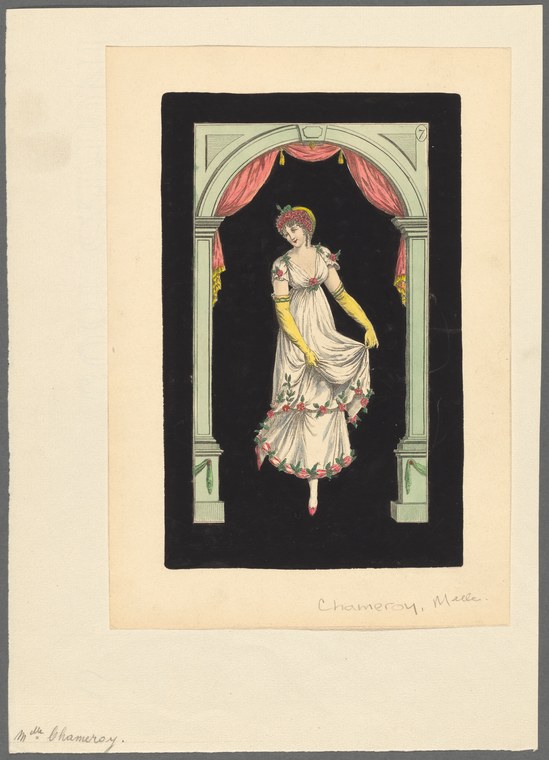
A single female dancer stands in a neoclassical interior framed by a proscenium arch with coral-red curtains drawn to either side. She wears a high-waisted white Empire-line dress with a draped skirt that falls to mid-calf, her blonde hair crowned with a gilded wreath. She stands in profile or three-quarter view, poised in a graceful contrapposto stance, with one arm extended diagonally across her body in a languid gesture and the other at her side. The setting is austere and formal—a black ground isolates the figure, emphasizing the theatrical staging. The interior architecture features pale green pilasters flanking the arch, creating the illusion of a stage within a stage. The whole composition suggests a moment of refined, solitary performance, with the dancer's elongated silhouette and measured grace conveying both stillness and potential movement.
The dancing
The dancer's body is tall and slender, weight settled on both feet in a relaxed but dignified stance. Her torso is upright and lengthened; her extended arm moves horizontally across her body with gentle, controlled extension, the hand soft and articulate. The other arm hangs naturally at her side. Her head is held high and slightly turned, her gaze directed forward. There is no tension or effort visible—the pose reads as one of classical repose, the kind a trained dancer of the period would hold between movements or at the opening of a formal piece. The frame is static, not mid-leap or mid-turn, suggesting a posed portrait of the dancer rather than a captured moment of action.
The dance depicted
This appears to be a theatrical dance of the Romantic era, most likely a ballet, given the Empire-waist costume, the neoclassical setting, and the refined, balletic carriage. The dress and setting evoke the early nineteenth century—the heyday of Romantic ballet—when dancers in light, diaphanous costumes were posed in elegant classical interiors for theatrical effect. The inscription suggests this is a portrait of a specific dancer, 'Melle. Chameroy', whose name and performance style are otherwise unrecorded here. The solitary figure, the formal proscenium framing, and the absence of partners or narrative action suggest this is a studio study or print made to commemorate or advertise the dancer's talents, rather than a scene from a specific ballet. Without further documentation, the exact repertoire cannot be identified, but the visual language is unmistakably that of early-nineteenth-century European ballet.
How it was made
This is a hand-colored print, likely a lithograph or engraving, executed with fine linear precision in the architecture and fabric, and delicate watercolor or hand-tinting in the flesh tones, hair, and the red curtains. The technique allowed for mass production and circulation of theatrical portraits, making such images affordable souvenirs for audiences and records of celebrated dancers. The careful attention to the dancer's costume and bearing suggests a professional print made for commercial distribution—the kind that would have been sold in theatre lobbies or by print sellers to admirers of the performer. The quality of draftsmanship and the careful color work indicate a skilled printmaker, though the artist remains unrecorded in the catalogue.
About this work
This is a theatrical portrait of a Romantic-era ballet dancer, likely from the 1830s–1850s, preserved as a hand-colored print. It documents the dancer Mlle. Chameroy in the formal costume and classical setting that defined the European ballet stage of its time. The work belongs to a vast tradition of theatrical celebrity portraiture—prints made to commemorate and promote individual dancers, circulating their image to a public fascinated by the new art of Romantic ballet. Such prints are valuable historical records of how dancers dressed, held themselves, and were seen by their contemporaries.
The work is part of the NYPL's collection of prints depicting dance, a category that ranges from formal studio portraits like this one to narrative scenes of performance, rehearsal, and social dance. This image is a primary document of the performer, the repertoire, and the visual aesthetics of nineteenth-century theatrical dance.
How to look at it
Attend to the dancer's elongated line and the precision of her stance—this is the kind of formal presentation a trained ballet dancer would have been expected to hold for a portrait. Notice how the framing and architecture emphasize verticality and grace: the pale columns, the arched opening, and the dancer's own upright posture all work together to create an image of effortless elegance. The extended arm and the soft, articulate hand are details worth studying; they show the dancer's training in the refined, controlled gestures that Romantic ballet prized. The print's hand-coloring is also part of the work's appeal—the warm coral of the curtains, the cool whites and golds of the costume, and the delicate flesh tones all contribute to the sense of a precious, theatrical moment preserved.
The period
This print was made during the heyday of Romantic ballet in Europe (roughly 1830–1860), when the art form was at the height of its popularity and cultural prestige. Dancers became celebrities, and their images were mass-produced and widely collected. The neoclassical aesthetic visible here—the Empire-line dress, the classical architecture, the refined and ethereal pose—reflects both the surviving taste for Greco-Roman ideals and the Romantic era's fascination with beauty, grace, and the ethereal female form. The theatrical portrait print was a major commercial and artistic category of the period, rivaling photography in circulation until the 1860s. This work sits in the transition moment when lithography and hand-coloring were still the dominant technologies for reproducing images of performers.
Where it lives
This print is held by the New York Public Library as part of its collection of prints depicting dance. The collection preserves a wide range of theatrical and social dance imagery from the fifteenth century onward, and this work is one of many nineteenth-century portraits of European ballet dancers.
Dance in this work
Questions about this work
Who was Mlle. Chameroy?
The catalogue record provides no biographical information beyond the name inscribed on the print. She was likely a professional ballet dancer working in Europe in the mid-nineteenth century, but her career, repertoire, and dates are not documented here. This print is one of the few surviving records of her existence as a performer.
What dance is being shown?
The print does not depict a specific moment from a named ballet or social dance. Rather, it is a formal portrait study showing the dancer in classical costume and pose, the kind of image made to advertise a performer's talents and grace. It documents her training and bearing, but not a particular choreography.
Why are there curtains framing the figure?
The red curtains are a theatrical convention, signaling that this is a staged performance or formal theatrical portrait. They frame the dancer as if she were appearing on a proscenium stage, emphasizing her status as a professional entertainer and her belonging to the world of formal theatrical spectacle.
When was this print made?
The catalogue record does not provide a date. Based on the costume style, the technique, and the aesthetic conventions, it was likely made between 1830 and 1860, during the peak of Romantic ballet and the popularity of hand-colored theatrical prints in Europe.
More dance artwork





