49 works in this view — arrow keys or swipe to move between them.
Dance in Art
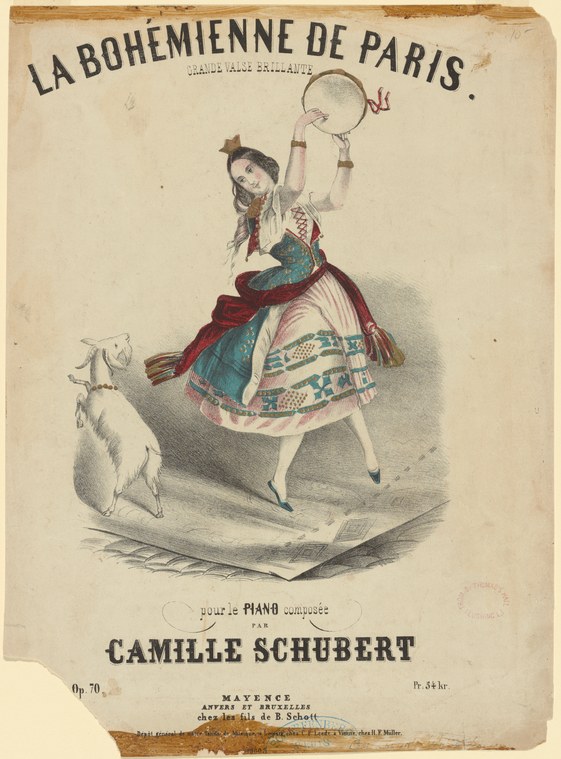
La bohémienne de Paris. Grande valse brillante pour le piano composée par Camille Schubert
Unknown artist
- Collection:
- Prints depicting dance
- Source:
- New York Public Library
- Rights:
- Public domain — free to use, share and adapt.
- Recorded as:
- Public Domain
This work documents the aesthetic and commercial life of a working theatrical dance in a pre-photographic era, showing how costume, movement, and musical composition were advertised and consumed by the theatre-going and musical middle class. The image is evidence of how the Romantic ballet's imagery and technique had penetrated popular culture and domestic performance by mid-century.
What you are looking at
A young woman in Romantic-era theatrical dress executes a spirited pirouette or turning movement, captured mid-spin with her arms raised and one leg extended. She wears a deep teal or blue-green corseted bodice with a cream and white skirt trimmed in decorative borders, and a burgundy shawl or cape flows behind her shoulders. Her dark hair is styled with a ribbon or ornament. The composition is set against a neutral background with subtle floor indication; a small white dog or poodle sits to the left, watching the dancer. The image is the cover of a published piano score, suggesting this is a theatrical or social dance performed to music by Camille Schubert, titled *La bohémienne de Paris* (The Bohemian Girl of Paris).
The dancing
A single figure dances in a nearly vertical axis, torso lifted and arms held high in a balletic frame—one arm raised above the head, the other extended outward. The raised leg, the lifted upper body, and the rotational momentum captured in the image suggest a turning movement such as a pirouette or waltz-based rotation. The pose shows formal balletic training: the body is elongated and the limbs arranged with classical precision rather than folk or vernacular ease.
The dance depicted
This is most likely a Romantic-era stage dance, possibly a character piece or solo from a theatrical ballet or musical tableau. The title *La bohémienne de Paris* and the theatrical costume suggest a narrative dance tied to a popular story of Paris low life, a common theme in mid-nineteenth-century theatre. The musical score by Camille Schubert indicates this was danced to specifically composed music for piano, suggesting either a stage performance or a fashionable drawing-room piece. The style of movement and dress—the corset, the skirt length, the balletic frame—place this firmly in the 1840s–1860s theatrical vocabulary.
How it was made
This is a hand-colored lithographic print, a technology perfectly suited to the rapid, inexpensive production of theatrical promotional images and domestic sheet-music covers in the mid-nineteenth century. The delicate hand-coloring—visible in the teal bodice, cream skirt, and burgundy shawl—was applied after printing, allowing for variation between copies. Lithography permitted the fine detail visible in the fabric patterns, facial features, and the small dog, and the soft tonal values typical of the process. As a sheet-music cover, this image functioned as both artistic promotion and domestic dance instruction, circulating in homes of amateur musicians and dancers.
About this work
This lithographic sheet-music cover records a named character dance from mid-nineteenth-century Paris theatre: a solo for a young woman performing as a bohemian girl of the city streets. The image is both document and advertisement—it preserves the visual memory of a theatrical costume and movement vocabulary while simultaneously marketing the music to amateur performers in the drawing room. The presence of the dog and the narrative title suggest this was a sentimental, mildly exotic character piece in the fashion of Romantic-era ballet and theatrical entertainment. As a published score, it represents the industrial apparatus of nineteenth-century urban theatre and the circulation of dance through print.
How to look at it
The artist has captured a moment of dynamic rotation, freezing the dancer mid-pirouette or turning movement—a signature moment of virtuosity in Romantic ballet. Notice the formal balletic frame: the lifted torso, the raised arms, the extended leg, all organized around a vertical axis. This is not a snapshot of naturalistic movement but a composed pose that distils the essence of the dance. The small white dog's calm observation anchors the scene and humanizes the theatrical moment, placing it within the intimate world of the drawing room rather than leaving it abstract or purely formal. The decorative borders of the skirt and the elaborate costume work suggest that visual spectacle—fine fabrics, movement through space—was central to the appeal of this dance.
The artist
Camille Schubert was a nineteenth-century French composer, though his biographical details are sparse in standard references. He composed theatrical music and popular piano works, of which *La bohémienne de Paris* was one example. The music was published by Mayence (Mainz), with distribution in Paris and Brussels, indicating a professional theatrical composer working within the mid-century Parisian entertainment industry. The engraver and artist who created this lithographic cover are not recorded.
The period
This work dates to the height of the Romantic ballet era (roughly 1830–1870), when narrative character dances and exotic or folk-inspired solos were standard fare in ballet and theatrical spectacle. Paris was the capital of dance innovation and the international centre of ballet; character dances—often titled with references to national or urban identity (*La Sylphide, La Giselle, La Péri, La bohémienne*)—were immensely popular. The figure of the bohemian girl or street dancer was a recurring motif in Romantic literature and theatre, associated with passion, danger, and erotic allure. Sheet-music covers like this one were primary vehicles for the circulation of dance imagery, reaching a far wider audience than the theatre itself; they served the double function of promoting performances and providing music for amateur dancers and musicians in the home.
Where it lives
This is a sheet-music cover held in the New York Public Library's collection of prints depicting dance. It is a published lithographic object, one of many such covers produced in Paris and distributed throughout Europe and North America in the mid-nineteenth century. As a cover to a piano score, it served a dual function: theatrical promotion and domestic instruction.
Dance in this work
Questions about this work
What is a bohémienne and why is she dancing in Paris?
In Romantic-era theatre, the bohémienne (bohemian girl or gypsy woman) was a stock character associated with street life, passion, and exoticism. She appeared frequently in ballet, opera, and theatrical entertainment. Paris, as the setting, grounds the fantasy in contemporary urban life rather than a distant land, making the character both exotic and familiar to the Parisian audience. This particular dance was likely part of a larger theatrical work or standalone entertainment piece.
Who danced this role and when was it first performed?
The catalogue record does not name the dancer or the date of first performance. Sheet-music covers of this era sometimes credited the original performer, but not always. The lithographic style and costume suggest a date in the 1840s–1860s, but without further research or inscription on the cover itself, precise dating cannot be established from the image alone.
Is this a real dance, or just a picture of a dancer in costume?
Both. This is a promotional image for a specific musical composition by Camille Schubert titled *La bohémienne de Paris*—a named work that was danced in a theatre or concert hall and then published in sheet-music form for amateur musicians. It is a real dance, but the image is not a direct documentary record; it is an artistic rendering created for commercial promotion.
Why does the dog matter?
The presence of the small dog is characteristic of Romantic-era theatrical imagery. It humanizes and domesticates the dance, suggesting a narrative context and adding charm or pathos to the scene. The dog's calm presence also suggests that this is a performance designed to entertain and delight a refined audience, not to shock or overwhelm. It may also be part of the character's narrative identity.
More dance artwork





