49 works in this view — arrow keys or swipe to move between them.
Dance in Art
Crinoline parasol
Unknown artist
- Collection:
- Prints depicting dance
- Source:
- New York Public Library
- Rights:
- Public domain — free to use, share and adapt.
- Recorded as:
- Public Domain
This print is a primary-source document of romantic ballet aesthetics and the material constraints that shaped them. It reveals contemporary anxiety about the crinoline—the very garment that defined the visual silhouette of romantic ballet—and suggests that even in the 1840s-50s, observers recognized the fundamental contradiction between the expanding skirt and the refined bodily control that ballet demanded.
What you are looking at
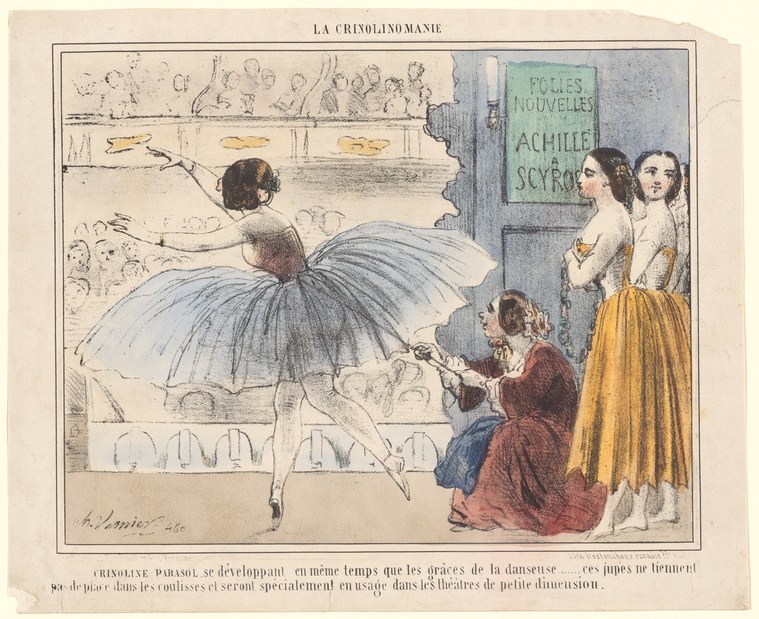
A French satirical print depicting a fashionable woman in a voluminous crinoline skirt, shown in profile as she executes a high kick or arabesque-like leg extension. She wears a pale blue tutu-like skirt with dark shading that emphasizes its enormous circumference, a pink or mauve bodice, and has dark hair styled in the period fashion. To the right stand two other women in classical drapery observing the scene; one kneels or sits, the other stands. Behind them a classical architectural setting with relief sculpture and a doorway inscribed 'COURS NOUVELLE / ACHILLE ET SCYROS' suggests an academic or theatrical context. The upper register shows seated spectators in a theater box. The composition satirizes both the extremes of crinoline fashion and the pretension of classical dance instruction, using the contrast between the absurd bulk of the skirt and the balletic aspiration of the pose.
The dancing
The central dancer's supporting leg is relatively straight while the other extends high and to the side in an attitude or arabesque, with the extended leg notably elevated. The pose suggests balletic training—specifically the turned-out positions and high extensions characteristic of romantic-era ballet technique. However, the enormous crinoline, which would physically prevent such extension and true turnout, is the point of the satire. The two companion figures stand in relaxed classical poses, functioning as witnesses or instructors.
The dance depicted
This is ballet as performed in early-to-mid 19th-century Paris, almost certainly romantic ballet given the tutu silhouette and the classical subject matter (Achilles and Scyros refers to a classical myth, used in ballet narrative). The print mocks the fashion excess of the crinoline era, which coincided with the golden age of romantic ballet, by showing a dancer attempting canonical ballet positions in a skirt so wide it would make the movements physically impossible. The 'Cours Nouvelle' inscription suggests a dance academy or instruction context.
How it was made
This is a hand-colored engraving or lithograph, evident from the fine linear work defining the architectural elements and figures, with watercolor or gouache applied afterward to create the soft palette of blues, pinks, and flesh tones. The technique allowed for satirical social commentary to circulate widely in Paris during the 1840s-1850s, reaching an educated middle-class audience familiar with both ballet and fashion criticism. The style is consistent with the commercial satirical prints of the period, possibly from a series or periodical.
About this work
This is a French satirical print from the mid-19th century that captures a moment of deliberate absurdity: a ballet dancer in an elaborate crinoline attempting a canonical romantic-ballet pose. The work sits at the intersection of fashion history, dance history, and satirical art practice. It belongs in a dance gallery because it documents both the actual silhouette in which dancers performed and the social anxiety around women's bodies, fashion excess, and physical capability that preoccupied the period. The image shows not just what was danced, but what could and could not be done in the clothes of the era.
How to look at it
Observe the exaggerated width of the crinoline in relation to the dancer's leg extension: the skirt is so vast that the lifted leg barely projects beyond it, undermining the visual effect the pose should achieve. Notice also the artist's choice to frame the figure in three-quarter view rather than true profile, allowing the skirt's circumference to be legible while still showing the leg position. The classical setting and the inscribed reference to Achilles and Scyros elevate the satire: the dancer aspires to classical refinement, but the fashion of the moment makes the aspiration look ridiculous. The theatrical spectators in the upper register suggest this is commentary on an actual stage or academy scene.
The artist
The print is unsigned in the visible portion of the image and the artist is not recorded in the catalogue. However, the style and inscription 'LA CRINOLINONAME' (a pun on crinoline) suggest a professional satirical print shop, likely Parisian, from the 1840s-50s. The quality of the draftsmanship and hand-coloring indicates a commercial operation producing social satire for periodicals or print collections.
The period
The crinoline emerged as mainstream fashion in the 1840s and reached peak width in the 1850s-60s, precisely the period of romantic ballet's dominance in Paris. Dancers including Marie Taglioni and her successors performed in tutus supported by crinolines or hoop skirts, creating the iconic bell-jar silhouette. Yet the extreme width of the skirt fundamentally limited the dancer's range of motion—especially in the legs—making poses like high extensions or wide developés visually compromised. This print documents the era's awareness of that contradiction through humor. Satirical prints on fashion and social manners were a major art form in Paris during this period, rivaling painting in cultural reach.
Where it lives
The print is held in the New York Public Library's collection of prints depicting dance, which specializes in visual documentation of dance practice and performance across periods and cultures.
Dance in this work
Questions about this work
Could dancers actually perform in these crinolines?
Yes, but with severe limitations. Crinolines and hoop skirts were standard theatrical costume for romantic ballet in the 1840s-60s. They created the desired silhouette from the front and allowed the skirt to move dramatically in turns. However, they significantly restricted leg extension and true hip turnout—the very movements ballet technique emphasizes. Dancers adapted by using smaller movements and exaggerating upper-body port de bras to compensate.
What does the inscription 'Cours Nouvelle / Achille et Scyros' mean?
'Cours Nouvelle' means 'New Course' or 'New Class,' suggesting a dance academy or instruction setting. 'Achille et Scyros' (Achilles and Scyros) references a classical myth used in ballet narratives—a subject for an academic dance composition. The combination mocks the pretension of framing fashion excess as classical study.
Is this making fun of ballet or fashion?
Both, but primarily fashion. The print respects ballet technique (the drawn pose is anatomically sound) while ridiculing the crinoline for making that technique look absurd in practice. It is a commentary on the social priority given to fashionable silhouette over functional movement.
Who made this print?
The artist is not recorded in the catalogue. The style, subject matter, and hand-coloring are consistent with professional Parisian satirical print studios of the 1840s-50s, the period when crinoline satire was common in French popular prints.
More dance artwork





