49 works in this view — arrow keys or swipe to move between them.
Dance in Art
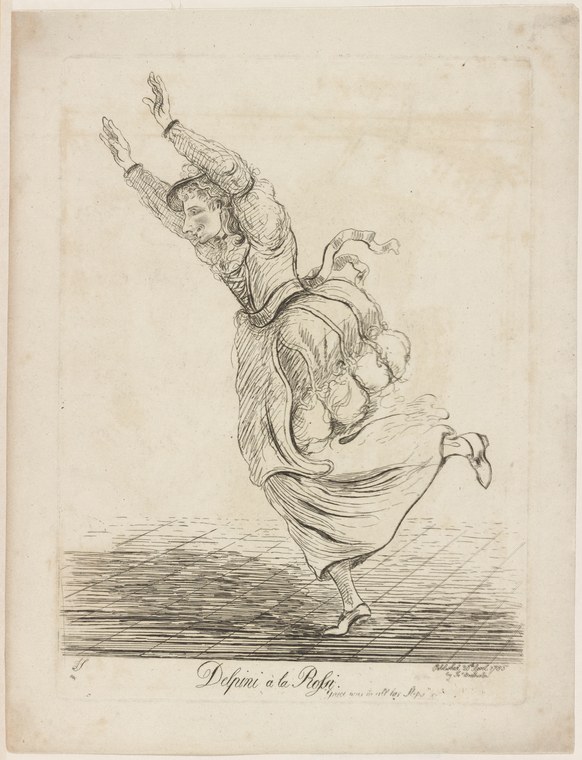
Delpini à la Rossi
Unknown artist
- Collection:
- Prints depicting dance
- Source:
- New York Public Library
- Rights:
- Public domain — free to use, share and adapt.
- Recorded as:
- Public Domain
This print provides rare visual evidence of the acrobatic demands placed on early 19th-century theatrical dancers and demonstrates the high technical expectations of the Romantic stage. It documents a style of performance—virtuosic, balletic, and oriented toward display—that shaped the development of classical ballet and influenced what audiences came to expect of dancers' bodies. For historians of dance and print culture, it is a primary source that shows how celebrated performances were disseminated, consumed, and remembered before the invention of photography.
What you are looking at
A single female dancer is captured mid-leap, her body suspended in a moment of exuberant motion against a plain ground. She wears a high-waisted empire silhouette dress with long sleeves, typical of early 19th-century fashion, and her hair is bound up in the style of the period. Her left leg is bent sharply upward, knee high, while her right leg extends behind her; both arms are raised, one reaching skyward in an open gesture of abandon. The composition is spare and intimate—no orchestra, no stage setting, no audience—which focuses all attention on the acrobatic extremity of her movement. The dancer appears to be executing a jump of considerable technical difficulty, her torso pitched forward dynamically to balance the raised leg.
The dancing
A single performer dominates the frame. Her body is in a pronounced diagonal, torso folded forward at the hips while one knee drives upward sharply and the other leg trails or extends behind. Both arms are away from the body—the upper arm lifted, forearms and hands active in an open, spirited gesture. Her weight is clearly airborne; the positioning suggests a moment of full suspension rather than a preparation or landing. The ease and height of the movement, combined with the articulation of the limbs, indicates technical virtuosity and suggests trained acrobatic capability rather than social or folk movement.
The dance depicted
This appears to be a portrait of a theatrical dancer executing a signature move or specialty jump, likely from the early 19th-century stage. The extreme lift and the deliberate, showy character of the movement—particularly the raised knee combined with extended arms—is consistent with the acrobatic display pieces that became fashionable in Romantic-era ballet and pantomime. Without more documentation, the specific dance cannot be definitively named, but the athletic virtuosity and theatrical presentation suggest this may record a celebrated performer's signature step or a known choreographic moment. The title reference to Rossi (possibly the dancer's surname) and Delpini (possibly a choreographer or company name) might provide identification, but cannot be verified from the image alone.
How it was made
This is an engraving, executed with fine parallel hatching and delicate line work typical of late 18th or early 19th-century printmaking practice. The technique allows the artist to capture precise anatomical and gestural detail while maintaining the economy of black line on white paper. Engravings of this type were relatively expensive to produce and were circulated among the literate and theater-going public—they functioned as both documentation of celebrated performances and as collectible souvenirs. The relative finish and detail suggest this was a commissioned or commercial work intended for a paying audience rather than a sketch or preliminary study.
About this work
This engraving records a moment from early 19th-century theatrical dance, depicting a single performer in a moment of acrobatic suspension that would have astonished and delighted contemporary audiences. The image captures a style of performance in which dancers—particularly women—were expected to demonstrate extraordinary physical control and aerial capability, feats that pushed the boundaries of what the body could accomplish on stage. The work sits at the intersection of dance documentation and theatrical portraiture, serving both to commemorate a specific performer and to disseminate an image of an exemplary moment of virtuosic movement.
The engraving format and the refined execution suggest this was a prestigious publication, likely sold to patrons of the theater or to dance enthusiasts who collected such records. It preserves a fleeting instant from a live performance—a tradition of dance documentation that predates photography and establishes the visual genealogy of how audiences understood and remembered dance in the pre-photographic age.
How to look at it
Notice the impossibility of the pose: the sharp right angle of the raised knee, the lifted center of gravity, the open arms. This is not a pose the body can hold; it is a fraction of movement captured mid-flight. The artist has chosen to freeze the moment of maximum suspension and display—not the preparation or the landing, but the instant of greatest visual drama. The convention here is that of theatrical portraiture translated into action: the performer is presented as a monument to her own virtuosity. Attend to how the engraver has used line to suggest musculature, effort, and the illusion of weightlessness through the positioning of the limbs and the absence of any ground support.
The artist
The artist is not recorded. The print appears to be a commercial theatrical engraving of the type produced in London or Paris in the early 19th century, possibly by a specialist in dance and performance subjects. Such prints were often unsigned or credited only to the publisher, and artists working in this genre were frequently considered artisans rather than fine artists. The level of anatomical accuracy and the theatrical subject matter suggest the printmaker had direct knowledge of stage performance or worked from drawings by an artist present at the performance.
The period
The early 19th century saw an explosion of theatrical dance documentation and a dramatic shift in what dancers—especially women—were expected to do. The Romantic ballet movement elevated the dancer from court performer to celebrated virtuoso, and prints like this one were a primary means of disseminating images of celebrated performers to a widening public. The acrobatic vocabulary visible here—the extreme height, the sharp articulation of the limbs, the theatrical abandon—was part of the Romantic aesthetic that valued the appearance of effortlessness, transcendence, and otherworldly ability. Simultaneously, engravings were a dominant technology of visual reproduction and entertainment; they were collected, traded, and displayed in theaters and homes as souvenirs of celebrated performances.
Where it lives
The work is held in the New York Public Library's collection of prints depicting dance. It is catalogued with minimal metadata, reflecting the historical treatment of theatrical engravings as commercial ephemera rather than art-historical objects worthy of detailed documentation.
Dance in this work
Questions about this work
Who was Delpini and who was Rossi?
The title suggests these names refer to either a dancer, choreographer, or company associated with the performance depicted. Without additional documentation or archival research, their identities cannot be confirmed from the image alone. Early 19th-century theater records—playbills, reviews, company rosters—would be necessary to establish their roles and the context of this performance.
Is this an example of early ballet?
It appears to document theatrical dance from the Romantic era, and the acrobatic vocabulary and costume are consistent with early 19th-century ballet. However, the image alone cannot specify whether this is ballet, pantomime, or a hybrid theatrical form. The extreme athleticism and the focus on a single signature move suggests a star performer's showcase piece rather than part of a narrative ballet.
How was an image like this created and distributed?
This engraving was made by incising lines into a metal plate and then inking and printing from that plate. It was likely produced on commission after a celebrated performance, sold through theater lobbies or print shops, and collected by theater enthusiasts. Engravings were the primary technology for disseminating images of performances before photography; each print was hand-printed from the plate, making them relatively scarce and valuable compared to later photographic reproductions.
More dance artwork





