49 works in this view — arrow keys or swipe to move between them.
Dance in Art
Rosita Mauri
Unknown artist
- Collection:
- Prints depicting dance
- Source:
- New York Public Library
- Rights:
- Public domain — free to use, share and adapt.
- Recorded as:
- Public Domain
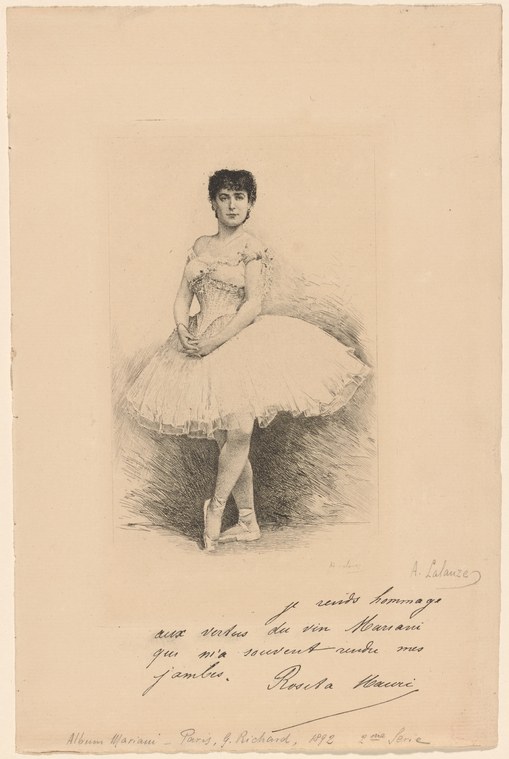
Rosita Mauri was a significant performer of the late 19th-century Paris Opéra, and this portrait is direct evidence of her rank and costume in that institution. The work also illustrates the visual and sartorial conventions of Romantic and Neoclassical ballet at its peak, particularly the standardized costume and body ideal of the era—information that cannot be recovered from written sources alone. For dancers and historians, the inscription adds a layer of professional intimacy, showing how dancers self-presented and honored their colleagues.
What you are looking at
A young woman in performance costume stands in an elegant contrapposto pose against a neutral background. She wears a fitted corset bodice with delicate off-shoulder sleeves and a voluminous tulle skirt that falls to mid-calf, gathered to reveal her legs and pointe shoes. Her dark hair is styled in a late 19th-century updo, and her gaze is directed downward in a contemplative or modest expression. The figure occupies the center of the composition, rendered in fine pen or engraving technique with careful attention to the texture of the tulle and the definition of her form. Below the image, a handwritten inscription in French reads "avec hommages à ses étoiles de l'Opéra qui m'a secourt mainte ou jamais," signed "Rosita Mauri," establishing this as a signed portrait or presentation print.
The dancing
The dancer stands in a relaxed yet poised position, her weight distributed on both feet with subtle sway, one leg slightly forward. Her arms hang naturally, one at her side and one resting across her lower torso in a modest gesture. The positioning suggests a moment of repose rather than active movement—she is "off-stage" in character, presenting herself rather than mid-choreography. Her body is fully supported by two legs; no elevation or active extension is shown. The pose conveys the refined deportment expected of a prima ballerina of her era.
The dance depicted
This is a portrait of a principal dancer of the Romantic or late Romantic ballet era, identifiable by the pointe shoes, tulle skirt, and corseted silhouette characteristic of 19th-century classical ballet. The inscription confirms the sitter as Rosita Mauri, a notable figure in late 19th-century opera-ballet performance. The image is not a record of movement but rather a formal presentation of the dancer in costume, a common genre of theatrical portraiture. No specific ballet is depicted; instead, this is a professional portrait intended for circulation and commemoration.
How it was made
This is a fine engraving or etching, rendered in black ink on paper with careful cross-hatching and line work to define form, volume, and texture—particularly the layered opacity of the tulle skirt. The delicate parallel lines suggest steel engraving rather than lithography. The technique allowed for precise reproduction and wide distribution, making this a standard format for theatrical promotion and archival documentation in the late 19th century. The handwritten inscription is part of the original object, confirming this as a signed or dedicated print, likely presented or autographed by the sitter herself.
About this work
This is a formal portrait engraving of Rosita Mauri, a principal dancer of the Opéra in Paris during the late 19th century, presented in full classical ballet costume. The work captures the professional and aesthetic ideals of the Romantic and Neoclassical ballet tradition: the ethereal tulle skirt, the corseted silhouette, the pointe shoes, and the modest, refined bearing. It belongs in a dance history collection both as evidence of a specific dancer's celebrity and as a document of how ballet dancers of this period were publicly represented—not as moving bodies but as idealized aesthetic objects. The inscription establishes this as a gift or dedication from the dancer to her peers at the Opéra, making it personal testimony as well as theatrical promotion.
How to look at it
The viewer should observe the artist's choice to present the dancer at rest rather than in motion—this is a costume and bearing study, not a choreographic moment. Note the careful rendering of the tulle, which required fine engraving technique to convey its translucency and volume. The modest downward gaze and the relaxed arm position signal 'the dancer offstage,' a convention of theatrical portraiture that presented performers as refined, tasteful figures rather than acrobats. The inscription reminds us to read this as a gift and a historical document, not merely an aesthetic object.
The artist
The artist is not recorded in the catalogue, but the engraving is technically sophisticated and clearly a professional theatrical print, likely commissioned by the Opéra or produced by a specialist in theatrical portraiture. Late 19th-century Paris supported a substantial trade in ballet and opera prints; such works were typically the product of established engravers working from drawings or photographs, often signed by the sitter for distribution as gifts or promotional materials.
The period
By the late 19th century, classical ballet in Paris was entering a period of consolidation and codification. The Romantic era of the 1830s–1850s had given way to a more technically virtuosic, visually refined form, exemplified by the work of dancers like Rosita Mauri. This era saw the emergence of the modern ballet vocabulary (the five positions, pointe work, turnout) as standardized practice. Theatrically, ballet remained a spectacle of visual beauty and spectacle, centered on the female dancer; the tulle skirt and corseted silhouette shown here were the standardized aesthetic of feminine ballet bodies. In the visual arts, portrait engravings of celebrated performers were a major market, combining theatrical promotion, fine-art printmaking, and fan culture.
Where it lives
The work is held in the New York Public Library's collection of prints depicting dance. The handwritten inscription in French, addressed to peers at the Opéra, suggests this is either a signed copy made for presentation or a single-print gift edition. Its arrival in the NYPL collection reflects the library's long investment in theatrical and dance documentation.
Dance in this work
Questions about this work
Who was Rosita Mauri?
Rosita Mauri was a Spanish-born ballerina and principal dancer at the Paris Opéra during the late 19th century. She was celebrated for her technical skill and grace and was a major figure in the classical ballet tradition of her era. The inscription on this print identifies her as an 'étoile' (star) of the Opéra.
Why is she standing still instead of dancing?
This is a formal portrait, not a record of choreography. The convention of ballet portraiture in this period was to present the dancer in costume and in a graceful pose, often at rest, to celebrate her rank, beauty, and professional identity. Movement studies existed but were less common in circulation prints.
What is the French inscription?
Roughly translated: 'With compliments to the stars of the Opéra who have sometimes supported me.' It is signed by Rosita Mauri herself, indicating this was either a gift print or a presentation copy she signed. The inscription personalizes the portrait and connects it to the social world of the Opéra.
What does the costume tell us about ballet at this time?
The pointe shoes, tulle skirt, corseted bodice, and refined posture were the standard costume and aesthetic of classical ballet by the late 19th century. These elements signal that ballet was fully codified as a form, with a recognized ideal of feminine beauty, technique, and presentation. The style would remain largely unchanged into the early 20th century.
More dance artwork





