49 works in this view — arrow keys or swipe to move between them.
Dance in Art
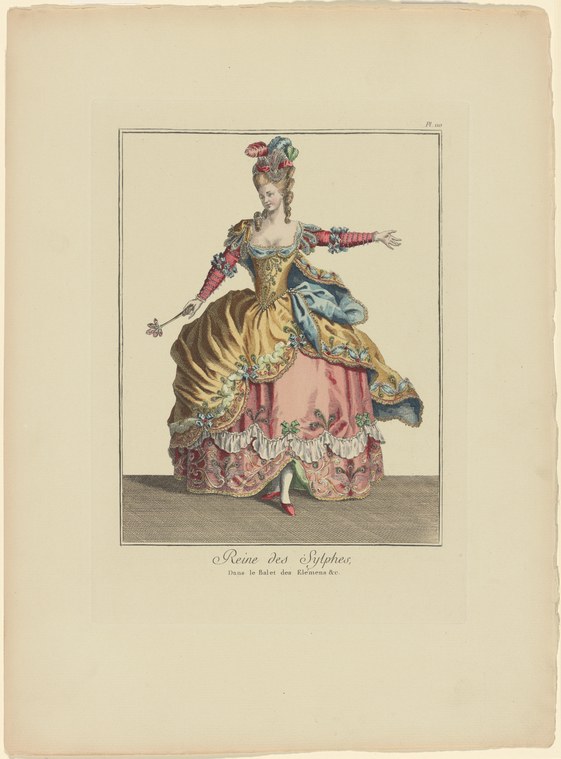
Reine des sylphes, dans le balet des Elémens, &c.
Unknown artist
- Collection:
- Prints depicting dance
- Source:
- New York Public Library
- Rights:
- Public domain — free to use, share and adapt.
- Recorded as:
- Public Domain
This image documents a moment when ballet was as much costume theater and noble bearing as it was movement technique, and when women's roles in ballet were conceived as ethereal, supernatural characters. It also provides concrete visual evidence of how theatrical dance was marketed and imagined by audiences: through hand-colored prints that circulated as luxury objects and theatrical souvenirs.
What you are looking at
A single female figure dominates this hand-colored engraving, posed in an elegant theatrical stance against a plain background. She wears an elaborate costume of the mid-to-late 18th century: a gold brocaded bodice with pink sleeves, a voluminous skirt of pink silk caught up and swept to one side to reveal darker underskirts, and a draped blue silk panel that falls from her waist. Her blonde hair is dressed high and adorned with flowers and ribbons. Her left arm extends outward in a graceful gesture of presentation, while her right arm is held at mid-level with the hand turned delicately upward. She stands with her weight on one leg, her posture conveying both nobility and weightlessness. The figure occupies the lower two-thirds of the composition, leaving ample sky above, a common framing device in theatrical costume prints of the period.
The dancing
The dancer's frame is upright and composed, with shoulders held back and the chest lifted—characteristic of aristocratic theatrical deportment. The extended left arm suggests an invitation or presentation, a gesture often seen in court dances and in the balletic vocabulary of the era. Her weight appears centered but mobile, as if captured mid-movement or in the moment before turning. The position of the feet is not clearly articulated, but the stance suggests she is en face or turning slightly toward the viewer, with no apparent strain in the posture.
The dance depicted
The title *Reine des Sylphes* (Queen of the Sylphs) indicates this is a character or role from a theatrical dance or ballet, likely one that featured elemental or mythological themes—the inscription references "le balet des Elémens" (the Ballet of the Elements). Sylphs were ethereal, spirit-like creatures popular in Romantic-era ballet. This image is almost certainly connected to the theatrical dance tradition of the 18th century, when such allegorical roles were performed as part of court spectacles or professional ballet. The pose suggests a moment of repose or presentation rather than active movement, which was typical of how costume prints documented theatrical roles—showing the character in an attitude of nobility rather than mid-step.
How it was made
This is a hand-colored engraving, a reproductive print technique that allowed theatrical costume designs and roles to be widely distributed to audiences and collectors. The engraved line work provides fine detail in the fabrics and ornamental elements, while the watercolor or gouache hand-coloring—applied after printing—captures the richness of the silk, gold thread, and flowers. This technique was standard practice for documenting theater fashions from the 1740s–1780s, making such prints both records of performance and objects of aesthetic consumption in their own right.
About this work
This print documents a named theatrical role—the Queen of the Sylphs—from a ballet or court dance spectacle centered on elemental themes. The figure is rendered as a portrait of a character type rather than a captured moment of movement, a convention that shaped how 18th-century dance was visualized and circulated. It belongs to the tradition of ballet de cour and early theatrical ballet imagery, when elaborate costumes and allegorical roles were essential to the appeal of dance performance. The print records not steps or technique but the visual fantasy that dancers inhabited: an aristocratic, ethereal presence that the costume and pose together constructed.
How to look at it
The artist has chosen to show the figure in a moment of repose or presentation rather than in motion, which was standard for costume prints of this era. Attend to how the pose constructs character: the lifted chest and extended arm convey nobility and composure despite the ethereal subject matter. The treatment of the drapery—the way the skirt is caught up and the blue silk falls—shows both technical skill in rendering fabric and the choreographic vocabulary of the period, in which arm gestures and the management of voluminous skirts were central to a dancer's art. The inclusion of the full costume, from hair ornaments to shoes, reminds us that theatrical dance was a total visual spectacle, not a study of isolated movement.
The period
This print dates stylistically to the mid-to-late 18th century, an era when ballet was transitioning from aristocratic court entertainment toward professional theatrical performance. The costume and the allegorical subject (sylphs, elements) reflect the taste for mythological and fantastic themes that dominated French ballet between the 1750s and 1780s. The technique and format—hand-colored engraving—was the primary means by which theatrical fashions were documented and disseminated among European elites. Contemporaneous sources like the Recueil de danses or similar costume compilations show that such prints were collected as records of performers and roles, serving both as theatrical documentation and fashion reference.
Where it lives
The print is held in the New York Public Library's collection of prints depicting dance, part of a larger archive of theatrical and costume documentation. It is catalogued as a source document within the Library's research collections rather than as a fine art object or unique work, reflecting its historical function as a circulating print and reference material for theatrical professionals.
Dance in this work
Questions about this work
What are sylphs and why did they appear in 18th-century ballet?
Sylphs were supernatural air spirits from European mythology and literature, conceived as delicate, weightless, and ethereal. They became popular in 18th-century ballet as a way to visualize an ideal of feminine grace and otherworldliness. Dancers who played sylphs wore gossamer fabrics, flowers in their hair, and adopted elevated, weightless poses meant to suggest they were not quite human—an aesthetic that culminated in 19th-century Romantic ballet.
How do we know this depicts a real dancer and not just a fantasy costume design?
We don't, definitively. However, the specificity of the title (naming a particular role in a particular ballet), the professional quality of the engraving, and its circulation as a print suggest this documents an actual staged performance. Such prints were commissioned to commemorate roles danced by known performers and sold to audiences as theatrical souvenirs and fashion references. Whether the figure shown is a portrait of a named dancer or a generic representation of the role remains unclear from the image alone.
What does the Ballet of the Elements refer to?
The ballet des Élémens was likely one of several 18th-century spectacles that divided characters among elemental themes—fire, water, earth, and air. These allegorical ballets were popular in both court and professional theater as frameworks for showcasing dancers in different character roles and costumes. A character like the Queen of the Sylphs (air spirits) would belong to the air or water element, allowing for an aesthetic of lightness and fluidity in both costume and movement.
More dance artwork





