49 works in this view — arrow keys or swipe to move between them.
Dance in Art
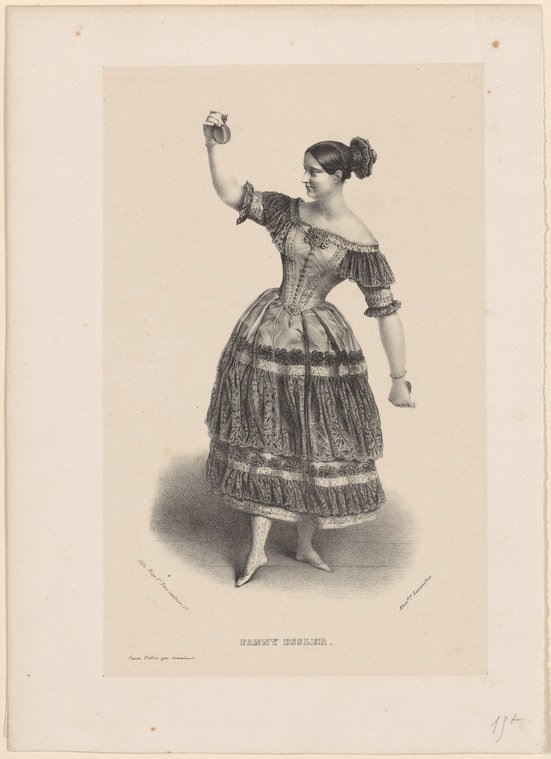
Fanny Essler [sic]
Unknown artist
- Collection:
- Prints depicting dance
- Source:
- New York Public Library
- Rights:
- Public domain — free to use, share and adapt.
- Recorded as:
- Public Domain
Fanny Essler was one of the most celebrated dancers of the 19th century, and prints like this circulated her image and her artistic legacy long after performances ended. The work is historically vital because it shows us not what Essler could do technically, but what choreographers and audiences valued in her performance—the ability to convey emotion through stillness and gesture. For dance historians, this print is a primary document of Romantic ballet's aesthetics and narrative conventions, capturing the theatrical moment that gave the form its cultural power.
What you are looking at
A young woman in Romantic-era theatrical dress stands in a frontal pose, gazing upward and to the side. She holds a small object—possibly a locket, miniature portrait, or similar keepsake—in her raised right hand at approximately eye level, her arm extended in an attitude of contemplation or longing. She wears a fitted bodice with short, puffed sleeves and a voluminous skirt with horizontal bands or flounces, characteristic of 1830s–1840s fashion. The skirt extends to mid-calf, revealing her feet in flat ballet slippers. Her dark hair is arranged in the period style, pulled back and gathered at the nape. The figure is set against a plain, neutral background with subtle shading that creates depth and focuses attention on her isolated, introspective pose. The engraving technique produces a luminous quality, with fine cross-hatching defining the fabric textures and the play of light across her form.
The dancing
A single female dancer stands in a pose that combines stillness with emotional expressiveness. Her weight appears evenly distributed, with a slight contrapposto tilt; her raised arm creates an open, upward line that draws the viewer's eye. The extended gesture—holding the object aloft—suggests a moment of heightened feeling rather than active locomotion. Her feet are positioned in what appears to be a soft, naturalistic stance rather than a turned-out ballet position, though she wears ballet slippers. The entire composition conveys repose and introspection rather than dynamic movement, a hallmark of Romantic-era choreography where pantomime and emotional narrative were central to the form.
The dance depicted
This appears to depict a moment from Romantic ballet, most likely representing a solitary, emotionally charged scene—possibly a memory, reverie, or moment of yearning. The object in her raised hand suggests a narrative context: she might be holding a portrait of a lover, a letter, or a precious token around which her character's fate turns. The pose and costume align with mid-19th-century Romantic ballet, when dancers performed such intimate, narrative-driven moments as part of longer dramatic works. The artist has chosen to isolate the figure in a non-dancing moment, capturing instead the pantomimic and emotional register that was as essential to Romantic ballet as the dancing itself.
How it was made
This is an engraving or lithograph, executed with fine lines and careful tonal gradation to model form. The technique allows for precise rendering of fabric, gesture, and facial expression, and the print's monochromatic medium creates a classical, timeless quality. The skilled cross-hatching and subtle shading suggest a professional theatrical print, likely made for commercial distribution—these images were sold as souvenirs of celebrated performances and dancers. The technique's accessibility and reproducibility made such prints the primary visual record of stage performance in the pre-photographic era.
About this work
This is a theatrical print documenting a moment from Romantic ballet performance, most likely depicting the celebrated dancer Fanny Essler (though the catalogue spells the name inconsistently). The work captures not a virtuosic feat but an intimate, dramatically charged instant: a solitary figure holding a keepsake, her gaze distant and her bearing reflective. Such scenes were the emotional heart of Romantic ballet, and this print preserves both the choreography of the pose and the narrative context in which it appeared. The image belongs in a dance history collection because it documents how 19th-century ballet audiences understood and valued their art—not only as display of technical prowess, but as a vehicle for storytelling, pathos, and the expression of inner feeling.
How to look at it
Attend to the direction of the dancer's gaze and the gesture of her raised hand: the artist has frozen a moment of psychological intensity rather than physical action. Notice how the pose is asymmetrical and open, with the raised arm creating an unstable, yearning line—this is not a balanced, classical position but a gesture of longing or sorrow. The flat ballet slippers and fitted bodice place her within the ballet tradition, while the emotional directness and narrative quality of the pose link her to the Romantic movement. The engraving's fine detail allows you to read fabric texture, the tilt of her head, and the delicate definition of her face—all elements that conveyed character and feeling to 19th-century viewers.
The artist
The artist is not recorded in the catalogue. Based on style and period, this is a professional theatrical print, likely produced by a commercial printmaker working in Paris or London during the 1830s–1840s, when Essler's fame was at its height. Such prints were often unsigned or credited only to the printmaker rather than the designer, and they represent a collaborative form of theatrical documentation rather than the work of a single named artist.
The period
This engraving dates to the height of Romantic ballet, when the form had shifted decisively from the technical display and courtly refinement of Classical ballet toward narrative, emotional intensity, and the supernatural. Works like *La Sylphide* (1832) and *Giselle* (1841) dominated the stage, and dancers like Marie Taglioni and Fanny Essler became international celebrities. Essler was particularly famous for her dramatic intensity and her prowess in Spanish and character dances, as well as her ability to convey pathos and inner conflict. In the visual arts, Romantic ideology privileged feeling over form, the particular over the universal, and the fleeting moment over static beauty—all evident in the print's compositional choice to capture an instant of emotional suspension rather than virtuosic display.
Where it lives
This print is held in the New York Public Library's collection of prints depicting dance. It is catalogued as "Fanny Essler" [sic], though the artist and precise date are not recorded. Such theatrical prints were mass-produced and widely distributed; this one is part of a substantial archive documenting 19th-century performance through commercial imagery.
Dance in this work
Questions about this work
Was Fanny Essler a famous dancer?
Yes. Essler was one of the most celebrated performers of the 19th century, known for her dramatic intensity, technical skill, and mastery of character and Spanish dances. She was a rival to the even more famous Marie Taglioni, and her international tours made her a celebrity across Europe and America. Prints like this one were sold as souvenirs to eager fans.
Why is she holding that object?
The object almost certainly carries narrative significance—it is likely a portrait, letter, or keepsake central to the plot of the ballet from which this moment was extracted. In Romantic ballet, such props were not merely decorative but were vehicles for emotional expression and storytelling, and the dancer's handling of them was part of the choreographic vocabulary.
Is this a photograph or a drawing?
This is an engraving or lithograph—a printmaking process, not a photograph. Prints like this were the primary way theatrical images were reproduced and distributed before photography became practical for theater documentation. The technique allowed for fine detail and wide circulation at low cost.
What ballet is this from?
The catalogue does not identify a specific work. Based on the style and costume, it likely depicts a moment from a Romantic ballet of the 1830s–1840s, but without additional documentation we cannot say which ballet or which performance this scene represents.
More dance artwork





