49 works in this view — arrow keys or swipe to move between them.
Dance in Art
Carlotta Grisi
Unknown artist
- Collection:
- Prints depicting dance
- Source:
- New York Public Library
- Rights:
- Public domain — free to use, share and adapt.
- Recorded as:
- Public Domain
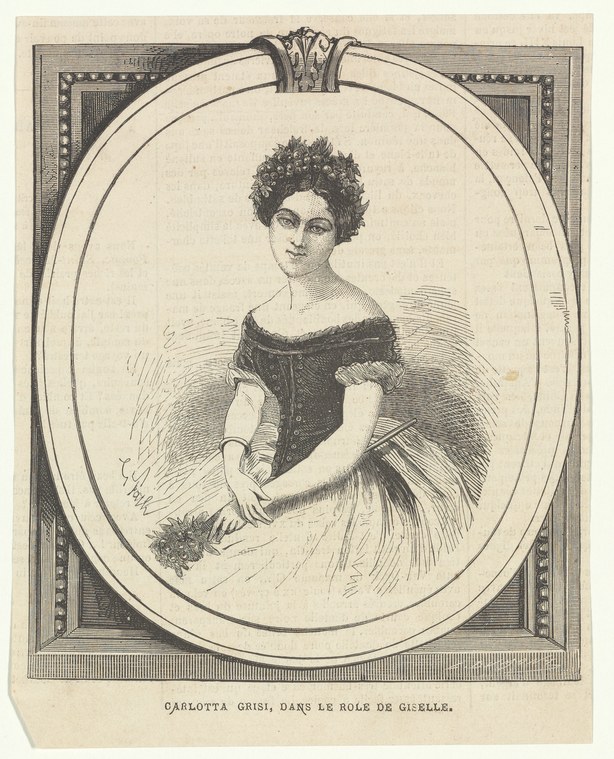
Carlotta Grisi was one of the defining dancers of the Romantic era, and *Giselle* remains the most frequently performed Romantic ballet in the world. This engraving is a direct record of how Grisi presented herself and was presented to audiences during that role's creation, capturing the visual aesthetic and the deportment that made Romantic ballet distinct from earlier classical forms. For historians, it provides a tangible image of one of ballet's foundational figures.
What you are looking at
A young woman is portrayed in a delicate oval frame against a pale background. She wears a dark off-shoulder dress with short puffed sleeves and a full skirt of pale fabric, her dark curled hair arranged fashionably atop her head. Her posture is graceful and composed: she stands with one hand resting on her skirt, the other at her side, her body angled slightly to suggest movement or a moment of pause during performance. The framing is formal and classical, with an ornamental cartouche at the top of the oval and a decorative border frame around the whole, in the manner of theatrical portraiture. The engraving technique creates fine linear details, particularly in the rendering of the fabric's texture and the delicate features of her face.
The dancing
The dancer is shown as a solitary figure in an elegant contrapposto stance—her weight appears to rest primarily on one leg, with the other subtly advanced, creating the illusion of a pose caught between stillness and motion. Her arms are held softly, one across her body and one gently deployed, neither in a rigid theatrical frame nor entirely relaxed. The posture suggests the refined carriage and controlled elegance expected of a Romantic-era ballet dancer. There is no grimace or strained expression; instead, the face registers composed grace and a distant, dreamy quality characteristic of Romantic ballet's aesthetic.
The dance depicted
This is a portrait of Carlotta Grisi in the role of Giselle, the titular character of the ballet *Giselle* (choreography by Jules Perrot and Jean Coralli, 1841). The inscription confirms this reading. Grisi, an Italian dancer and prima ballerina of the Romantic era, created the role of Giselle and made it one of the defining parts of her career. The image captures her in the refined, ethereal style of mid-19th-century ballet: pointe work is implied by the elegant arching of her foot, and the soft draping of the skirt and the restraint of her gesture place this squarely within the Romantic ballet idiom. The work depicts neither a virtuosic display nor a dramatic moment, but rather the sustained elegance and emotional restraint that characterised the Romantic aesthetic.
How it was made
This is an engraving, a relief-printing process that allowed for wide circulation of theatrical portraiture in the 19th century. The fine parallel lines (hatching) used to create shadow and volume are consistent with reproductive engraving, a technique that made theatrical imagery affordable and popular with a growing middle-class audience who attended opera and ballet. The oval portrait format within a decorative architectural frame follows the convention established for prints celebrating famous performers. The controlled, precise line work speaks to skilled hand-engraving rather than a mechanical process, allowing the artist to capture both the delicate features and the quality of movement suggested by the pose.
About this work
This is a commemorative engraved portrait of the legendary Romantic-era ballerina Carlotta Grisi in her breakthrough role as Giselle. The image is part of a genre of theatrical ephemera—prints celebrating famous performers—that circulated widely in 19th-century Europe and America. It documents not a moment of violent action but the sustained elegance, ethereal quality, and emotional restraint that defined the Romantic ballet aesthetic. The work serves as evidence of Grisi's fame and the way her performances were consumed and remembered by the public beyond the theatre itself.
How to look at it
Observe the subtle suggestion of weight shift and the controlled elegance of the arm positions, which together convey not a moment of technical display but rather a pose of emotional and physical grace. The soft, downward gaze and the delicate features create the 'ethereal' quality that characterised Romantic ballet's ideal of the dancer as an otherworldly, emotion-driven figure rather than an acrobat. Notice how the costume—the off-shoulder neckline, the short puffed sleeves, the full skirt—defines the silhouette and is rendered with attention to the texture and movement of fabric. This is a portrait designed to communicate elegance, refinement, and emotional depth rather than technical virtuosity.
The artist
The artist is not recorded. The work is a reproductive engraving, likely produced for commercial distribution by a publishing house serving the opera and ballet-going public of the mid-19th century. Such prints were often executed by accomplished but unnamed craftsmen working within established conventions of theatrical portraiture.
The period
The 1840s saw the full flowering of the Romantic era in ballet. *Giselle*, premiered in Paris in 1841, was a landmark work that synthesized the aesthetic principles of Romanticism—the emphasis on emotion, the supernatural, the feminine ideal, and the fusion of drama with dance—that had been emerging since the late 1820s. This period saw the rise of the female dancer as the principal focus of theatrical spectacle, and prints like this one were among the primary means by which dance images reached the broader public. Engraving was the dominant reproductive medium for theatrical portraiture before the advent of photography; these prints shaped and recorded the visual memory of famous performers.
Where it lives
The work is held in the New York Public Library's collection of prints depicting dance. It is part of a larger body of 19th-century theatrical portraiture, a genre created for public consumption and circulation rather than as a unique artwork.
Dance in this work
Questions about this work
Who was Carlotta Grisi and why is she important?
Carlotta Grisi (1819–1899) was an Italian prima ballerina and one of the most celebrated dancers of the Romantic era. She created the role of Giselle in 1841, one of ballet's most iconic parts, and her performances defined the aesthetic of Romantic ballet for a generation. She was also a significant figure in developing the technical standards and dramatic range of the ballerina in the mid-19th century.
What is *Giselle* and why does it matter?
*Giselle* (1841) is a two-act ballet with choreography by Jules Perrot and Jean Coralli and a libretto by Théophile Gautier. It is a cornerstone of the Romantic ballet repertory and remains one of the most frequently performed ballets in the world. The ballet tells the story of a young peasant woman who dies of a broken heart and returns as a ghost, blending the supernatural and emotional themes central to Romantic aesthetics.
How do we know this is Giselle?
The inscription at the bottom of the engraving reads 'CARLOTTA GRISI, DANS LE ROLE DE GISELLE,' identifying both the dancer and the role. The costume, posture, and theatrical context all align with mid-19th-century Romantic ballet portraiture.
Why was this portrait made and how was it used?
Theatrical portraits like this were created and sold to the public as mementos of performances and as fan images. They circulated in cities and towns, allowing people who had seen a performance to own a keepsake and allowing those who had not to learn about celebrated dancers. Such prints were often collected in albums or framed and hung in homes.
More dance artwork





