49 works in this view — arrow keys or swipe to move between them.
Dance in Art
Carlotta Grisi
Unknown artist
- Collection:
- Prints depicting dance
- Source:
- New York Public Library
- Rights:
- Public domain — free to use, share and adapt.
- Recorded as:
- Public Domain
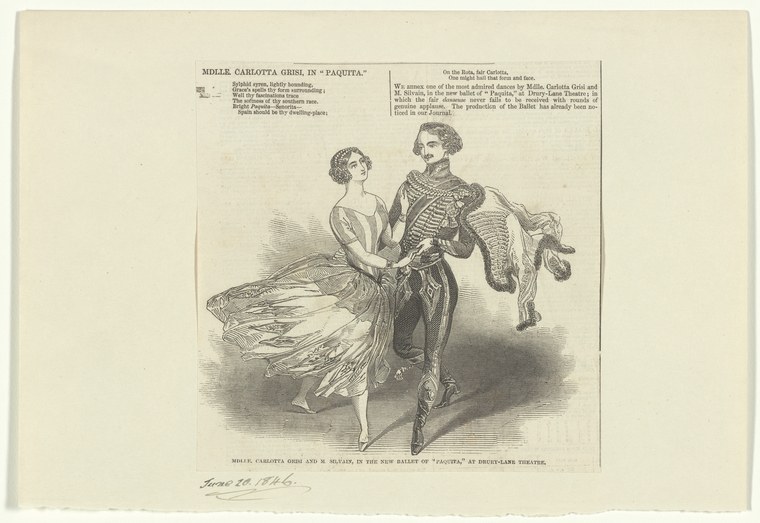
Carlotta Grisi was one of the defining figures of Romantic ballet, and this engraving is likely one of very few contemporary images that show her actual dancing technique in performance context rather than studio pose. The image documents the partnering aesthetic of the 1840s, which is central to understanding how Romantic ballet differed technically from both the classical ballet that followed and the court dances that preceded it.
What you are looking at
A wood-engraved theatrical scene depicts a male dancer in military dress—dark coat with ornamental braiding and epaulettes—partnering with a female dancer in a billowing white tulle skirt. The woman's skirt dominates the composition, its voluminous folds swept dramatically to one side, suggesting rapid movement or a turn. The man, positioned slightly behind and to her side, appears to support her with one arm while holding what looks like a small prop or garment in his other hand. The setting is spare, rendered with minimal background detail in the engraver's characteristic cross-hatching; the focus is entirely on the two figures and the sculptural quality of the woman's dress. The image has the hallmark of 19th-century theatrical illustration—bold contrasts, delicate line work, and a moment frozen mid-motion that captures the energy of the stage.
The dancing
The male dancer stands in a supportive position, his weight grounded, his frame angled to present his partner. The female dancer appears to be executing a turn or traveling step, her body leaning slightly forward, her free arm extended as her skirt billows. Their connection is intimate but not ballroom-close—his hand appears to guide her at the back rather than hold her in a closed frame. The exaggerated volume of the woman's skirt and the theatrical posture of both figures suggest a trained, codified partnering style characteristic of the ballet of the era.
The dance depicted
This appears to be a Romantic-era ballet scene, most likely from the 1840s when Carlotta Grisi was an international star. Grisi was renowned for her technical brilliance and her roles in ballets like *Giselle* (1841) and *La Jolie Fille de Gand* (1842). The man's military dress and the woman's voluminous skirt are consistent with the Romantic ballet aesthetic, where male partners often wore contemporary military or aristocratic costume while women wore the tutu. The moment depicted—a traveling turn with the skirt in dramatic flight—is characteristic of the step vocabulary that defined Romantic technique. The engraving records not just the dancer but the visual spectacle that made the Romantic ballet a sensation.
How it was made
This is a wood engraving, a relief printing technique that required cutting an image into the end grain of a boxwood block. The fine cross-hatching visible throughout the image, the precise line work, and the high contrast between black and white are all characteristic of wood engraving at its height. Wood engraving allowed for mass reproduction in newspapers and periodicals, making theatrical images accessible to a wide audience who might never see the actual performance. This particular engraving was likely published in a theatrical or gossip journal, where images of celebrated dancers like Grisi were commercial assets.
About this work
This wood engraving captures a moment from a Romantic-era ballet, almost certainly featuring the legendary Italian dancer Carlotta Grisi in partnership with a male dancer in military dress. The image is both a document of dance practice and a work of theatrical publicity: it preserves the posture, the partnering style, and the visual impact of the Romantic tutu at a moment when ballet was at the height of its cultural prestige. The engraver has frozen the woman mid-turn, her skirt flying, her partner steady beneath her—a pose that conveys both the technical demand and the visual magic that made Romantic ballet an obsession of 19th-century Europe.
The work belongs in a dance history collection as evidence of how ballet was seen and celebrated in its moment. It is not a choreographer's notation or a dancer's reflection, but a journalist's image—the visual record of what spectators paid to witness. For historians, it offers concrete detail: the male partnering technique, the costume, the posture, the moment of the phrase chosen for representation.
How to look at it
Focus first on the construction of the woman's skirt: the way the folds are rendered suggests not just volume but movement—the tulle is caught in the moment of turn, flying outward. Note how the engraver has used cross-hatching to create shadow and depth, making the skirt read as a sculptural form rather than a flat piece of cloth. Then look at the connection between the dancers: the man's hand placement and the angle of his body relative to the woman's. This is not a ballroom position; it is a partnering technique designed to support and amplify the woman's movement. The military dress on the man is also significant—it establishes the narrative context of the ballet and fixes the era in which it is set.
The artist
The engraver is not recorded in the catalogue, but the style and subject matter suggest a professional theatrical illustrator working for a London or Paris publication in the 1840s. Wood engraving was the dominant medium for theatrical journalism of the period, and the quality of line work here indicates a skilled craftsperson working from a live performance sketch or a posed studio study.
The period
This engraving dates from the height of the Romantic ballet era (c. 1830–1850), when ballet became increasingly feminized, both visually and structurally. The Romantic tutu—white, voluminous, reaching mid-calf—was invented during this period and became the symbol of the ballerina. Male dancers, by contrast, wore increasingly naturalistic dress: military uniforms, noble coats, peasant clothes. Carlotta Grisi was Italian by birth but achieved her greatest fame in Paris at the Opéra, where she created roles in some of the era's greatest ballets. She was celebrated for her technical virtuosity, her acting ability, and her beauty—all of which this engraving attempts to capture. The image is a product of the mass media culture that grew around ballet in the 19th century: theatrical journals, newspapers, and popular prints made dancers into celebrities whose images circulated far beyond the theater.
Where it lives
The work is held in the New York Public Library's Prints collection, which houses theatrical imagery, playbills, and dance documentation from the 18th century onward. It is catalogued as a print depicting dance, with Carlotta Grisi identified in the title but limited additional metadata.
Dance in this work
Questions about this work
Who was Carlotta Grisi?
Carlotta Grisi (1819–1899) was an Italian-born dancer who became one of the greatest stars of the Romantic ballet era. She created the role of Giselle in the 1841 premiere of that ballet, which is still performed today. She was known for her technical skill, her dramatic range, and her beauty, and she was celebrated across Europe. This engraving captures her at the height of her fame.
What is the male dancer wearing and why?
The man wears a military coat with braiding and epaulettes, which was typical male costume in Romantic ballets. It established the character within a narrative context—often a nobleman, a soldier, or a prince. Unlike the ballerina, the male dancer wore contemporary or historical dress rather than a theatrical costume designed specifically for the stage.
How do we know this is from a ballet and not another kind of dance?
The tutu, the partnering style, the posture of the woman, and the male military dress are all conventions of Romantic ballet from the 1840s. The engraving was likely made to publicize a specific performance, and the catalogue title identifies Grisi, a ballet dancer. The technique depicted—the supported turn with flying skirt—is ballet technique.
Why is this a wood engraving and not a painting or photograph?
Wood engraving was the standard technology for mass-producing theatrical images in the 1840s. It allowed publishers to distribute images of famous dancers quickly and cheaply to newspapers and theatrical journals. Photographs existed by the 1840s but were not yet used widely for theatrical publicity, and they could not be printed alongside text in the same way an engraving could.
More dance artwork





