49 works in this view — arrow keys or swipe to move between them.
Dance in Art
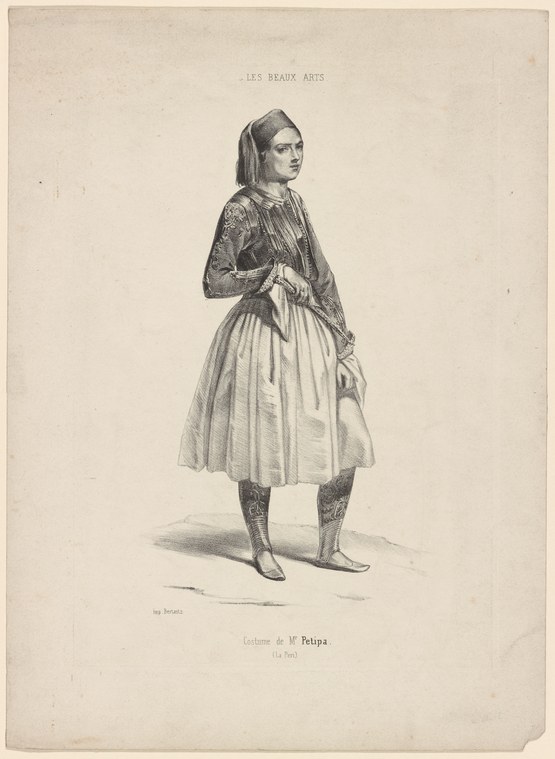
Costume de Mr. Petipa (La péri)
Unknown artist
- Collection:
- Prints depicting dance
- Source:
- New York Public Library
- Rights:
- Public domain — free to use, share and adapt.
- Recorded as:
- Public Domain
Petipa's early career as a performer—before he became the dominant choreographer of Imperial Russian ballet—is less documented than his later achievement, making this record of his own costume in a named role historically valuable. The *La Péri* costume itself is an iconic image of romantic ballet: the image shows how the sylph ideal actually appeared on a mid-19th-century stage, not as later imagination reimagined it.
What you are looking at
A young female dancer stands in three-quarter profile against a plain background, wearing the romantic-era costume of a sylph or supernatural being. Her dress consists of a fitted dark bodice with intricate lace or embroidered patterning on the sleeves and bodice, paired with a voluminous white tulle skirt that falls to mid-calf. A delicate headpiece or veil drapes from her hair, adding to the ethereal quality. Her posture is upright and composed, with one arm gracefully positioned and her weight evenly distributed. The engraving technique creates fine tonal gradations in the fabric, rendering the contrast between the dark corseted torso and the luminous, pleated skirt with considerable sophistication. The figure is centrally placed in an austere composition with no theatrical setting—simply a ground line and neutral space—which emphasizes the costume itself as the subject.
The dancing
A single female dancer is depicted in a standing, neutral position that suggests readiness rather than active movement. Her frame is erect and her shoulders are level, with one arm held in a relaxed position at her side or slightly extended. The other arm appears to hold or adjust the fabric of her skirt. Her legs are straight and her feet are planted firmly, showing no evidence of turnout or pointe work typical of ballet technique. The stillness of the pose suggests a moment of repose or a costume study rather than a captured moment of choreographed action.
The dance depicted
This appears to be a costume plate for Marius Petipa's *La Péri* (The Fairy), a romantic-era ballet that premiered in 1843. The inscription confirms this is Petipa's own costume for the role. The ethereal white tulle skirt, fitted bodice, and delicate headpiece are signature elements of the romantic ballet aesthetic—the sylph costume that defined the genre. However, the static, frontal presentation of the figure suggests this is a costume documentation rather than a choreographic record, showing how the costume appeared to a theater audience rather than demonstrating the movement vocabulary of the role.
How it was made
This is a fine-line engraving, likely steel-engraved, printed from a metal plate. The technique allows precise linear definition of the lace patterning on the bodice and careful tonal modeling of the pleated tulle through fine parallel lines (hatching and cross-hatching). The legibility and finish suggest professional theatrical documentation—this is the kind of illustration that would appear in periodicals or costume books circulating among theater professionals and informed audiences in the mid-19th century. Engraving was the dominant print medium for reproducible theatrical imagery before photography became practical.
About this work
This is a costume plate for Marius Petipa, one of the foundational figures of classical ballet, in the role of the fairy in his own work *La Péri*. It documents the romantic-era sylph aesthetic at the moment of its maturity—the ethereal white tulle, the fitted bodice, the delicate headpiece that marked the supernatural beings who inhabited romantic ballet stages. The work belongs to the tradition of theatrical costume documentation, a practice that preserved the visual appearance of celebrated dancers and roles for circulation beyond the theater. Because Petipa was both the creator of ballets and a performed dancer, this image records an intersection of choreographic and performance history: the originator of the work appearing in it.
How to look at it
Look at the costume as a complete visual system: the way the dark bodice grounds and defines the figure, while the white skirt creates an impression of weightlessness and otherworldliness. The engraver has rendered the tulle with meticulous care, using fine parallel lines to suggest its transparency and volume. Note that the figure is posed in repose rather than in a moment of leap or turn—this is documentation of how the costume appeared when the dancer was still, which is how audiences would have seen it most clearly during performance. The formal, frontal presentation and plain background follow the convention of theatrical costume prints: the emphasis is entirely on the dress and its silhouette, not on the stage picture or narrative context.
The period
Marius Petipa (1818–1910) was a French ballet dancer and choreographer who became the dominant artistic figure of Imperial Russian ballet in the late 19th century. In the 1840s, when this work dates from, he was still an active performer in Western Europe before his eventual migration to Russia. *La Péri*, choreographed to music by Friedrich Burgmüller, premiered in 1843 and was part of the romantic ballet repertory that dominated European stages—works that celebrated supernatural, ethereal female figures (sylphs, odalisques, shades) and the technical and visual possibilities of the developing pointe-work technique. The print tradition of theatrical costume plates flourished during this period, circulating images of celebrated dancers and roles to educated subscribers and theater patrons.
Where it lives
The print is held in the New York Public Library's collection of prints depicting dance. The inscription at the foot identifies this as a costume worn by M. Petipa in *La Péri*.
Dance in this work
Questions about this work
Who was Marius Petipa and why does it matter that this is his costume?
Marius Petipa (1818–1910) was a French dancer and choreographer who created most of the classical ballet repertory performed today, including Swan Lake (Acts I and III) and The Sleeping Beauty. In the 1840s, when this print was made, he was still an active performer in Paris and Western Europe. He later became the ballet master of the Imperial Russian theater. This image is significant because it documents Petipa both as a creator (he choreographed *La Péri*) and as a performer.
What is a sylph and what does the costume tell us?
In romantic-era ballet, sylphs were supernatural, ethereal female spirits—the most famous example is the title character in La Sylphide (1832). The costume in this print—white tulle skirt, fitted bodice, delicate headpiece—is the visual language for representing these beings. The voluminous pleated skirt suggests weightlessness and otherworldliness; the dark bodice defines the torso and makes the skirt appear to float. This costume established the silhouette that ballet audiences came to expect for supernatural characters.
Why is this an engraving rather than a photograph?
This print dates from the 1840s, before photographic printing technology could reliably reproduce detail for mass circulation. Engraving was the standard method for distributing images of celebrated performers and roles to subscribers and patrons. The medium allowed the artist to control the rendering of fine detail—the lace patterning, the translucency of tulle—and to present an idealized, carefully composed image. Theatrical costume plates in this style circulated among theater professionals and educated audiences as a form of documentation.
Is there actual ballet technique visible in this image?
No. The figure is posed in a standing, neutral position rather than in a moment of active choreography. This is a costume plate, not a choreographic study. Its purpose was to document how the costume appeared, not to convey movement vocabulary or technique. If you wanted to see how a role was actually danced, you would need other sources—accounts by observers, later photographs, or reconstructions based on dance notation.
More dance artwork





