49 works in this view — arrow keys or swipe to move between them.
Dance in Art
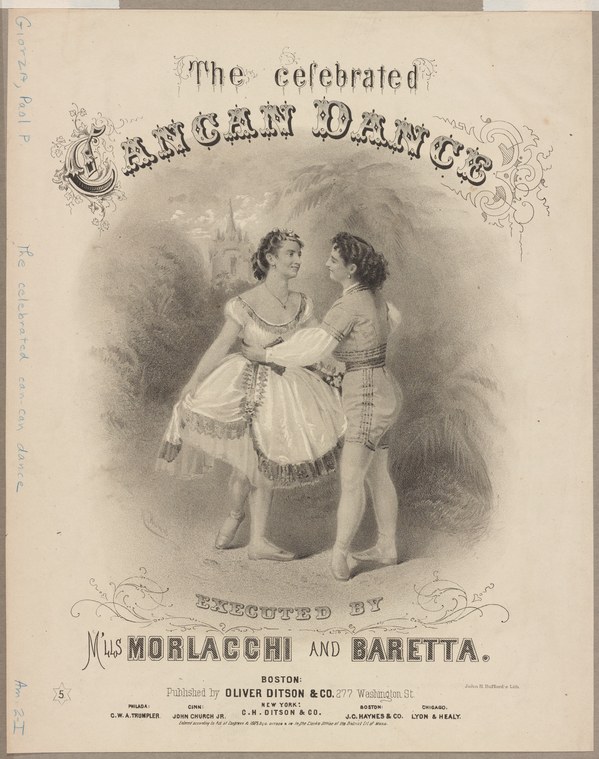
The celebrated cancan dance executed by M'lls Morlacchi and Baretta
Unknown artist
- Collection:
- Prints depicting dance
- Source:
- New York Public Library
- Rights:
- Public domain — free to use, share and adapt.
- Recorded as:
- Public Domain
This image is a primary historical document of the Cancan's ascent from music-hall novelty to mainstream theatrical spectacle. It shows how mid-century performance marketing worked: through idealized lithographic imagery that emphasized elegance and classical reference rather than authentic recreation of movement. The performers' names—Morlacchi and Baretta—are historically significant dancers whose celebrity helped establish the Cancan as a commodity in the transatlantic entertainment market.
What you are looking at
This is a lithographed title page for a mid-19th-century dance performance, rendered in soft greyscale tones. Two female dancers occupy the center of the composition, positioned in an intimate moment of connection against a hazy architectural backdrop dominated by what appears to be a cathedral or church spire. The figure on the left, dressed in a pale classical tunic with decorative trim at the hem and waist, reaches toward her companion with an extended arm in a gesture of entreaty or greeting. The figure on the right, similarly dressed in a light garment with ornamental detailing, turns toward her with arms raised and body angled in response. Both dancers wear their hair up in the fashion of the 1840s–50s. The composition uses atmospheric perspective and soft shading to create depth, with the architecture receding into shadow behind the figures. The title appears in decorative script at top and bottom, with ornamental flourishes framing the dancers. This is a theatrical advertisement and souvenir rather than documentary imagery—a broadside meant to publicize and memorialize a celebrated performance.
The dancing
Both dancers are depicted in classical tutus or short chitons rather than the longer skirts of contemporary fashion, anchoring them in a balletic or antique theatrical idiom. The dancer on the left reaches forward with one arm extended, the other positioned at her side, while the dancer on the right responds with both arms raised and weight shifted onto one leg in a pose suggesting movement or elevation. Their bodies are slender and idealized rather than anatomically emphatic, typical of mid-century lithographic convention. The positioning suggests a moment of meeting or duet interaction, with the dancers turned toward one another in close proximity but not in direct physical contact.
The dance depicted
The title explicitly names this as the Cancan dance, a form that emerged from Parisian popular dance halls in the 1840s and rapidly became a sensation in theatrical contexts. The image, however, presents a highly sanitized and romanticized version: classical dress, architectural grandeur, and graceful emotional register rather than the athletic high-kicking and scandalous physicality for which the Cancan was notorious. This reflects the Cancan's rapid transition from low-class dance-hall entertainment to respectable theatrical spectacle, particularly in the hands of celebrated performers such as Morlacchi and Baretta. The softness of the lithographic rendering and the emphasis on gesture over movement suggests this is selling a performance persona and a cultural moment rather than documenting actual choreography.
How it was made
This is a lithographic print, most likely a hand-colored or tinted lithograph given the subtle modulation of greys and the soft halftone effects. The technique was ideal for theatrical ephemera: fast to produce, relatively inexpensive, and capable of reproducing fine gradations of tone that made the figures appear three-dimensional and romantic. Lithography's ability to render soft, painterly effects suited the aspirations of mid-century theatrical marketing, which aimed to elevate performers and spectacles into the realm of fine art. The print was published by Oliver Ditson & Co. in Boston, New York, and London, indicating distribution across the transatlantic theatrical circuit.
About this work
This is a theatrical broadside advertising a celebrated performance of the Cancan by the dancers Morlacchi and Baretta, likely from the 1840s or early 1850s. The Cancan, born in working-class Parisian dance halls, had by mid-century become fashionable entertainment for middle-class audiences on both sides of the Atlantic. This image captures a crucial cultural moment: the transformation of a disreputable popular dance into theatrical art. The lithographic medium and the classical costume are deliberate strategies of cultural legitimation, presenting the Cancan not as scandalous spectacle but as graceful, romantic performance worthy of fine-art reproduction. The work belongs in a gallery of dance imagery because it documents both a specific historical dance form and the broader process by which popular movement enters theatrical culture and gets repackaged for respectable audiences.
How to look at it
Attend to the tension between the dance's actual content and its representation here. The real Cancan involved aggressive high kicks, exposed legs, and deliberate provocation; this image offers grace, classical costume, and emotional interiority. The soft, romantic lithographic technique reinforces this sanitization—there is nothing sharp or transgressive in the rendering. The architectural setting (a cathedral or grand public building) situates the dancers in a space of cultural prestige. Notice also the moment chosen: not a moment of action or spectacle, but of mutual recognition or entreaty between the two dancers, emphasizing artistic partnership over popular entertainment.
The artist
The artist is not recorded in the catalogue. The work was published by the Boston music publisher Oliver Ditson & Co., which specialized in theatrical music and related promotional materials. The style and production values suggest a professional theatrical lithographer working for a major publishing house, capable of the soft tonal work and figure drawing that gave the image its romantic appeal.
The period
The Cancan emerged around 1840 in the Parisian dance hall culture, characterized by high kicks, rapid footwork, and a reputation for indecency that made it shocking to respectable society. By the late 1840s, theatrical entrepreneurs had begun importing the dance into proper theater, where it was performed in costumes and contexts that emphasized spectacle and novelty rather than authentic popular form. The Romantic ballet tradition, which privileged ethereal, classical-looking female dancers in tutus, provided the visual language for this domestication. Mid-century lithography was the dominant medium for theatrical advertising and souvenir production, enabling the rapid circulation of performers' images across the transatlantic market.
Where it lives
This print is held in the New York Public Library's collection of prints depicting dance. The catalogue identifies it as a theatrical broadside or promotional lithograph, the type of object produced in large quantities for distribution to audiences and customers of music and theatrical goods.
Dance in this work
Questions about this work
What is the Cancan and why was it shocking?
The Cancan originated in working-class Parisian dance halls in the 1840s as a fast, energetic social dance featuring high kicks that revealed the dancers' legs—scandalous at a time when women were expected to keep their limbs covered. It became associated with disreputable venues and was condemned by respectable society. However, theatrical entrepreneurs quickly saw its commercial potential and began presenting it on legitimate stages in modified, costumed forms.
Why does this image look so different from what the Cancan actually was?
This is a marketing image designed to make the Cancan respectable and appealing to middle-class theatergoers. The classical tutus, emotional gesture, refined architectural setting, and soft romantic lithographic style all work to elevate the dance into the realm of fine art and high culture. It is selling a performance and a persona, not documenting actual movement or the dance's popular origins.
Who were Morlacchi and Baretta?
Morlacchi and Baretta were celebrated theatrical dancers of the mid-19th century whose names on a broadside would have attracted audiences. Their celebrity helped establish the Cancan as mainstream entertainment. Beyond these names and their association with this performance, little is recorded in standard historical sources, but their prominence on the title page indicates they were significant performers in the transatlantic theatrical circuit.
What is a lithograph and why was it used for this image?
A lithograph is a print made by drawing on a stone or metal plate with a grease-based medium and then treating the surface so that ink adheres to the drawn areas and repels from blank areas. Lithography was the dominant theatrical marketing medium of the 19th century because it was fast, affordable, and capable of reproducing soft tonal effects that made performers look elegant and three-dimensional. It was perfect for circulating images of stars across multiple cities and countries.
More dance artwork





