49 works in this view — arrow keys or swipe to move between them.
Dance in Art
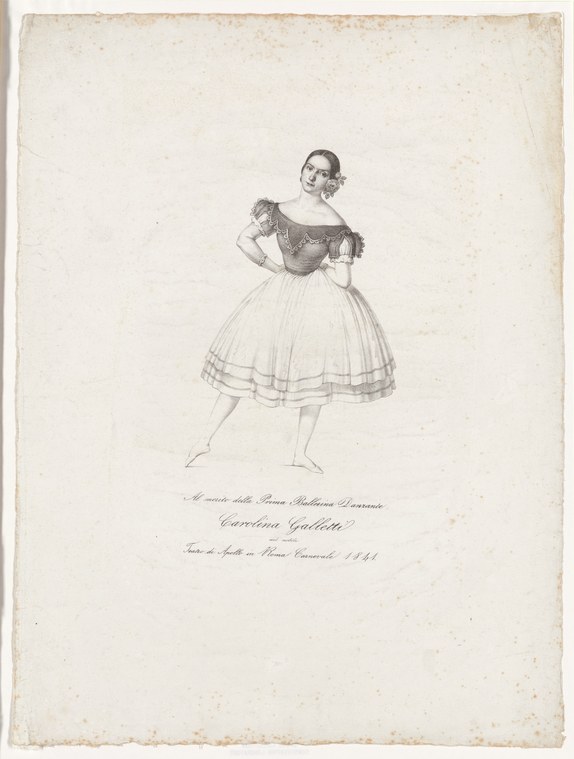
Al merito della prima ballerina danzante Carolina Galletti, Teatro di Apollo in Roma, carnevale 1841
Unknown artist
- Collection:
- Prints depicting dance
- Source:
- New York Public Library
- Rights:
- Public domain — free to use, share and adapt.
- Recorded as:
- Public Domain
This print documents a professional ballet dancer and her engagement at a specific Italian theater during the Romantic ballet era, providing concrete evidence of who performed where and when. It also shows how dancers were marketed and remembered—through formal portraiture that emphasized their status as celebrated public figures, not just through descriptions of their roles or performances.
What you are looking at
A single female dancer is depicted in a three-quarter stance against a plain background, shown from approximately mid-thigh upward. She wears a dark, off-shoulder bodice with short puffed sleeves and a voluminous white skirt with three horizontal bands or flounces near the hem—a silhouette characteristic of 1840s Romantic ballet. Her posture is upright but relaxed, with one arm resting at her side and the other bent naturally. Her gaze is directed upward and to the side, suggesting an inward, ethereal quality. The drawing technique is precise and delicate: fine linear work in the figure contrasts with the plain cream ground, typical of reproductive engravings of the period. The inscription below identifies this as a commemorative portrait of the dancer Carolina Galletti, documented to the Apollo Theatre in Rome during carnival 1841.
The dancing
The dancer stands in a neutral, weight-bearing position with both feet approximately hip-width apart; the right leg appears to carry more weight. Her posture is upright and dignified but not rigidly formal—the body is relaxed rather than held in a extreme turnout or tension. The arms are positioned naturally at the sides and waist rather than in an extreme port de bras or lifted frame. There is no visible turnout at the feet or hyperextension of the legs. The overall presentation reads as a portrait pose rather than a captured moment of vigorous movement.
The dance depicted
This is a commemorative print of a professional ballerina, Carolina Galletti, documenting her engagement at the Teatro Apollo in Rome during the 1841 carnival season. The dress, bearing three horizontal flounces and off-shoulder styling, is consistent with Romantic-era ballet costume of the 1840s, the period that saw the rise of ethereal, white-skirted heroines. However, the pose is deliberately still and frontal—this is not a narrative ballet scene but a theatrical portrait meant to publicize and commemorate a dancer's performance. The inscription suggests this was a formal document of a specific professional engagement, typical of how 19th-century opera houses and theaters marketed their principal dancers.
How it was made
This is an engraving, executed in fine line work on paper. The technique employs delicate parallel lines and careful modeling to render the figure's form and drapery, with particular attention to the texture and volume of the skirt. The plain background and linear execution suggest a reproductive print—likely circulated as a souvenir or promotional item by the theater or for sale to the public. Such prints were common vehicles for disseminating images of celebrated dancers across Italy and Europe, cheaper and more portable than paintings and suited to a broad audience.
About this work
This is a commemorative engraved portrait of the professional ballerina Carolina Galletti, documenting her appearance at the Apollo Theatre in Rome during the 1841 carnival season. It captures her in the standard costume of Romantic-era ballet—a dark bodice and white flounced skirt—posed in a dignified but relaxed stance that emphasizes her role as a celebrated performer rather than a dramatic character. The work is a document of mid-19th-century Italian theatrical practice and the international circulation of Romantic ballet, when such engravings served as both souvenirs and advertising for opera houses and their principal dancers.
The print offers a window into how professional ballet dancers were commodified and memorialized in the 1840s. Unlike narrative ballet scenes that captured dramatic action or technical virtuosity, this work presents the dancer as a public persona—named, dated, and located in a specific theater and season. It belongs to a genre of theatrical portraiture that made dancers' faces and forms known to audiences who might see them perform, and to the broader public who never would.
How to look at it
Attend to the deliberate stillness of the pose and the emphasis on the costume and silhouette rather than on movement or technical difficulty. The dancer's gaze is lifted away from the viewer, contributing to the ethereal, inward quality central to Romantic ballet aesthetics. The engraver has lavished detail on the skirt—its volume, the precision of the flounces, the delicate folds—because the tutu was the visual signature of the Romantic ballerina. The frontal, portrait-like composition and the formal inscription below signal that this is a document of a professional engagement, not an illustration of a specific ballet, and its value lay in recording who performed where for posterity.
The artist
The artist is not recorded. The engraving is executed in a competent but formulaic style consistent with mid-19th-century theatrical reproductive prints produced across Italian publishing centers. Such commemorative works were often created by anonymous or lesser-known engravers working for theaters or printing houses, with the identity of the dancer—not the artist—serving as the primary claim to public interest.
The period
The 1840s were the height of the Romantic ballet era in Europe, when white tutus, supernatural heroines, and ethereal aesthetics dominated the stage from Paris to Milan to Rome. Romantic ballet emphasized the dancer's body as weightless and otherworldly, a quality reflected in the costume depicted here. Italy, though less dominant than Paris in ballet innovation, maintained a vigorous operatic and theatrical culture, and imported or adapted the latest Romantic fashions. The carnival season in Rome was a major theatrical event, and theaters competed for celebrated dancers from across Europe. This print is part of the apparatus by which such performances were advertised and remembered—a form of theatrical ephemera that also served as a collectible souvenir.
Where it lives
This work is held in the New York Public Library's collection of prints depicting dance. It is a reproductive engraving, likely produced in Italy in 1841 or shortly thereafter, and circulated as a souvenir or commemorative item associated with the Apollo Theatre's carnival season.
Dance in this work
Questions about this work
Was Carolina Galletti a famous dancer?
The historical record on Galletti is thin—this print is one of the primary documents we have of her career. Her engagement at the Apollo Theatre in Rome during 1841 is documented here, and her presence as a 'prima ballerina danzante' (principal dancing ballerina) indicates professional status and recognition, but she did not achieve the international fame of contemporaries like Marie Taglioni. She represents the many skilled, celebrated professional dancers whose work was documented through such prints but whose careers have been largely forgotten.
Why does the costume look so different from modern ballet tutus?
This is a Romantic-era tutu from the 1840s: white, voluminous, and ending well below the knee, with visible horizontal flounces or tiers. Modern classical tutus are much shorter, stiffer, and flatter. The Romantic tutu was designed to emphasize weightlessness and to flow and flutter in movement; it was also more practical for dancing in heeled, soft ballet slippers rather than pointe shoes (which did not become standard until later in the 19th century).
Was this print used to advertise Galletti's performances?
Almost certainly. Such engravings were produced by theaters and printing houses as promotional materials and souvenirs. They were sold to the public, distributed to other theaters and newspapers, and served as both advertisement and collectible record of celebrated performers. In an era before photography became common, they were the primary way a dancer's image circulated beyond the cities where she performed.
What does 'carnevale' mean in this context?
The carnival season (carnevale) was the theatrical high season in Italian cities, particularly in Rome. It ran from late autumn through early spring and was a time of celebrations, masked balls, and intense operatic and theatrical performances. Major theaters booked their most celebrated dancers and singers for the carnival season, making it a crucial time for professional dancers' careers and earnings.
More dance artwork





