49 works in this view — arrow keys or swipe to move between them.
Dance in Art
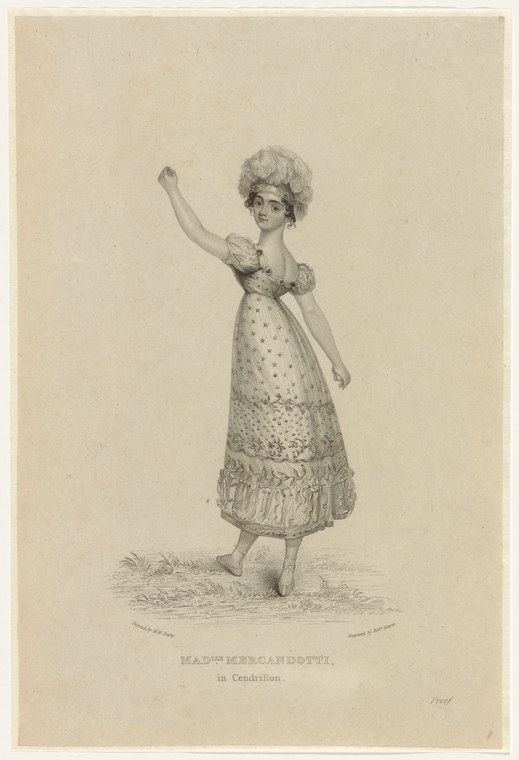
Mad'lle Mercandotti in Cendrillon
Unknown artist
- Collection:
- Prints depicting dance
- Source:
- New York Public Library
- Rights:
- Public domain — free to use, share and adapt.
- Recorded as:
- Public Domain
For dancers and historians, this print is a rare direct visual record of how a professional Romantic ballet performer actually moved and was dressed—not a later imagination or a body idealized in retrospect, but a contemporary document of actual stage practice. It captures the moment when ballet shifted from court spectacle to commercial theater and when female dancers became celebrities whose images were mass-produced and consumed.
What you are looking at
A young woman stands in an elegant contrapposto pose against a plain background, her body angled to suggest graceful movement. She wears a high-waisted Regency-era gown in a dotted or patterned fabric, with puffed shoulders and a gathered hem decorated with a ruched border at the knee. Her hair is styled in the Regency fashion—voluminous and pinned atop her head. Her left arm is raised and extended with a curved, expressive gesture; her right arm hangs at her side. She wears dancing slippers. The figure is rendered as an engraved print, with delicate line work and subtle shading that captures the translucence of fabric and the play of light on her form. A thin line suggests the floor beneath her feet.
The dancing
A single female dancer, weightless and posed rather than captured mid-step. Her raised left arm flows upward in an elegant arc, the hand relaxed; her torso is lifted and turned slightly, opening the right side of her body toward the viewer. Her legs are nearly straight, with no weight clearly committed to either foot—the posture is one of suspension and grace rather than active propulsion. The arm position and open chest suggest a moment of lyrical extension, typical of early 19th-century theatrical vocabulary.
The dance depicted
This is a portrait of a professional dancer, Mad'lle Mercandotti, in a costume from Cendrillon (Cinderella). The print documents her performance in what was most likely a Romantic-era ballet, probably the 1822 Jean-Louis Aumer production that premiered at the Paris Opéra, or a later revival. The costume—the high-waisted empire silhouette, puffed sleeves, and dancing slippers—places her squarely in theatrical ballet of the 1820s–1830s. The pose itself shows the aesthetic of Romantic ballet: verticality, elongation, and a studied grace that suggests noble birth and ethereal lightness rather than technical pyrotechnics. The raised arm and open posture are characteristic of the épaulement (arm styling) valued in classical ballet vocabulary of this period.
How it was made
This is a hand-colored or tinted engraving, a reproductive print made from a steel or copper plate. The delicate parallel lines and hatching visible in the background, and the precision of the dress details, are characteristic of professional theatrical portraiture of the Regency and early Romantic periods. Engraved prints like this were the primary means of circulating images of celebrated performers to a broad public—they were affordable, reproducible, and could be hand-tinted to approximate the colors of the original costume. The technique allowed for fine detail in facial features and fabric textures, making these prints valuable documents of how dancers and their costumes actually appeared on stage.
About this work
This is an engraved theatrical portrait of a professional dancer in her role as Cinderella, created during the early Romantic ballet era when Cinderella stories were a major vehicle for virtuoso female dancers. The print preserves both the costume and the aesthetic ideal of the period: a young woman in an elegant, high-waisted gown, posed to convey grace, elevation, and a kind of noble melancholy. Mercandotti was one of many solo dancers celebrated in this era through such prints, which served as both souvenirs for audience members and marketing tools for the theaters. The work sits at the intersection of fashion history, performance documentation, and the visual culture of early 19th-century theater.
How to look at it
Look first at the raised arm and the arch of the back: this is not a natural stance but a learned vocabulary of grace. The artist has chosen a moment of stillness and suspension, not active dancing—a pose that could be held and studied. The costume detail is equally important: the high waistline, the puffed sleeves, and the shortened hem are all specific to this period and this story, designed to convey both elegance and a kind of romantic innocence. Notice how the print captures the translucence of the fabric through line work alone—a technical achievement that shows how skillfully the engraver understood both cloth and the female form.
The artist
The artist is not recorded in the catalogue. However, the print bears a publisher's mark and typical professional engraver's signature (partially legible on the plate). Theatrical portraiture of this kind was a specialized commercial practice in early 19th-century Paris; prints were produced rapidly by engravers working from sketches made in the theater or from costume designs, often in collaboration with hand-colorists. The style and finish suggest a professional atelier producing work for the print market.
The period
Cendrillon was one of the great successes of early Romantic ballet. The most celebrated version was Jean-Louis Aumer's 1822 production at the Paris Opéra, with music by Fernando Sor. The 1830s saw multiple versions and tours across Europe. This was the era when the female dancer became the primary vehicle for ballet spectacle—pointe work was still emerging, but the aesthetic emphasized elongation, weightlessness, and a turn from classical formality toward emotional expression and narrative. Theatrical prints like this were essential to the star system: dancers became celebrities whose likenesses sold in print shops, and the public could own a memento of a celebrated performance or a keepsake of a favorite artist.
Where it lives
The print is held in the New York Public Library's collection of prints depicting dance. It is one of thousands of such theatrical portraits produced in the early 19th century, many now scattered across public collections in Europe and North America. The NYPL's holding reflects the library's role as a comprehensive archive of performance history and visual culture.
Dance in this work
Questions about this work
Who was Mad'lle Mercandotti?
She was a professional ballerina active in the early 19th century, celebrated enough to have her image circulated in print. Beyond that, little is documented in standard ballet histories—a reminder that many dancers of the era are now known to us only through such prints and passing references in reviews.
How do I know this is from a ballet and not just a fashionable woman in a pretty dress?
The dancing slippers and the title inscription on the print are the key evidence. The pose—the raised arm, the arch of the back, the lightness of the stance—also signals trained movement rather than portraiture of an aristocratic sitter. The costume, while fashionable, is decorated and styled specifically for stage effect.
Why is she posed like that instead of actually dancing?
Engraved theatrical portraits typically show the dancer in a key or characteristic pose rather than mid-step. This allowed the engraver to capture fine detail, the face clearly visible, and the full costume on display. The pose was also meant to be iconic—to represent the dancer's identity and artistry in a single, studiable image.
What was the original Cendrillon ballet like?
The 1822 Aumer production was a full-length story ballet in three acts, with music by Fernando Sor. It combined mime, ensemble work, and solo divertissements—an early example of the full-length narrative ballet that would dominate the 19th century. Later versions, including Petipa's, elaborated the technical demands on the ballerina.
More dance artwork





