49 works in this view — arrow keys or swipe to move between them.
Dance in Art
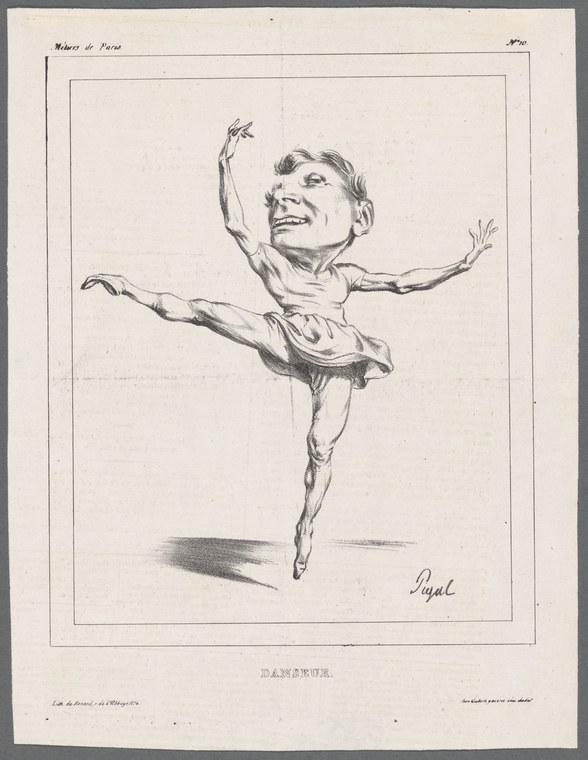
Danseur
Unknown artist
- Collection:
- Prints depicting dance
- Source:
- New York Public Library
- Rights:
- Public domain — free to use, share and adapt.
- Recorded as:
- Public Domain
The print documents male ballet technique and theatrical presentation at a moment when virtuosic elevation and expressive, character-driven dancing defined the male dancer's role. For historians, it is evidence of how balletic movement was visualized, marketed, and consumed by theatrical audiences, and of the caricatural conventions that shaped public understanding of dance.
What you are looking at
A single male dancer is captured mid-leap in a virtuosic moment of suspension. He wears a short tunic or shirt and fitted breeches or tights, his legs extended in a dynamic split-leap or grand jeté-like position, one leg forward and one back. His arms are raised expressively, one higher than the other, his head tilted back with an exuberant expression. The figure is rendered in pen and ink with loose, confident linework that suggests movement and energy. A simple shadow beneath the dancer grounds the figure on the page. The work is framed by a simple double-line border, characteristic of prints from the 18th or early 19th century. The composition is spare and focused entirely on the dancer's body and the moment of flight.
The dancing
A single male dancer, drawn with anatomical understanding but in a caricatural or exaggerated style. The body is elongated and limbs are extended to their limit—a wide split leap with one leg forward and extended, the supporting leg lifted behind. Both arms are raised and splayed, the torso twisted upward, the face animated. The pose suggests virtuosic elevation and a moment of apparent weightlessness, the kind of balletic or theatrical male solo that displays strength and agility.
The dance depicted
This depicts a male theatrical dancer in the Romantic or early 19th-century balletic tradition. The leap, the elevation, the expressive port de bras, and the exuberant facial expression are characteristic of the demi-caractère or male ballet soloist of that era. The garment—a short tunic—is consistent with male ballet costume of the period, though the style could also represent danseur or pantomime roles in theatre. The emphasis on height, extension, and theatrical presence suggests a professional dancer of considerable skill, likely from a court or commercial theatre setting.
How it was made
This is an engraving or etching, rendered in black ink on paper with a signature or mark visible in the lower right. The technique employs loose, gestural linework rather than close cross-hatching, suggesting speed and liveliness. The boundary lines and compositional simplicity indicate a print designed for circulation and reproduction, likely from a series or portfolio documenting theatrical performers or dance types. The engraved medium made such images affordable and widely distributable to audiences interested in theatre and dance.
About this work
This is a portrait of a male ballet dancer in mid-leap, likely from the early 19th century, rendered as an engraving for wide circulation. The work documents the virtuosity and showmanship of professional male dancers during the Romantic era, when male soloists were celebrated as technical and dramatic performers. The exaggerated pose and animated expression are characteristic of how dancers were caricatured and idealized in popular theatrical prints, capturing both the physicality of the leap and the performer's persona.
The image sits within a tradition of theatrical ephemera and performer portraiture that flourished in the 18th and 19th centuries. Dance prints were collected by theatergoers and served both as souvenirs and as records of celebrated dancers and roles. This work preserves a moment of theatrical convention and male balletic style from an era when the danseur was a central attraction of the stage.
How to look at it
Observe the moment the artist chose: not a posed static position but a climactic leap, captured in full extension. The exaggeration of the body—the elongated limbs, the wide split, the lifted torso—is deliberate and serves both to display the dancer's facility and to make the print visually striking and legible at small scale. The animated face and raised arms emphasize the theatrical excitement of the moment rather than classical restraint, a convention of Romantic-era dance portraiture.
The artist
The artist is not recorded in the catalogue. The signature in the lower right may be legible on the original, but the attribution remains uncertain. The style—confident but economical linework, theatrical subject matter, and print format—is consistent with early 19th-century theatrical engravers working for Paris or European theater markets.
The period
The Romantic era (roughly 1820–1850) elevated the female dancer to primacy in ballet, but male dancers remained essential to the spectacle. Male soloists performed virtuosic variations, pantomime roles, and character parts that showcased technical feats and dramatic presence. Theatrical prints proliferated during this period as consumer goods, capturing performers in celebrated roles or signature poses. The loose, energetic line of this engraving is typical of quickly produced commercial theatrical portraiture from this era.
Where it lives
The work is held in the Prints collection of the New York Public Library and is part of a larger series or portfolio of dance and theatrical prints. It is catalogued as a loose print rather than a bound volume, suggesting it may have circulated individually as a souvenir or collector's item.
Dance in this work
Questions about this work
Is this a famous dancer?
The catalogue does not identify the subject. The signature on the print may name the performer, but it is not legible in the reproduction. Comparison with other theatrical prints from the same era and workshop might reveal the dancer's identity, but without further research this remains unknown.
What style of dance is this?
This is a theatrical male dancer of the Romantic era, performing in the idiom of ballet or pantomime. The leap, extension, costume, and animated expression are consistent with the demi-caractère or soloist roles central to early 19th-century stage dancing.
Why is the figure drawn in such an exaggerated way?
Theatrical prints of this era often exaggerated the body to emphasize virtuosity and to make the image more visually dramatic and legible at small scale. The elongation and the wide leap are both a record of balletic technique and a stylistic convention of how dancers were marketed to audiences.
Who made this print?
The artist is not identified in the catalogue record. The signature visible in the lower right may provide the name on the original, but it has not been transcribed in the available documentation.
More dance artwork





