49 works in this view — arrow keys or swipe to move between them.
Dance in Art
La Périchole
Unknown artist
- Collection:
- Prints depicting dance
- Source:
- New York Public Library
- Rights:
- Public domain — free to use, share and adapt.
- Recorded as:
- Public Domain
This engraving documents the visual culture of 19th-century popular musical theatre at a moment when opera comique was one of the most widely consumed and influential forms of stage performance in Europe. It shows how theatrical bodies were arranged and understood in comic drama—the physical grammar of performance that lay behind music and text. For dance historians, it is evidence of the broader theatrical movement vocabulary beyond ballet and concert dance that shaped how performers used their bodies in public entertainment.
What you are looking at
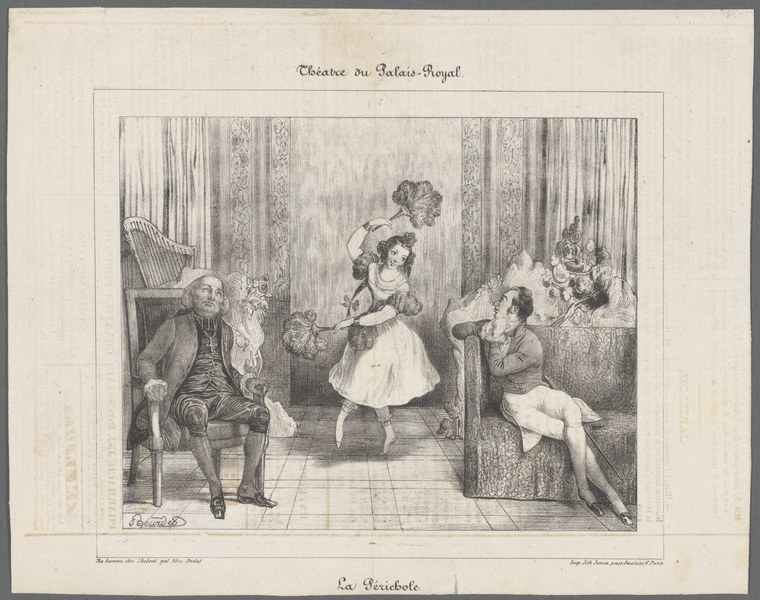
This engraving depicts a theatrical interior scene, likely from a comic opera or operetta. A central female figure in a high-waisted white Empire-silhouette dress with puffed sleeves stands in the middle of an ornate room with tall curtained windows and classical wall panels. She is surrounded by four male figures in period dress—one seated left in dark coat and breeches, two reclining on furniture to the right in similar attire, and a fourth figure partially visible. The woman's posture and the men's varied positions suggest a moment of comic interaction or seduction, with the men in attitudes of attention or repose. The scene is rendered in fine detail with careful attention to textile patterns, drapery, and the architectural setting that suggests wealth and aristocratic life.
The dancing
The central woman stands with her weight forward, her body angled slightly, with arms gesturing in what appears to be an animated conversational or performative manner. Her companions are positioned in contrasting attitudes of leisure and attention—one slouched in a chair, others reclining—creating a theatrical tableau of social interaction rather than synchronized dance movement. The asymmetrical positioning and varied body orientations suggest a moment of dramatic comedy rather than formal choreography. The woman's elevated stance and the men's subordinate positions create a visual hierarchy typical of comic theatrical staging.
The dance depicted
This does not depict ballroom dancing or concert dance in the conventional sense. The scene is theatrical and likely illustrates a moment from *La Périchole*, the opéra comique by Jacques Offenbach (1868), which tells the story of a street singer who becomes a viceroy's mistress in 18th-century Peru. The image captures a dramatic or comedic moment of social or romantic interaction typical of the genre—theatrical gesture and movement for comic or dramatic effect rather than structured dance. The engraving documents the visual vocabulary of popular musical theatre rather than virtuosic dance.
How it was made
This is an engraving, identifiable by its fine linear hatching, precision line-work, and monochromatic execution. The technique allowed for wide circulation in newspapers, journals, and playbills—this was a primary means of advertising theatrical productions and documenting them for audiences who could not attend performances. The quality of engraving suggests professional theatrical documentation, likely French, from the mid-to-late 19th century when such images were part of the marketing and cultural record of popular musical theatre.
About this work
This engraving records a moment from a major work of popular theatrical entertainment—Offenbach's *La Périchole*. It documents not concert dance but the theatrical movement vocabulary of opéra comique, a genre that blended song, comedy, and physical comedy in ways that shaped how bodies moved on stage in the second half of the 19th century. The image shows the conventions of comic theatrical staging: exaggerated posture, asymmetrical grouping, and the visual comedy of relative positions and attitudes. For dancers and historians, it is evidence of how theatrical movement in musical comedy was understood and presented to the public through mass-produced imagery.
How to look at it
Observe the deliberate asymmetry and the varied body attitudes—this is theatrical composition for comedy and drama, not the symmetry of classical dance. Notice how the woman's forward-leaning posture and gesture contrast with the men's relaxed or recumbent positions, creating a visual joke about power and attention. The setting itself is part of the comedy: the formal neoclassical interior frames the disorderly social moment. This is what stage comedy looked like in 19th-century musical theatre—physical relationships and exaggerated attitudes that conveyed narrative and emotion without virtuosic movement.
The artist
The engraving is unsigned in the visible portion of the image. The style and quality suggest a professional theatrical engraver working for the Parisian theatrical press, likely during or shortly after the premiere of *La Périchole* in 1868. Such engravings were produced rapidly and in quantity for distribution through playbills, theatrical newspapers, and magazines—they represent the work of skilled but often anonymous artisans serving the entertainment industry.
The period
This engraving dates to the reign of *La Périchole* in popular culture, from its 1868 premiere through the end of the 19th century. Offenbach's opéra comique works dominated European stages and influenced theatrical practice across forms. In visual culture, engravings like this one were the primary means by which theatrical moments reached the public; photography existed but theatrical illustration remained dominant for dramatic documentation. The image reflects the mid-Victorian taste for comic opera and the cultural practice of circulating images of theatrical celebrities and memorable scenes through print media.
Where it lives
The print is held in the New York Public Library's collection of prints depicting dance. It originated as part of the mass-produced theatrical imagery that circulated through Paris and beyond in the late 19th century, documenting both the works themselves and the stars who performed in them.
Dance in this work
Questions about this work
Is this actual dance or just theatrical acting?
It is theatrical acting in the context of opéra comique. While the genre included danced passages, this engraving captures a comedic dramatic moment rather than a dance number. However, it is important to the history of movement on stage because opéra comique was a major form of theatrical entertainment that influenced how bodies moved, gestured, and interacted in 19th-century performance.
What is La Périchole?
La Périchole is an opéra comique by Jacques Offenbach, premiered in 1868. It tells the story of a street singer in 18th-century Peru who becomes the mistress of the Viceroy. The work was enormously popular across Europe and established conventions of comic musical theatre that lasted well into the 20th century.
Why is this engraving important for dance history?
It documents how theatrical bodies moved and were arranged in one of the most influential popular theatrical forms of the 19th century. It shows the visual grammar of comic staging—posture, relative positioning, and attitude—that shaped performance practice across musical theatre, influencing dancers and actors who worked in these genres.
More dance artwork





