49 works in this view — arrow keys or swipe to move between them.
Dance in Art
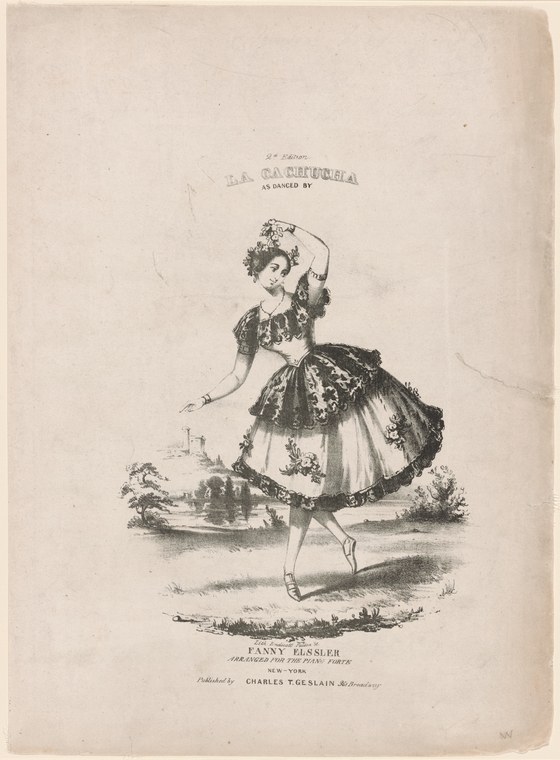
La cachucha as danced by Fanny Elssler.: Arranged for the piano forte
Unknown artist
- Collection:
- Prints depicting dance
- Source:
- New York Public Library
- Rights:
- Public domain — free to use, share and adapt.
- Recorded as:
- Public Domain
Fanny Elssler's Cachucha is one of the most historically significant performances of the Romantic era, and this engraving is a direct record of how it was staged and promoted. The image reveals the hybrid technique Elssler developed—neither pure Spanish folk dance nor classical ballet, but a synthesis that influenced how European and American dancers approached character work for decades. Understanding what Romantic audiences actually saw—not what romantic ballet historians later imagined—depends on prints like this.
What you are looking at
A solitary female dancer in Romantic-era theatrical dress dominates the composition, positioned center-stage against a minimal backdrop of sketched landscape. She wears a white tulle skirt with dark patterned panels or embroidery, a dark fitted bodice with short puffed sleeves, and an elaborate headdress with feathers or ornaments. Her pose is suspended mid-movement, weight on one leg with the other extended, arms positioned with balletic control—one raised, one lowered. The engraving's fine linework creates a sense of lightness and ethereal quality typical of mid-nineteenth-century dance imagery. The figure is surrounded by decorative cartouches at top and bottom containing the work's title and publication details, framing her as the subject of a musical arrangement rather than a narrative scene.
The dancing
The dancer stands in a clearly trained balletic posture: one supporting leg straight and turned out, the other extended behind or to the side in a lifted attitude. Her upper body is upright but animated, with arms in a soft, controlled frame—neither the rigid geometry of neo-classical ballet nor the limp romanticism of some contemporary styles, but something in between. The apparent lightness of the pose, the lifted quality, and the turned-out leg positions indicate someone trained in the rigorous technique of ballet as performed in the 1830s–1840s. There is no partner; the dance is a solo.
The dance depicted
This is a printed music cover for a piano arrangement of the Cachucha, a Spanish folk dance that became one of the defining showpieces of the Romantic ballet era. The image celebrates Fanny Elssler, the Austrian dancer who made the Cachucha famous across Europe and America between 1836 and the 1850s. Though the Cachucha originated as a regional Spanish dance with hip and footwork articulation, Elssler's theatrical version absorbed balletic technique while retaining Spanish character and energy. The print documents what was performed on stage, not the folk form itself: a hybrid work in which a trained ballet dancer adopted elements of national character dance. The engraving's date is unknown, but the style and Elssler's prominence place it in the late 1830s or 1840s.
How it was made
This is a steel engraving, a technique that allowed fine detail and wide circulation at moderate cost. The precision of the linework—visible in the feathering of the headdress, the shading of the skirt's patterned panels, and the delicate rendering of the arms—is characteristic of the best commercial dance prints of the period. The publication by Charles d'Almaine, a London music publisher, indicates this was marketed to amateur pianists and music enthusiasts, not primarily to theater-goers. The combination of a dance image with a musical score made such prints both collectible and functional; a buyer could hang the image and play the music.
About this work
This is a music-cover engraving documenting one of the most celebrated dances of the Romantic era: Fanny Elssler's Cachucha, a Spanish-character dance that became a signature role in her international career. The image shows the dancer mid-performance in her theatrical costume, captured in a moment of balletic control that betrays the formal training underlying what was marketed as a folk dance. The engraving is both a souvenir of Elssler's fame and a practical object—the printed music below the image suggests this was sold to pianists who wanted to recreate the dance's accompaniment for drawing-room performance or study. It stands as evidence of how nineteenth-century dancers and audiences blurred the line between ballet technique and character dance, and how imagery circulated through commercial music publishing.
How to look at it
Notice the precision of the pose—this is not a snapshot of motion but a composed, held moment designed to be both balletically correct and visually striking. The engraver has chosen an attitude or extended leg position that displays the dancer's training while maintaining the illusion of spontaneous performance. The elaborate costume, with its patterned skirt and ornate headdress, is historically accurate to mid-1830s theatrical dress; these details were as important to the audience as the technique. The cartouche format—the formal title and publication information framing the figure—emphasizes that this is an official, authorized image of a famous person, not a genre scene.
The artist
The engraver is not recorded. The work was published by Charles d'Almaine, a London music publisher active in the 1830s–1850s, who specialized in dance music and theatrical arrangements. Prints by d'Almaine were distributed internationally and are now held in major collections including the New York Public Library. The unnamed engraver was one of many commercial artists producing dance imagery in this period, working in the tradition of theatrical portraiture and ballet documentation.
The period
The 1830s–1840s were the height of the Romantic ballet era, when dancers like Marie Taglioni and Fanny Elssler became international celebrities. Elssler's fame was built partly on her rival differentiation from Taglioni: where Taglioni was ethereal and otherworldly, Elssler was earthy, spirited, and connected to folk and national dance traditions. The Cachucha epitomized this persona. In the same period, character dances drawn from Spanish, Italian, and Eastern European sources were becoming core to ballet technique and training. Printed dance images and music arrangements proliferated as middle-class drawing rooms became sites of amateur performance, and theatrical dancers became commercial brands marketed through prints, music, and lithographs.
Where it lives
This work is held in the New York Public Library's collection of prints depicting dance. It is a commercially published music cover from the London printer Charles d'Almaine, suggesting it was distributed to piano teachers, students, and music collectors throughout the English-speaking world.
Dance in this work
Questions about this work
Did Fanny Elssler really dance the Cachucha, or is this theatrical invention?
Elssler did perform the Cachucha extensively, and it became her signature role. But the version she danced was not an authentic Spanish folk tradition; it was a theatrical adaptation created for the ballet stage, incorporating Spanish elements and rhythms with fully trained ballet technique. Contemporary accounts describe it as energetic, flirtatious, and technically brilliant—a character dance in the balletic sense, not a folk performance.
Why was a Spanish dance so popular in European ballet?
In the Romantic era, national and regional dances were fashionable as subjects for ballet. They offered a way for trained dancers to perform roles with character and local color while maintaining technical display. Spain in particular had romantic appeal in the nineteenth-century European imagination—passion, drama, exoticism. Elssler's Cachucha capitalized on all of this.
What is this engraving actually used for?
It served multiple purposes: as a souvenir or portrait of a famous dancer, as a cover for a published piano arrangement that amateurs could buy and learn, and as promotional material for both Elssler and d'Almaine's music publishing business. Theater-goers could take home both the image and the music, extending Elssler's fame into the domestic sphere.
How is this dance different from the ballet we see today?
The Cachucha existed only in this nineteenth-century form; it is not regularly performed now. But it represents a crucial moment in ballet history when character dances and ethnic/national themes became integrated into the classical repertory. The approach Elssler pioneered—adapting folk forms for the balletic body—remained influential throughout the twentieth century.
More dance artwork





