49 works in this view — arrow keys or swipe to move between them.
Dance in Art
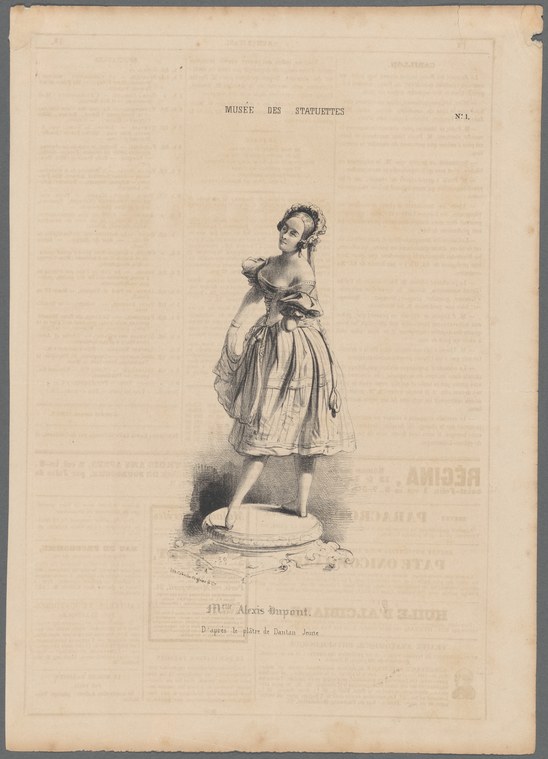
Melle Alexis Dupont, d'après le plâtre de Dantan Jeune
Unknown artist
- Collection:
- Prints depicting dance
- Source:
- New York Public Library
- Rights:
- Public domain — free to use, share and adapt.
- Recorded as:
- Public Domain
This image preserves the appearance and bearing of a professional dancer from the golden age of Romantic ballet and shows how dancers' bodies were studied, sculpted, and circulated as works of art in their own right. It demonstrates the nineteenth-century practice of translating celebrated performers into multiple media, and the value placed on the dancer's trained physique as an object of aesthetic contemplation. For historians of dance, costume, and body culture, it is direct evidence of how early-nineteenth-century ballet dancers dressed, moved, and were remembered.
What you are looking at
A young woman in mid-nineteenth-century dress stands alone against a plain background, captured in a moment of classical dance posture. She wears a white tulle skirt of moderate length, fitted at the waist, with what appears to be a corset or structured bodice, and her shoulders are bare or minimally covered. Her hair is styled up and back, adorned with flowers or a wreath. Her weight rests on one leg while the other is extended or lifted; her arms are held in a graceful, controlled position. The figure stands on a simple round pedestal or base, suggesting this is a sculpture or a sculptural study rather than a spontaneous moment. The image is rendered in fine black-and-white engraving or lithograph, with careful attention to the fall of fabric and the line of the body.
The dancing
A single female figure in a classical contrapposto stance, with elongated limbs and an upright carriage. Her arms are held away from the body in a soft, rounded position characteristic of neoclassical ballet training. The extended leg and the lift of the torso suggest a prepared arabesque or similar ballet position, though the exact step is not fully clarified. The pose emphasises verticality, grace, and the display of the body's line—hallmarks of early-to-mid nineteenth-century ballet pedagogy and aesthetics.
The dance depicted
This is a portrait of a professional ballet dancer, most likely in a classical solo role or in a pose representing the dancer's trained body as an object of artistic study. The style and costume suggest the Romantic ballet era, approximately the 1830s–1850s. The inscription identifies the subject as Melle Alexis Dupont, a known danseuse of that period. The pose is formal and controlled, representing the dancer in classical attire and bearing rather than in the heat of narrative performance, which was a common way to celebrate and memorialize celebrated dancers of the era.
How it was made
This is an engraving or lithographic print, rendered in black and white with fine cross-hatching and careful gradation to create form and shadow. The technique allowed for multiple impressions and wide circulation, making it an accessible way to distribute images of celebrated performers to a curious public. The title indicates the print was made 'd'après le plâtre de Dantan Jeune'—after a plaster model by the sculptor Jean-Pierre Dantan—suggesting this image is a secondary work, translated from a three-dimensional sculptural study into a print medium. This chain of creation (sculpture then engraving) was common practice for popularising images of public figures.
About this work
This is a portrait engraving of a celebrated nineteenth-century ballet dancer, Alexis Dupont, reproduced from a plaster sculpture by the French sculptor Jean-Pierre Dantan. It belongs to a genre of theatrical portraiture that flourished in the Romantic era, when lithography and engraving made it possible to circulate images of admired performers to a wide audience. The print captures the ideal of classical ballet training and beauty as understood in the mid-1800s: a young woman in perfect composure, demonstrating the elongated line, upright carriage, and restrained elegance that defined the art form of her time.
The work is valuable not as a record of a specific choreographed moment, but as a document of how the ballet body itself was celebrated and commodified as a subject of visual art. It sits at the intersection of sculpture, printmaking, performance, and celebrity culture, and represents a moment when dancers—particularly female dancers—were elevated to the status of subjects worthy of fine-art portraiture.
How to look at it
Attend to the precision of the figure's pose: the alignment of the spine, the placement of the head, the control in the arms, and the extension of the leg all communicate a body trained to extreme discipline and grace. The pedestal and formal presentation signal that this is not a moment of narrative action, but a timeless display of the ballet body itself. The engraving technique, with its fine lines and careful shading, emphasises the linearity and verticality that were central to the ballet aesthetic of the era. Note also the costume: the bare shoulders, the tulle skirt, and the style of the hair all anchor the image to a specific time and place in dance history.
The artist
The print is attributed to Jean-Pierre Dantan Jeune (1800–1869), a prolific French sculptor specialising in portrait busts and caricature pieces. Dantan was known for rapid, witty portrait work that captured both the likeness and the character of his subjects. He created numerous studies of celebrated performers and public figures of his era, and his work was frequently reproduced in print form, making him an important figure in the visual documentation of nineteenth-century theatrical culture. The print itself is by an unnamed engraver or lithographer working from Dantan's plaster model.
The period
The 1830s–1850s were the height of the Romantic ballet era, when the art form experienced a surge in popularity and cultural prestige across Europe. This was the age of Marie Taglioni, Fanny Cerrito, and other celebrated female dancers who achieved celebrity status comparable to that of opera singers and theatrical stars. Lithography and engraving became major vehicles for circulating images of these performers to an eager public. Simultaneously, sculpture was establishing itself as a serious medium for theatrical portraiture; the practice of creating portrait busts and figures of celebrated dancers was part of a broader elevation of ballet to the status of high art. Alexis Dupont was a respected danseuse of the period, and her inclusion in Dantan's sculptural practice suggests her prominence in Parisian dance circles.
Where it lives
The print is held in the New York Public Library's collection of prints depicting dance. It is part of the 'Musée des Statettes' series, suggesting it was one of a larger set of prints documenting Dantan's sculptural portraits of celebrated public figures.
Dance in this work
Questions about this work
Who was Alexis Dupont?
Alexis Dupont (also known as Mlle Alexis Dupont) was a French ballet dancer active in the 1830s–1840s, celebrated in Paris and other European dance centres during the height of Romantic ballet. Details of her career are sparse, but her inclusion in Dantan's portraits and the circulation of this print suggest she was a respected and visible performer of her time.
What is a 'plâtre' and why was the print made from it?
A plâtre (plaster) is a sculptural model, often used as an intermediate or final stage in the creation of a larger work or as a collector's piece in its own right. Dantan created plaster portrait busts and figurines of celebrated performers; these were then reproduced as engravings and lithographs, allowing multiple copies to be made and sold to the public. This practice made celebrity portraiture affordable and accessible.
Is this a record of how Dupont actually danced?
Not directly. This is a posed portrait, designed to show Dupont's trained body and classical bearing at rest, not in the midst of choreography. However, the pose—likely an arabesque or similar classical position—does demonstrate the fundamental posture and aesthetic ideal that would have governed her performance. It is evidence of how she trained and how her body was understood as a work of art.
Why were dancers' sculptures and portraits so popular in the nineteenth century?
The rise of Romantic ballet coincided with an explosion in print culture and a new appetite for celebrity portraiture. Dancers, particularly female dancers, had achieved unprecedented fame and social visibility. Their portraits circulated as tokens of admiration, as merchandise, and as documents of the era's beauty standards and performance ideals. Sculpture and engraving gave dancers a permanence and prestige comparable to that of actors and opera singers.
More dance artwork





