49 works in this view — arrow keys or swipe to move between them.
Dance in Art
Fanny Elssler, d'après le plâtre de Barre
Unknown artist
- Collection:
- Prints depicting dance
- Source:
- New York Public Library
- Rights:
- Public domain — free to use, share and adapt.
- Recorded as:
- Public Domain
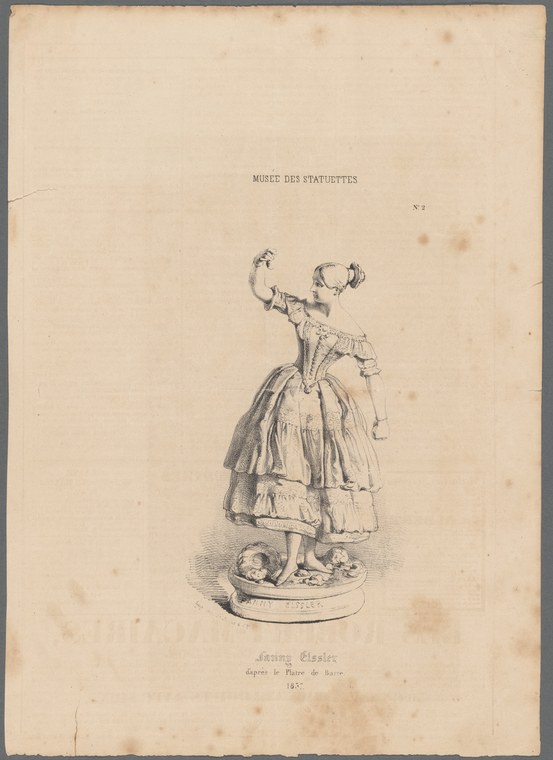
Fanny Elssler was one of the most celebrated dancers of the nineteenth century, and this sculpture is one of several commemorative monuments made in her honor. The work shows how sculptural portraiture was used to immortalize great dancers and elevate their status to that of classical nymphs or muses. The print itself is evidence of the international circulation of dance celebrity in the pre-photographic era, when engravings like this were the primary means of spreading images of famous performers.
What you are looking at
A single female figure stands in a classical contrapposto stance on a shallow circular base, her body turned three-quarters to the viewer's right. She wears a Romantic-era dress with a fitted bodice, short puffed sleeves, and a full skirt that falls to mid-calf—the silhouette characteristic of 1830s–1840s theatrical costume. Her left arm is raised gracefully overhead, the hand extended with fingers articulated, while her right arm hangs naturally at her side. Her head is tilted slightly upward and to the side, with her gaze directed beyond the picture plane, creating a mood of elevation or yearning. The figure stands on what appears to be a plaster or marble sculpture base, rendered in line work, against the plain cream ground of the page. The entire composition reads as a printmaker's record of a three-dimensional sculpture—a portrait statue of a celebrated dancer.
The dancing
The single figure occupies the full height of the composition, standing with her weight shifted slightly onto her back leg in a classical pose. Her raised left arm traces a graceful arc above her head, with the wrist softly curved and fingers extended in the refined hand position typical of Romantic ballet. The lifted gaze and gentle tilt of the head convey a sense of aspiration or transcendence. Her torso is aligned over her hips, and the full skirt falls in soft folds that suggest both weight and movement, though the figure herself is motionless—as befits a sculpture.
The dance depicted
This is a portrait of Fanny Elssler, the Austrian dancer who dominated the Romantic ballet stage from the 1830s onward, recorded here as a sculptural monument by the artist Barre. The work is not a depiction of Elssler in active performance, but a commemorative sculpture—likely one made to honor her at the peak of her fame. The refined upright posture, the Romantic-era tutu, and the elevated arm position all accord with the classical ballet aesthetic of her era, particularly the aesthetic of the French Romantic ballet in which she achieved her greatest renown. The pose itself suggests not a specific choreographic moment but rather an idealized image of the dancer—noble, ethereal, and eternally young.
How it was made
This is a black-and-ink engraving or line print on laid paper, likely a reproductive print made to document Barre's plaster sculpture. The fine parallel hatching and precise linear articulation are characteristic of nineteenth-century reproductive engraving. The title and artist credit are printed in capitals at the top of the sheet, and a small inscription at the bottom identifies the original sculptor as Barre and dates the work to 1837. The process of engraving allowed sculptural works to circulate widely in printed form, making them accessible to audiences who could not visit galleries or studios, and ensuring the sculptor's and subject's fame could spread across Europe.
About this work
This print records a plaster or marble portrait sculpture of Fanny Elssler, the celebrated Romantic-era ballerina, created by the sculptor Barre in 1837 at the height of her international fame. The work is a formal commemorative monument rather than a stage performance image, presenting Elssler in an idealized classical pose that embodies the aesthetic values of Romantic ballet—grace, elevation, and feminine refinement. As a reproductive print, it served to preserve and publicize the sculpture, allowing Elssler's image to circulate among admirers across Europe.
This work belongs in a dance gallery because it documents both the material culture of nineteenth-century dance fame and the visual conventions through which that fame was constructed and celebrated. The sculpture itself is an artwork about a dancer; the print is a second-order work about the sculpture, yet both are evidence of how the dance world honored its greatest stars. Elssler's image, fixed in this noble pose, became part of the visual language through which Romantic ballet was understood and remembered.
How to look at it
The viewer should attend to the pose itself: this is not a dancer mid-movement, but a dancer fixed in an idealized, timeless moment of repose. The raised arm and uplifted gaze suggest aspiration and grace rather than action. The convention at work here is the classical contrapposto pose, borrowed from antique sculpture, which lends Elssler a timeless, mythic quality. The artist has chosen to present her not as a virtuoso performer, but as a refined, noble figure—a muse rather than an athlete. The engraving's linear technique makes the dress's fall of fabric visible, emphasizing the elegance of the silhouette that was so central to Romantic ballet aesthetics.
The artist
The sculptor Barre is identified in the inscription as the creator of the original plaster work (dated 1837). Beyond this attribution, little can be established from the image alone. Barre was likely a Paris-based or European sculptor working in the neoclassical tradition, as the style and idealization of the figure accord with mid-nineteenth-century academic sculptural practice. The print itself may have been engraved by a different hand, as was common practice in reproductive printmaking of the period.
The period
Fanny Elssler's career spanned the height of the Romantic ballet period (1820s–1850s), when the art form was at the center of European cultural life. During this era, celebrated dancers like Elssler and Marie Taglioni became international celebrities, and their likenesses were widely reproduced in prints, sculptures, and paintings. Sculptural monuments to dancers were a relatively new phenomenon, reflecting the elevated social status dance and dancers had achieved. The 1830s–1840s saw an explosion of portraiture of famous performers across all media, and Barre's work is part of this broader cultural moment in which dance was recognized as worthy of serious artistic commemoration.
Where it lives
The print is held in the New York Public Library's collection of prints depicting dance. It is a nineteenth-century reproductive engraving, likely produced in Paris or another European printing center in the years shortly after the sculpture's creation in 1837.
Dance in this work
Questions about this work
Who was Fanny Elssler?
Fanny Elssler (1810–1884) was an Austrian dancer who became one of the most celebrated performers of the Romantic ballet era. She was known for her technical brilliance, dramatic intensity, and charisma. She performed throughout Europe and America, and was a rival and contemporary of Marie Taglioni. She was particularly famous for her Spanish and character dances, as well as for her roles in ballets like La Sylphide and La Tarentule.
What does the inscription '1837' mean?
The date 1837 refers to the year the original plaster sculpture was created by Barre. This print was likely made shortly afterward as a reproductive engraving, to circulate the sculpture's image. The date marks a moment near the height of Elssler's international fame.
Is this a sculpture or a print?
The original work is a sculpture—a plaster or marble bust or full-length figure by Barre. This image shows a print (engraving) made from the sculpture, allowing it to be reproduced and distributed. Prints like this were the primary way sculptural works were circulated to a wide audience before photography.
Why is she posed like this?
The pose uses the classical contrapposto stance borrowed from antique Greek and Roman sculpture. This convention was used to elevate the subject and suggest timeless grace and nobility. Rather than catching her mid-performance, the sculptor presented Elssler in an idealized, contemplative moment—as a muse or nymph rather than as a working dancer.
More dance artwork





