49 works in this view — arrow keys or swipe to move between them.
Dance in Art
Scènes de pantomime anglaise
Unknown artist
- Collection:
- Prints depicting dance
- Source:
- New York Public Library
- Rights:
- Public domain — free to use, share and adapt.
- Recorded as:
- Public Domain
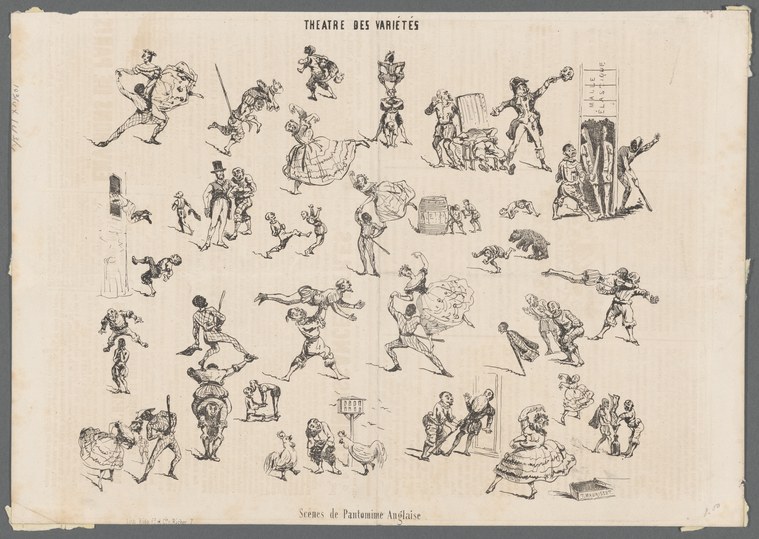
English pantomime was a major theatrical form and a proving ground for physical performance technique, yet it exists in most dance histories as a footnote or absence. This sheet is rare documentary evidence of pantomime's actual movement vocabulary—not described in words but sketched from observation or practice. For historians of popular theater, physical comedy, and the pre-modern circus and music-hall traditions, it offers concrete visual testimony to how pantomime bodies worked.
What you are looking at
A densely populated sheet of roughly fifty sketched figures in various states of comedic action and exaggeration, arranged without systematic order across the cream paper. The figures wear period dress—breeches, doublets, and loose garments suggesting late 18th or early 19th-century costume. Some perform acrobatic feats: a man tumbles through the air with legs splayed, another arches backward in an extreme contortion, a third balances on one hand. Others mime dramatic gestures—clutching at their chests, throwing arms wide, collapsing to the ground in exaggerated distress. Several figures interact in pairs or small groups: two men appear to grapple or wrestle, another pair face off in confrontation. Props scattered throughout include a barrel, a ladder, chairs, and what may be theatrical furnishings. The drawing style is loose and rapid, with heavy ink lines that capture movement and expression through shorthand rather than anatomical precision. No unified stage or setting is suggested; instead, the sheet reads as a collection of character studies and movement notes, possibly assembled as a reference or documentation sheet for performers.
The dancing
The bodies are characterized by extreme exaggeration and distortion: impossibly arched spines, limbs twisted at unnatural angles, heads thrown back in apparent anguish or wild laughter. Many figures lack the controlled frame or balletic posture of formal dance; instead, they adopt the loose-jointed, ungainly physicality of acrobatics, slapstick, and physical comedy. Feet are often splayed or extended awkwardly; arms reach, flail, or dangle without the ordered positioning of a dance vocabulary. The artist captures weight through collapse and momentum rather than balance—figures seem perpetually on the verge of falling or have already surrendered to gravity. The relationships between figures suggest pantomime scenarios: pursuit, confrontation, mutual distress, or collaborative tumbling.
The dance depicted
The title *Scènes de pantomime anglaise* (Scenes of English Pantomime) identifies this as documentation of English pantomime, a form of theatrical comedy that flourished in the 18th and 19th centuries. English pantomime relied on physical comedy, acrobatics, exaggerated gesture, and mime to tell stories with minimal dialogue, distinguishing it from balletic or choreographed dance. The image does not depict a single scene but rather a repertoire of stock characters and movement types—the tumbler, the sufferer, the aggressor, the contortionist—from which pantomime performers would draw. The extreme postures and lack of formal dance technique confirm this is popular theatrical entertainment rather than dance in the academic or ballroom sense, yet the deliberate documentation of physical vocabulary marks it as a serious record of professional performance practice.
How it was made
This is a pen and ink drawing on paper, executed in a rapid, sketching style with minimal shading and no color. The technique prioritizes linear clarity and expressive distortion over anatomical accuracy or tonal modeling, allowing the artist to capture multiple figures and movement variations efficiently on a single sheet. The loose, energetic line work conveys motion and personality through exaggeration rather than detail. This approach suggests the work was either a direct study from performance or a reference sheet compiled for rehearsal or archival purposes. The medium's economy and portability made it ideal for theater documentation in an era before photography.
About this work
This sheet of rapid sketches captures the physical vocabulary of English pantomime, a form of comedic theater performance that dominated stages from the early 18th century onward. English pantomime was built on physical extremity, acrobatic skill, and mime rather than on balletic training or formal dance steps. The artist has documented roughly fifty character poses and movement types—each exaggerated, distorted, and designed for immediate theatrical impact—without narrative or spatial continuity. The work survives as evidence of how pantomime performers moved, what physical states they inhabited, and what kinds of bodies and behaviors audiences expected to see.
The sheet belongs in a dance history collection not because pantomime is formally choreographed dance, but because it represents a major theatrical tradition in which the trained body and deliberate movement vocabulary were central to performance. Pantomime was performed by professional artists, required physical training and specialization, and was documented and transmitted as a craft. The drawing records movement practice and teaching material in an era when such documentation rarely survived.
How to look at it
Observe the repeated postures and movement types: the tumbler appears multiple times in different phases of flight; the contortionist is shown in variations of extreme backbend; the aggressor and victim play out their physical relationship. Rather than read the sheet as a chaotic jumble, scan for these patterns, which represent the core vocabulary of performance. Notice how the artist uses distortion to convey effort, pain, shock, or exertion—these are not naturalistic bodies but caricatured ones, designed to make a point instantly. The looseness of the linework is itself a record of performance: these are gesture-notes, not polished studies, and they capture the impression of movement rather than its anatomical detail. Finally, consider what is *not* shown: no formal steps, no arranged couples, no balletic positions—this is the physical world of slapstick and acrobatics, not dance as it was being codified in the academies.
The period
English pantomime emerged as a distinct theatrical genre in the early 18th century, synthesizing commedia dell'arte traditions, acrobatics, music, and topical comedy into a form that dominated London stages throughout the 1700s and 1800s. Major pantomime players became celebrities: John Rich, David Garrick, and later Dan Leno established careers and repertoires in the form. Pantomime relied on physical virtuosity—tumbling, contortion, balancing—often performed by younger, more acrobatically trained performers than conventional actors. The form was populist, rapidly responsive to current events and fashion, and highly physical; it also influenced and was influenced by circus arts, dance, and music-hall entertainment. This sketch appears to date from the late 18th or early 19th century, when pantomime documentation began to circulate more widely and when the form had reached a codified set of character types and physical gags. The title's explicit reference to 'English' pantomime also suggests this sheet may have been produced in France or for a French audience, as Continental theaters actively adopted and adapted English pantomime during this period.
Where it lives
The work is held in the New York Public Library's prints collection, which documents dance through prints, photographs, and ephemera. The collection catalog identifies the work by title and place of origin but does not record the artist's name, date of creation, or original publication details. It is cataloged as a single sheet in a broader collection of dance-related prints.
Dance in this work
Questions about this work
Is pantomime a dance?
English pantomime is not dance in the balletic or choreographic sense, but it is a trained physical practice that belongs to the broader history of theatrical movement. Pantomime performers were often acrobats or circus-trained artists; they worked from a codified vocabulary of gestures and physical gags; and they transmitted their craft through apprenticeship and imitation. For historians of performance and the body, pantomime is central to understanding how theater-makers thought about movement, training, and expression before modern dance and cinema changed everything.
Why was English pantomime so popular?
Pantomime required no literacy from the audience, worked in any language, relied on physical comedy that was immediately legible, and could be endlessly adapted to current events, scandals, and fashions. It was also thrilling to watch: the acrobatics were genuinely dangerous and difficult, and the physical exaggeration was designed for impact in a large theater lit by candles or early gas light. It was entertainment for everyone, not just the educated elite.
What can we learn from a sheet like this?
These sketches are a form of performance notation—not as precise as Labanotation or Benesh notation, but purposeful documentation nonetheless. They tell us what physical states and actions pantomime used, how the body was trained and deployed, what kinds of difficulty and virtuosity audiences valued, and how performers worked from a shared repertoire of types and gags. Without such images, we would know pantomime only through words, reviews, and speculation.
More dance artwork





