49 works in this view — arrow keys or swipe to move between them.
Dance in Art
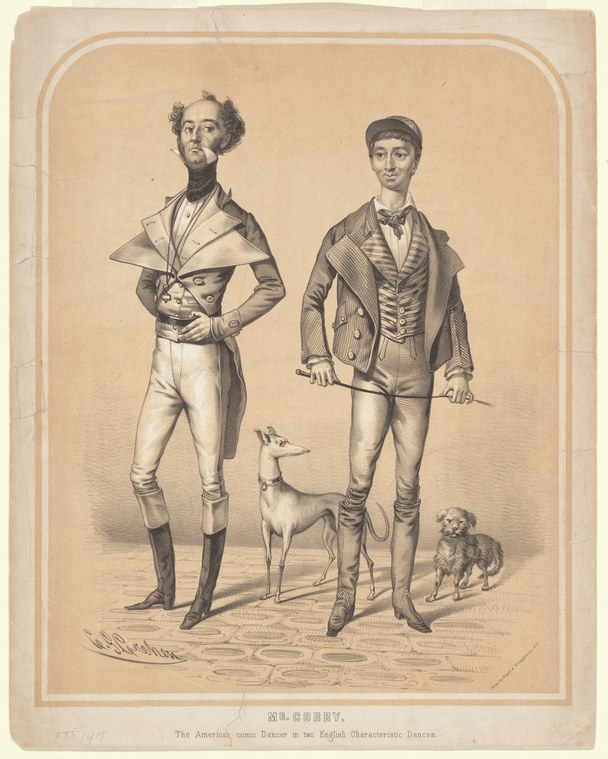
Mr. Corby: The American comic dancer in two English characteristic dances
Unknown artist
- Collection:
- Prints depicting dance
- Source:
- New York Public Library
- Rights:
- Public domain — free to use, share and adapt.
- Recorded as:
- Public Domain
Specialty and comic dancers like Mr. Corby have been largely erased from dance history, which has traditionally privileged ballet and later modern dance. This print is direct evidence of a thriving commercial dance practice—character dances, eccentric movement, and comedic pantomime performed by named professionals for paying audiences. It shows that 'dance' in the 19th century was broader and more socially embedded than the concert-stage narratives usually preserved.
What you are looking at
Two young male dancers stand in a shallow interior or outdoor space, positioned as if pausing between movements. The figure on the left wears a high-collared jacket with an enormous triangular cape or shawl draped across his shoulders, tight breeches, and boots; he stands with an exaggerated, affected posture, one hand resting on his hip. The figure on the right wears a tailored double-breasted coat with a waistcoat and similarly fitted breeches and boots; his stance is more compact and naturalistic. Between them stand two small dogs—a thin, delicate greyhound-type dog and a stockier spaniel. The ground is indicated with minimal detail. The engraving uses fine cross-hatching to model the figures and create subtle tonal effects, with particular attention to the textures of fabric and the play of light across the clothing.
The dancing
Both dancers are depicted in static, posed positions rather than mid-movement. The left figure adopts an exaggerated, almost theatrical stance with the cape creating a dramatic silhouette; his weight appears concentrated and formal. The right figure stands more conventionally upright. Neither figure demonstrates active footwork or a clear ballroom hold; instead, they are presented as character types or portraits. The inclusion of the dogs suggests a promenade or display pose typical of variety entertainment.
The dance depicted
This print documents 'Mr. Corby,' identified as 'The American comic dancer in two English characteristic dances.' The title suggests he performed character dances with national or ethnic themes—a common format in 19th-century music hall and variety entertainment. The exaggerated costume on the left figure, particularly the oversized cape, signals comedic intention and a burlesqued or stylized 'English characteristic' style. Without clearer movement information, the specific steps cannot be identified, but the theatrical presentation and inclusion of dogs implies pantomime or eccentric-dance elements typical of Victorian-era specialty performers. Comic dancers of this era often parodied genteel or fashionable movement styles.
How it was made
This is an engraving on paper, likely a commercial print produced for public circulation and sale. The fine line-work and careful cross-hatching are characteristic of mid-to-late 19th-century reproductive engraving techniques. The precision and quality suggest a professional print shop, and the subject matter—a named contemporary performer in a recognizable performance context—indicates this was promotional material or topical entertainment ephemera intended for a mass audience. The durability and reproducibility of the engraving format meant such images of performers reached theaters, homes, and the street.
About this work
This engraving records a Victorian-era specialty dancer known for character and comic dances performed in an English theatrical context. Mr. Corby appears here in two of his signature styles, presented as character types: one in exaggerated English costume with an oversized cape, the other in conventional formal dress. The inclusion of dogs and the theatrical posing suggest a performance tradition that blended dance, pantomime, and comedy—a staple of 19th-century music hall and variety stages. The work is a snapshot of vernacular entertainment practice and the kinds of specialty performers who populated Victorian theaters alongside ballet and legitimate drama.
How to look at it
Pay attention to the costume differences between the two figures: the left-hand dancer's exaggerated cape and affected posture signal parody or comic stylization, while the right-hand figure's more conventional dress and posture suggest a contrasting character or style. The dogs are not incidental ornament but part of the performance presentation, suggesting a tradition of eccentric or animal-assisted entertainment. Notice the precision of the engraver's attention to the fabrics and the way the garments are rendered; this level of detail was not mere decoration but information about how the performer appeared to the audience. The static posed quality does not capture actual movement, but rather presents two archetypal personas that Mr. Corby inhabited in performance.
The artist
The artist is not recorded. The print bears no visible signature. It was produced as commercial ephemera by a print shop, likely in London or another major English theatrical center. The quality of execution suggests a competent professional engraver working within established conventions of theatrical portraiture and character documentation.
The period
This print dates from an era when specialty and variety dance was at its commercial and social peak in Britain and America. The mid-to-late 19th century saw the proliferation of music halls, variety theaters, and traveling entertainment troupes, all of which employed dancers in non-classical idioms: jigs, reels, comic character pieces, and eccentric movement styles. Simultaneously, ballet—especially Romantic and later classical ballet—was being consolidated as the 'serious' or high form of dance, a distinction that effectively rendered specialty dancers and their forms invisible to posterity. This print is a rare artifact of what was actually being danced and watched.
Where it lives
The print is held in the New York Public Library's collection of prints depicting dance. It is classified as theatrical ephemera and promotional material from the 19th-century entertainment industry. No accession number, acquisition date, or provenance details are recorded in the available catalogue data.
Dance in this work
Questions about this work
Who was Mr. Corby?
Mr. Corby was a 19th-century specialty dancer known for comic character dances, particularly pieces styled as 'English characteristic dances.' Beyond this print and his appearance in theatrical contexts, little biographical information survives. He exemplifies the class of named entertainment performers—skilled, professional, and commercially successful—whose work was rarely documented beyond theatrical reviews and promotional prints like this one.
What are 'characteristic dances'?
Characteristic dances were a staple of 19th-century theater and music hall: stylized, often humorous or virtuosic pieces danced in costume, purporting to represent the manners, dress, or national traits of particular groups or stereotypes. They often involved elements of pantomime and comic exaggeration. They were distinct from both classical ballet and folk forms, occupying a commercial middle ground.
Why are the dogs included?
The dogs were likely part of the performance itself or its presentation. Eccentric and specialty dancers of the era often incorporated props, animals, or pantomime elements into their acts. The dogs may have been trained to interact with the dancer, or they may simply have been part of the visual spectacle and novelty that made such acts entertaining and marketable.
Is this a photograph or a drawing?
This is an engraving—a print made from an image incised into a metal plate. It is not a photograph or a drawing in the modern sense, but a reproductive medium designed for mass production. The image was likely based on a drawing or live observation, but it exists as a commercial print product.
More dance artwork





