49 works in this view — arrow keys or swipe to move between them.
Dance in Art
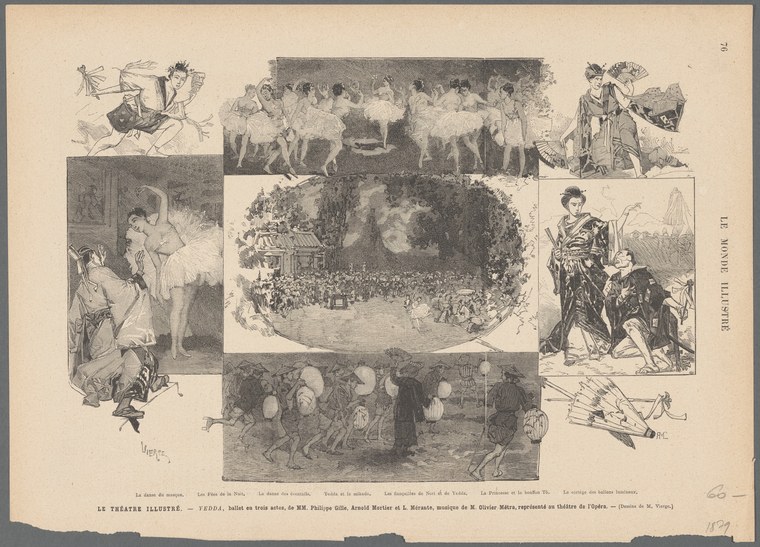
Yedda, ballet en trois actes, de MM. Philippe Gille, Arnold Mortier et L. Mérante, musique de M. Olivier Métra, représenté au théâtre de l'Opéra
Unknown artist
- Collection:
- Prints depicting dance
- Source:
- New York Public Library
- Rights:
- Public domain — free to use, share and adapt.
- Recorded as:
- Public Domain
This work documents a significant but now-forgotten ballet and its visual language at a moment when theatrical lithography was the primary means of circulating images of dance to a wider public. It shows how late Romantic and early modern ballet was understood and promoted—as narrative spectacle, emotional drama, and visual splendour rather than as abstract movement.
What you are looking at
This is a composite theatrical illustration documenting the ballet *Yedda*, arranged in a decorative format with a large central scene surrounded by six smaller vignettes. The central image shows a crowded indoor gathering—possibly a palace or grand salon—with numerous figures in period costume (appearing to be 18th or 19th century dress) arranged in depth. The lighting is dramatic, with the scene rendered in tones of sepia and grey wash. The six surrounding panels depict distinct moments: upper left shows a figure in animated pose, possibly mid-leap or gesture; upper center presents another group scene; upper right shows figures in formal dress with what appears to be architectural framing; lower left depicts an intimate interior with figures interacting; lower center shows what may be a dramatic or comedic moment with pronounced gesture; lower right presents a standing figure in elaborate costume, possibly a principal dancer or character role. The overall composition suggests this documents key scenes or emotional beats from across the ballet's narrative.
The dancing
Across all panels, bodies are rendered with fluid, expressive gestures characteristic of early theatrical illustration. The central scene shows figures distributed across the space at varying distances, creating a sense of depth and crowd movement. In several vignettes, individual dancers or actors display exaggerated arm positions and dynamic posture—extended limbs, arched backs, and engaged torsos suggesting theatrical rather than naturalistic movement. The costumes appear to be period dress or theatrical interpretations of period style, with full skirts, fitted bodices, and formal jackets visible on multiple figures. The artist has captured moment, not static positioning, with many figures shown mid-action or mid-expression.
The dance depicted
This is a documented scene from *Yedda*, a three-act ballet with music by Olivier Métra, choreography by Lucien Mérante, and libretto by Philippe Gille and Arnold Mortier. The presence of multiple theatrical settings and costume types suggests the work tells a narrative across its acts. The dramatic lighting and expressiveness of gesture in the vignettes indicate this was a Romantic or late Romantic era ballet, likely emphasizing pantomime and spectacle alongside dancing. Without access to the libretto or detailed choreographic record, the specific dances (if identifiable) cannot be determined from the image alone, but the consistent theatrical framing and varied costume states suggest this was a work of narrative ballet rather than abstract dance.
How it was made
This is a lithographic or engraved composite illustration, rendered primarily in black and grey wash with tonal gradation and fine linear detail. The technique allows both broad atmospheric effect (evident in the atmospheric central scene) and precise delineation of costume, facial expression, and architectural detail. The composite format—a central large image surrounded by smaller related scenes—was a standard Victorian and Edwardian theatrical promotion method, allowing multiple moments from a long work to be seen on a single page. This format indicates the image was likely published as a programme illustration, a theatre review insert, or a souvenir print for audiences after the work's premiere or a notable revival performance. The careful composition and professional execution suggest publication by a major theatrical press.
About this work
This composite theatrical illustration documents the ballet *Yedda*, created in the late 19th century with music by Olivier Métra and choreography by Lucien Mérante. It combines a large central scene of a grand interior gathering with six smaller panels depicting distinct dramatic moments, allowing viewers to apprehend the ballet's narrative structure and visual spectacle across a single page. The work belongs to the tradition of theatrical illustration that served both promotional and documentary purposes, capturing for audiences unable to attend (or to remember once they had) the look, scale, and emotional arc of a major theatrical production.
The image is valuable primarily as evidence of theatrical practice and production aesthetics of the period. It shows how late 19th-century ballet was staged, costumed, and framed for popular consumption—the emphasis on narrative and spectacle, the integration of pantomime with dance, and the centrality of the corps de ballet and ensemble work to the theatrical effect.
How to look at it
Pay attention to the central scene first: this appears to be the emotional or narrative climax, with a large assembly of figures in formal dress, suggesting either a court scene, a wedding, or another formal social gathering that drove the ballet's plot. Then examine the six surrounding scenes in sequence—they may follow the narrative order, or they may cluster moments of high dramatic or visual interest (a solo, a pas de deux, a comedic scene, a tragic or emotional peak). Notice how the artist uses costume variety and gesture exaggeration to communicate character and emotional state; this lithographic vocabulary was the standard way 19th-century theatre audiences understood dramatic intention. The rendering is more gestural and expressive than photographic; observe how the artist has emphasized movement, emotion, and spectacular effect rather than anatomical accuracy.
The period
The ballet dates to the late 19th century, during the period when the Opéra of Paris was producing large narrative ballets with substantial orchestral scores and complex scenic requirements. This was the era of the Romantic legacy—ballets like *Giselle* and *La Sylphide* remained in the repertoire—but increasingly inflected with the spectacular and exotic themes that would characterize the Belle Époque. The three-act structure and apparent narrative focus (suggested by the varied scenes and costumes) followed the Romantic blueprint. Lithographic theatrical illustration of this kind was at its height as a medium; within decades, photography would begin to replace it, but in the 1880s–1890s, the hand-drawn theatrical composite illustration remained the standard way to promote and document dance performances.
The presence of a substantial libretto (by two named authors) and a notable composer suggests this was a major production, not a minor or experimental work. The work's subsequent disappearance from the repertoire is notable—this may be the primary surviving image of the ballet.
Where it lives
The image is held in the New York Public Library's Prints collection, catalogued as depicting dance. It is a published theatrical illustration, likely from the late 19th century, and was probably distributed as a theatre programme insert, a newspaper or magazine illustration, or a commercial souvenir print.
Dance in this work
Questions about this work
Who choreographed Yedda?
Lucien Mérante, a prominent 19th-century ballet master at the Paris Opéra. Mérante was known for both classical technique and for narrative works; he was a significant figure in late Romantic ballet but is now less well known than some of his contemporaries.
What is this work and why does it look like multiple pictures?
This is a single lithographic print designed to show multiple scenes from the ballet *Yedda* on one page. It was a standard format in 19th-century theatrical promotion, allowing theatre-goers and potential audiences to see key moments and the visual scope of a production at a glance.
What kind of ballet was Yedda?
Based on the costume variety, setting diversity, and narrative scenes shown here, it appears to have been a three-act Romantic narrative ballet, likely with exotic or contemporary themes. The large formal scene in the center suggests a significant dramatic climax, possibly a court or ceremonial setting.
Why doesn't this ballet still exist in the repertoire?
Many 19th-century ballets were ephemeral works, dependent on star dancers and on-the-moment spectacle. After the principal dancers retired or a production fell out of fashion, the ballet often disappeared entirely unless it had achieved canonical status (like *Giselle* or *Swan Lake*). Few complete scores or choreographic records survive for works like *Yedda*.
More dance artwork





