49 works in this view — arrow keys or swipe to move between them.
Dance in Art
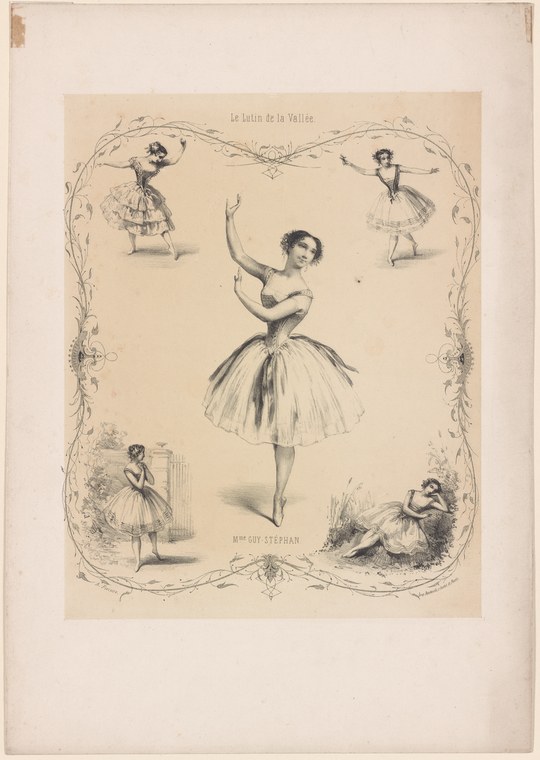
Le lutin de la vallée Mme Guy-Stéphan
Unknown artist
- Collection:
- Prints depicting dance
- Source:
- New York Public Library
- Rights:
- Public domain — free to use, share and adapt.
- Recorded as:
- Public Domain
This print is evidence of how Romantic-era ballet dancers were promoted and remembered, and of the international circulation of French theatrical dance in the nineteenth century. For historians and dancers, it documents the aesthetic, technique, and costume of classical ballet at a specific historical moment, and it preserves the name and image of a dancer who would otherwise be lost.
What you are looking at
This is a theatrical print centered on a solo female dancer identified as Mme Guy-Stéphan, shown in a graceful pose with one leg extended and an arm raised in an arc above her head. She wears a pale tutu and pointe shoes, her body weight clearly on one leg in a classical ballet attitude. She is framed by an ornamental border of scrolling vines and flowers in the Romantic era style. Arranged around her within this border are four smaller vignettes of other dancers in similar costumes and poses—two at the upper corners and two at the lower corners—each showing variations of classical ballet movement. The composition is symmetrical, suggesting this is a souvenir or promotional print documenting the dancer and her repertory.
The dancing
The central figure stands on one leg in a clear ballet position, the supporting leg straight, the working leg raised and bent, the torso erect and turned slightly, the raised arm forming a soft arc overhead while the other arm extends to the side—a pose consistent with Romantic-era classical ballet. The smaller surrounding figures are arranged to show a variety of attitudes and arabesques, all executed with the turned-out legs and lifted carriage of trained ballet dancers. All five figures wear identical or nearly identical tutus of the short, layered style characteristic of mid-nineteenth-century theatrical ballet. The poses suggest accomplished technique and a vocabulary of classical positions.
The dance depicted
This is a Romantic ballet print, almost certainly commemorating a performance or a dancer's career. Mme Guy-Stéphan was a mid-nineteenth-century French dancer, and the title "Le Lutin de la Vallée" (The Elf of the Valley) refers to a ballet or a role within a ballet from that era. The poses and costume are purely classical theatrical ballet of the 1840s–1850s. The print functions as a record of the dancer, the role, and the vocabulary of the ballet itself—a common format for circulating knowledge of popular performances before photography could do so.
How it was made
This is a lithograph or engraving on paper, executed in black ink on a cream or pale yellow ground. The line work is delicate and precise, the ornamental border is rendered in fine detail, and the figures are modeled with light shading to suggest form and fabric. The technique allows for relatively inexpensive mass production and circulation, suggesting this was aimed at a broad audience of opera-goers, dancers, and ballet enthusiasts. The hand-coloring visible in the tutu suggests some copies were finished by hand.
About this work
This is a mid-nineteenth-century French theatrical print commemorating the dancer Mme Guy-Stéphan and her role in the ballet *Le Lutin de la Vallée*. It is a document of Romantic-era classical ballet—the costumes, the poses, the aesthetic of the period are all authentically rendered. The print served both as a souvenir for patrons who had seen the performance and as a record of the choreography and the dancer's technical achievement for a wider audience. It belongs in a gallery about dance because it shows how ballet was circulated, celebrated, and remembered before photography, and it preserves the visual language of a specific dancer and a specific moment in the history of the art form.
How to look at it
Attend to the pose at the center: it is a moment of balance and suspension, not a moment of transition or effort. The dancer is held in a classical attitude, which itself was a vocabulary of beauty and technical achievement. Notice how the four surrounding vignettes show other poses from the same vocabulary—each one a moment of stillness and control. The ornamental border, with its organic scrollwork, is not decoration but part of the aesthetic: it places the dancer in a realm of fantasy and theatricality, not of ordinary life. The symmetry of the composition and the refinement of the line are all characteristic of how the Romantic ballet was perceived: as an art of grace, precision, and ethereal beauty.
The artist
The artist is not identified in the catalogue record. The style and execution suggest a professional theatrical print workshop, possibly Parisian, specializing in dance and opera imagery. Such workshops produced hundreds of commemorative prints of dancers and performances, often in collaboration with or with the permission of the dancers themselves. The quality of the draftsmanship indicates a trained artist with knowledge of ballet and stage costume.
The period
This print dates to the height of Romantic ballet in France, likely the 1840s or 1850s. This was the era of *La Sylphide*, *Giselle*, and *La Peri*—ballets centered on ethereal, supernatural female characters. The tutu, the pointe work, the delicate line of the figures, and the emphasis on the solo female dancer all reflect the Romantic aesthetic. Theatrical prints were a primary means of circulating images of celebrated dancers; lithography had made such prints affordable and accessible to a mass audience.
Where it lives
The print is held in the New York Public Library's collection of prints depicting dance. It is catalogued by title and subject but lacks attribution to an artist, a precise date, or technical description.
Dance in this work
Questions about this work
Who was Mme Guy-Stéphan?
She was a French ballet dancer of the mid-nineteenth century whose career coincided with the height of Romantic ballet. This print is evidence of her prominence and of the roles she danced. Beyond what theatrical records survive, little is widely known of her life or later career. The print itself is a primary document of her existence and her achievement.
What is *Le Lutin de la Vallée*?
The title translates as *The Elf of the Valley*. It is likely a ballet or a role within a ballet, now lost or obscure. The supernatural or fairy subject matter fits the Romantic-era fashion for tales of otherworldly female characters. No comprehensive record of the choreography or full cast appears to survive.
Why are there five dancers shown instead of one?
The central figure is the principal dancer in the role of the elf; the four surrounding figures show the range of poses and positions from the ballet, or variants of the role as performed in different acts or productions. This format allowed the print to document both the dancer and the choreography, and it made the print more visually interesting and valuable as a souvenir.
What was the purpose of theatrical prints like this?
They served multiple purposes: as souvenirs for patrons who had attended performances; as promotional material for the dancer and the theatre; as a record of the choreography and the dancer's technique for other dancers and choreographers; and as popular art for collectors and enthusiasts of dance. Before photography, they were the primary means of circulating images of celebrated dancers and roles.
More dance artwork





