49 works in this view — arrow keys or swipe to move between them.
Dance in Art
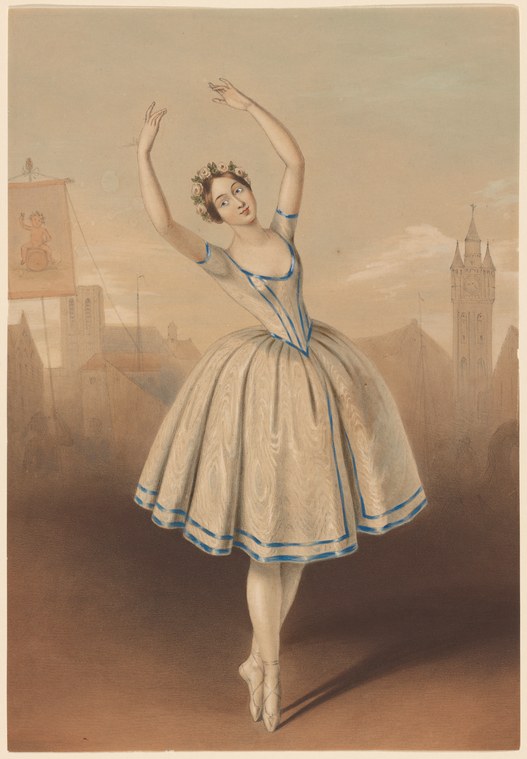
Louise Fleury as the Beauty of Ghent
Unknown artist
- Collection:
- Prints depicting dance
- Source:
- New York Public Library
- Rights:
- Public domain — free to use, share and adapt.
- Recorded as:
- Public Domain
This is documentary evidence of how Romantic ballet was danced, costumed, and marketed in the nineteenth century. It names a specific dancer and role, linking a real performer to a recorded moment in theatrical history. For historians and dancers alike, such prints are primary sources for understanding the physical vocabulary, the aesthetic values, and the social position of ballet in the nineteenth century.
What you are looking at
A woman in a pale cream tulle ballet skirt stands alone on a stage in a classical ballet pose, her body caught mid-movement in a graceful arabesque or attitude. She wears a fitted bodice with short sleeves trimmed in pale blue ribbon, and her dark hair is crowned with a wreath of flowers. Her arms are raised above her head in the soft, rounded frame characteristic of nineteenth-century ballet, and she stands en pointe on one leg. The stage floor beneath her is bare and sandy-toned. Behind her, a panoramic cityscape in warm sepia tones shows Gothic revival architecture—church spires, crenellated walls, and civic buildings—suggesting a European city, possibly Ghent or another Flemish town. The background is atmospheric and dreamlike, rendered in soft focus and pale wash, making the solitary figure the sharp centre of attention. A draped banner or coat of arms hangs to the left, further establishing a civic or theatrical setting.
The dancing
The dancer is isolated in a single, sustained classical pose. Her weight rests on her supporting leg, which is fully extended and turned out, while her working leg extends behind or to the side in a long line. Her arms are held high and soft, curved rather than angular, with the characteristic port de bras of Romantic-era ballet. Her upper body is upright and composed, her gaze directed upward or away from the viewer. The pose suggests a moment of stillness rather than rapid movement—a held balance or the apex of a phrase.
The dance depicted
This is Romantic ballet, almost certainly from the mid-nineteenth century. The lithograph depicts a named dancer, Louise Fleury, performing a solo—likely a variation from a larger work—in a role identified as 'the Beauty of Ghent.' The pose and costume are entirely consistent with the Romantic ballet repertoire of the 1840s–1850s. The pale tulle skirt, the pointe work, the raised port de bras, and the floral crown all follow the conventions of Romantic ballet as danced by the ballerinas of the Parisian stage. The identification of a specific dancer and role suggests this was a celebrated performance, possibly commemorated or marketed through such prints for the theatre-going public.
How it was made
This is a hand-coloured lithograph, as indicated by the soft tonal transitions, the delicate gradations of sepia and cream, and the characteristic flatness of lithographic line. The process allowed for the mass production of theatrical prints—far cheaper and more widely circulated than oils or watercolours—making this a commercial image intended for sale to patrons of dance and theatre. The colouring is precise and limited, suggesting a careful hand and possibly a specialist chromolithographer. The technique's softness and capacity for atmospheric effect suited the Romantic aesthetic perfectly, allowing the artist to render the dancer as an ethereal, almost dreamlike figure against a hazy urban backdrop.
About this work
This is a theatrical portrait print of a mid-nineteenth-century ballet dancer, Louise Fleury, performing in a Romantic-era role. The work is a commercial lithograph, probably French, issued to commemorate or publicize a celebrated performance. It documents both the aesthetic ideals of Romantic ballet—the ethereal solitary figure, the pale tulle skirt, the elevation and weightlessness implied by pointe work—and the commercial apparatus of theatre, where dancers became celebrities whose likenesses were sold as souvenirs and collectibles. The print belongs to a rich tradition of dance portraiture that saw ballerinas immortalized for a paying public.
How to look at it
Attend to the pose itself: the artist has chosen a moment of poised stillness, not a dramatic leap or turn, which emphasizes balance, control, and the illusion of effortless grace. Notice the play of solitude—the single dancer dominates the composition, isolated against the cityscape, which reinforces the Romantic ideal of the ballerina as a solitary, ethereal figure. The lifted arms and upward gaze suggest aspiration and otherworldliness. The careful rendering of the tulle skirt, with its graduated folds and the pale blue ribbon trim, shows the artist's attention to the visual splendour of the costume itself, which was a major draw for theatre-goers. The soft atmospheric background is a convention of the period—it frames the dancer as the sole focus and lends her an almost dreamlike quality.
The artist
The artist is not recorded. This is characteristic of mass-market theatrical prints of the period, where the focus was on the dancer and the role rather than the printmaker's name. Such works were often produced quickly by commercial printing houses to capitalize on a dancer's fame, and the artist may have worked from a sketch, a memory of a performance, or even a commission from the theatre or the dancer's own promoters. The style—soft, flattering, idealized—is consistent with the commercial portrait prints that lined shop windows and were sold at theatres throughout Europe.
The period
This print dates from the era of Romantic ballet (approximately 1830–1870), when ballet was at the height of its cultural prestige in Europe. The 1840s and 1850s saw the rise of the ballerina as a celebrity and sex symbol; dancers like Marie Taglioni and Fanny Cerrito commanded enormous fees and inspired a cult of fan culture. Theatrical prints and lithographs were a major form of entertainment marketing, displayed in shop windows and sold to theatre-goers as mementos. The iconography here—the Romantic tulle skirt, the pointe work, the ethereal solitude, the floral crown—reflects the period's obsession with supernatural and otherworldly femininity, influenced by the Romantic movement in literature and visual art. The naming of Louise Fleury and her role situates this within the specific competitive world of mid-nineteenth-century ballet, where dancers were known and celebrated by the roles they embodied.
Where it lives
This print is held in the New York Public Library's collection of prints depicting dance. It is a commercial lithograph, part of a much larger body of nineteenth-century theatrical portraiture that documented the stage stars of the era. Such prints were sold publicly and are now found in theatres, libraries, and private collections across Europe and North America.
Dance in this work
Questions about this work
Who was Louise Fleury?
Louise Fleury was a nineteenth-century ballet dancer known enough to be immortalized in a theatrical print. Without additional archival research, her career cannot be reconstructed in detail from this image alone, but the print indicates she was celebrated enough to merit a named portrait and was associated with a specific role, 'the Beauty of Ghent,' in what may have been a larger theatrical production or a popular variation. Dancers of her generation were often rivals, celebrities, and the subject of intense fan devotion.
What does 'the Beauty of Ghent' refer to?
The title likely refers to a specific role in a ballet production, though the work cannot be conclusively identified from the print alone. The Flemish setting suggested by the cityscape and the naming of Ghent implies a local or historical connection. It may be a character drawn from legend, literature, or local history, or it may be an allegorical representation. The role was significant enough to warrant a commemorative print.
How do we know this is Romantic ballet?
The costume—pale tulle skirt, fitted bodice, pointe shoes—is the hallmark of Romantic ballet in the 1840s–1860s. The pose, with its emphasis on lightness and the illusion of weightlessness, reflects the Romantic aesthetic. The floral crown and the ethereal presentation also align with the period's idealization of the ballerina as a supernatural or otherworldly figure. These visual markers allow us to date the print with confidence to the Romantic era.
Why are so many theatrical prints from this period hand-coloured lithographs?
Lithography was a relatively new and cheaper technology in the nineteenth century, allowing prints to be produced in volume and sold affordably to theatre-goers. Hand colouring added visual appeal and made each print feel like a special commodity. The process was economical enough to make theatrical portraiture a viable commercial enterprise, which is why so many dancers were immortalized in this way. It was mass culture before photography became dominant.
More dance artwork





