49 works in this view — arrow keys or swipe to move between them.
Dance in Art
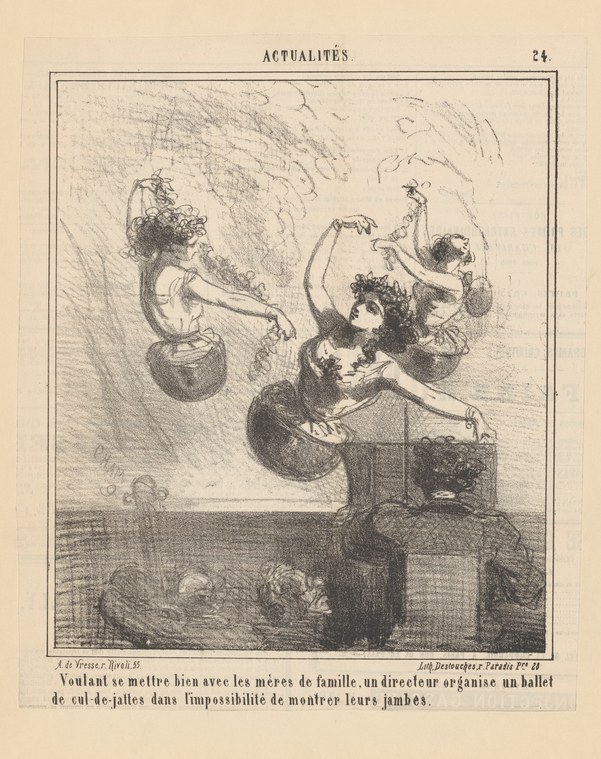
Voulant se mettre bien avec les mères de famille, un directeur organise un ballet de cul-de-jattes dans l'impossibilité de montrer leur jambes
Unknown artist
- Collection:
- Prints depicting dance
- Source:
- New York Public Library
- Rights:
- Public domain — free to use, share and adapt.
- Recorded as:
- Public Domain
This print is essential to understanding how 19th-century visual culture understood dance: not as movement or expression but as display of a perfect, able body. For historians of disability, it documents historical attitudes toward disabled bodies in public space. For dance historians, it reveals a moment when ballet's ideological foundations—the equation of ballet with bodily perfection and the erasure of disability—became visible enough to attack. The satire only works if the audience recognizes that a 'ballet of amputees' is inherently impossible within the logic of ballet itself.
What you are looking at
This satirical engraving depicts a theatrical absurdity: a ballet performance featuring amputees or people with severe leg disabilities. The scene is divided into two registers. In the upper half, four figures in classical ballet poses float or hover against a heavily hatched background suggesting theatrical space or clouds. Three wear draped classical costume with their legs completely hidden or rendered as stumps; one figure at upper right gestures with arms raised. The fourth figure, at lower center, sits astride what appears to be a wooden box or platform, arms gesturing expressively. Below, in the lower register, two more figures crouch or recline on the ground in shadow, visible only as hunched forms. The composition is chaotic and dreamlike, with the figures arranged at impossible angles and scales, emphasizing the grotesque premise: a director has organized a ballet of disabled performers 'in the impossibility of showing their legs'—a cruel joke at the expense of both the disabled performers and the pretensions of ballet itself.
The dancing
The upper figures maintain exaggerated classical ballet arm positions—raised, extended, reaching—while their lower bodies are absent or concealed. The central seated figure dominates through gesture and centrality, arms held high in an attitude of triumph or despair. The lower figures are rendered as mere silhouettes, emphasizing their marginalization. The artist has deliberately inverted ballet's visual hierarchy: the legs, site of the art form's virtuosity and beauty, are systematically erased, leaving only the upper body and the expressive arms. The poses reference academic ballet vocabulary but render it absurd through bodily incompleteness.
The dance depicted
This is not a depiction of actual dance but a biting visual satire on the conventions and pretensions of theatrical ballet in 19th-century France. The caption explains the premise: a well-meaning director, wanting to please respectable families (mères de famille), stages a ballet using disabled performers, creating an impossible spectacle in which the defining element of ballet—the display of the legs—cannot occur. The work mocks both the director's patronizing logic and the audience's expectations. It is propaganda in visual form: a critique of charity theater and of ballet itself as a form dependent on bodily perfection and display. The 'ballet' cannot exist as conceived, making this a work about the limits and failures of theater rather than a representation of actual choreography.
How it was made
This is an engraving or etching on paper, executed in fine linear hatching and cross-hatching to build form and shadow. The technique allows rapid circulation as a print and was the standard medium for satirical imagery in 19th-century Paris. The heavy, anxious line-work reinforces the grotesque mood; the hatched background creates a claustrophobic, theatrical space. The print's small scale and portable format made it a tool for social commentary, designed to be seen, shared, and discussed in salons and cabarets. The medium itself—reproducible, disposable, quick—suited its function as cutting topical satire.
About this work
This is a satirical engraving from the Actualités series (a French periodical of social and political satire), attacking both theatrical convention and the fashionable logic of charitable theater. It takes the form of a grotesque ballet scene but is not a dance work at all: it is a visual argument against the notion that ballet can or should be performed by disabled bodies, or more broadly, that tokenistic inclusion is a solution to inequality. The image sits at the intersection of dance representation, disability representation, and 19th-century print satire. It belongs in a gallery of dance in art as a work that defines dance by its absence—a dance that cannot be danced, because the form itself is exposed as dependent on a specific kind of able body.
How to look at it
Attend to the systematic absence: where are the legs? The artist has frozen the impossible moment at which ballet must acknowledge that it cannot proceed without them. Notice the contrast between the exaggerated, expressive upper bodies and arms—still performing 'ballet'—and the void or stump below. The composition's instability (figures floating, crooked, displaced) visualizes the contradiction the satire names: you cannot have a ballet without legs. The title is not a description but a provocation; read it carefully to understand the artist's target (the director's logic, not the disabled performers).
The artist
Unknown artist. The work appears in the Actualités series, a French periodical of social and political satire active in the mid-19th century. The series specialized in biting visual commentary on contemporary events, fashions, and social pretensions, using engraving and etching to reach a broad urban audience. The style and subject matter suggest a professional illustrator working in the tradition of Honoré Daumier, though attribution is not confirmed.
The period
This engraving was likely produced in the 1840s–1860s, when charitable theater and benefit performances were fashionable among the bourgeoisie. Ballet was at the height of its Romantic period, dominated by the cult of the ballerina and increasingly associated with ethereal femininity and bodily perfection. Simultaneously, the growth of urban print culture and periodic publications created a market for topical satire. The image reflects anxieties about authenticity in theater, the limits of bourgeois charity, and the degree to which ballet depended on the concealment and denial of bodily difference. It also captures a moment when disability was becoming visible as a social category (notably through war wounds and industrial accidents) while being systematically excluded from public representation.
Where it lives
The work is held in the New York Public Library's collection of prints depicting dance. It appears as a single engraved sheet in a bound periodical or collection, suggesting it circulated within the Actualités series and was preserved as part of a larger archival sequence on theatrical subjects.
Dance in this work
Questions about this work
Is this actually a ballet?
No. This is a satirical engraving that represents a ballet that cannot and does not actually exist. It is a visual argument against a concept, not a depiction of real performers or choreography. The satire depends on the logical impossibility of the premise.
What is the artist attacking here?
The primary target is the well-meaning director who thinks charity theater can benefit from disabling performers, and by extension, the bourgeois audience that would attend such a spectacle. But the deeper critique is of ballet itself as an art form that defines itself through bodily perfection and the display of legs. The satire exposes this by making it impossible.
Who would have seen this and what did they think?
The print was likely seen by urban, literate audiences in Paris—salon visitors, cabarets, and readers of the Actualités periodical. They would have recognized it as topical satire commenting on current fashionable practices. Some would have found it funny; others would have recognized the discomfort at its core: that the joke assumes the impossibility and impropriety of disabled people performing ballet.
What does this tell us about 19th-century attitudes to disability and dance?
It reveals that ballet was understood as inherently dependent on bodily perfection and the visual display of legs. Disability was seen as incompatible with performance. While the satire is critical of patronizing charity, it does so by accepting the premise that disabled people cannot dance ballet—rather than questioning why ballet required such narrow bodily norms in the first place.
More dance artwork





