49 works in this view — arrow keys or swipe to move between them.
Dance in Art
Fanny Elssler
Unknown artist
- Collection:
- Prints depicting dance
- Source:
- New York Public Library
- Rights:
- Public domain — free to use, share and adapt.
- Recorded as:
- Public Domain
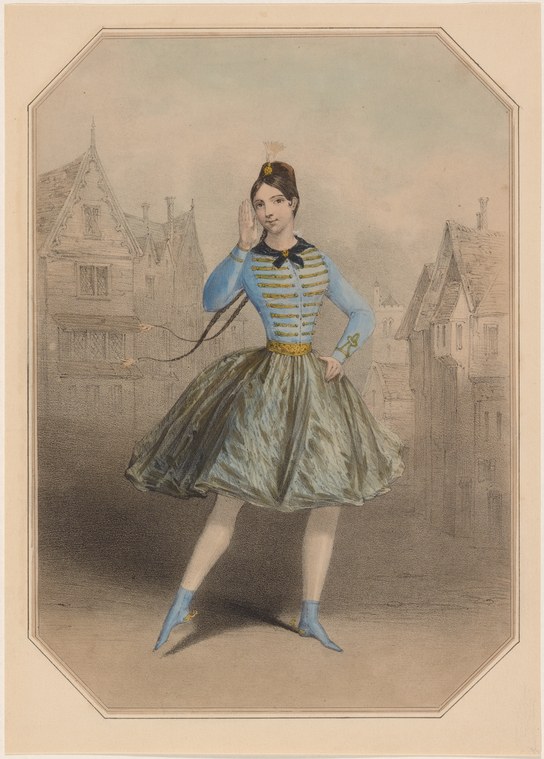
Fanny Elssler was one of the most celebrated dancers of the nineteenth century, and her image circulated widely in prints such as this. The work is a primary document of how a major dance figure was represented to the public, and of the costume styles and character roles that defined Romantic ballet performance.
What you are looking at
A young woman in theatrical dress stands alone against a softly rendered architectural backdrop of Gothic revival buildings. She wears a striking blue velvet jacket with ornate gold braid frogging across the chest, cinched at the waist, paired with a full skirt of pale gray silk that extends to just below the knee. Her dark hair is styled up with what appears to be a decorative comb or tiara. She stands in a poised, frontal position with one leg slightly advanced, her weight balanced as if between steps or in a moment of theatrical stillness. Her right arm is raised gracefully, holding what appears to be a riding crop or similar accessory. Blue stockings and blue heeled slippers complete the costume. The coloring is hand-tinted, with soft washes of sepia and cream tones across the architectural setting and the dancer's face and neck.
The dancing
The single figure adopts an upright, composed posture typical of theatrical portraiture rather than active dance movement. Her weight appears centered, with the torso held erect and the shoulders relaxed. The raised arm and advanced leg create a line of elegance and readiness rather than the momentum of actual motion; this is a presentation pose designed to display the costume and the dancer's carriage. The overall frame is vertical and symmetrical, emphasizing the geometric elegance of her silhouette.
The dance depicted
This is a costume portrait of a theatrical dancer, most likely a Romantic-era ballerina given the style of dress and the date range suggested by the clothing. The costume—particularly the military-inspired frogged jacket paired with a skirt—suggests either a character role requiring a `travesti` or masculine guise, or possibly a role from a narrative ballet with a non-classical setting. The image emphasizes the costume and the dancer's bearing rather than capturing a moment of active choreography, which was common in theatrical portraiture of the period. Without clearer evidence of the specific ballet or character, the style points toward Romantic ballet of the 1840s–1860s.
How it was made
This is a hand-colored lithograph or engraving, as evidenced by the crisp linear definition of the figure and the soft tonal variations characteristic of lithographic stone work. The coloring has been applied by hand in translucent washes, allowing the printed line work to remain visible beneath. The technique allowed for relatively economical reproduction and distribution of theatrical imagery to a broad audience of playgoers and dance enthusiasts. The soft wash technique conveys elegance and movement even within a static pose.
About this work
This is a costume portrait of a professional dancer in the Romantic ballet era, presented in the formal conventions of theatrical print culture. The work documents both a specific performance costume and the aesthetic ideals of nineteenth-century ballet: youth, grace, refined bearing, and the spectacle of elaborate dress. As part of the broader body of theatrical portraiture from this period, it offers evidence of how dancers were marketed and remembered, and what roles women occupied in mid-nineteenth-century theatrical life.
How to look at it
Study the pose: despite the theatrical costume, the dancer is not captured mid-movement but in a composed, frontal presentation. This convention served multiple purposes—it allowed the viewer to admire the costume detail, demonstrated the dancer's bearing and deportment, and created a formal, dignified image suitable for distribution and collection. The raised arm and advanced leg follow the vocabulary of classical ballet but are held in stillness, not in the flow of continuous motion. Notice how the lithographic technique allows the print to convey both the crisp geometric elegance of the jacket and the softness of the silk skirt.
The artist
The artist is not recorded in the catalogue information. The quality and style of the work suggest a professional theatrical lithographer working in Europe, likely in Vienna, Paris, or London during the height of Elssler's fame in the 1840s–1850s. Such portraits were commonly produced by studios specializing in theatrical imagery rather than by the painters or printmakers whose names survive in art-historical records.
The period
Fanny Elssler (1810–1884) was a Austrian dancer who achieved international stardom during the Romantic ballet era. She was known for her dramatic presence and technical brilliance, and she embodied the competing aesthetic of the period: where Marie Taglioni represented the ethereal, weightless ideal, Elssler was celebrated for her earthiness, fire, and connection to folk and national styles of dance. The Romantic period saw the rise of lithographic portraiture as a major means of circulating images of performers, and dancers of Elssler's stature were among the most widely reproduced theatrical figures of the day. The costume in this portrait may reference one of her famous roles, possibly a character requiring a masculine or military appearance.
Where it lives
This work is held in the New York Public Library's collection of prints depicting dance. It is a common format from the period—a theatrical portrait in lithograph or engraved print, hand-colored and distributed as a collectible item.
Dance in this work
Questions about this work
Who was Fanny Elssler?
Fanny Elssler (1810–1884) was an Austrian ballet dancer and one of the most celebrated performers of the nineteenth century. She achieved fame across Europe and in North America, known for her technical brilliance, dramatic intensity, and charisma. She was a major rival to Marie Taglioni during the Romantic ballet era and is remembered for roles emphasizing character, national dance styles, and theatrical presence rather than the weightless ideality associated with other Romantic ballerinas.
What does the costume tell us?
The military-inspired jacket with gold frogging, combined with the skirt, suggests a character role rather than classical tutu-based costuming. This may indicate a role with a narrative or geographic setting outside the supernatural or ethereal realms typical of Romantic ballet. Such costumes allowed dancers to demonstrate a broader range of character and physicality than the classical vocabulary alone.
Why are there so many prints of dancers from this period?
Lithography made theatrical portraiture affordable to produce and distribute in quantity. Dancers like Elssler were celebrities, and prints served as souvenirs for theatergoers, promotional images for theaters, and collectible items. They also circulated information about roles and costumes to audiences in other cities, extending a dancer's fame beyond the theaters where she performed.
What is the difference between this and a painting?
This is a print—made from a stone or metal plate—and hand-colored after printing. Prints could be produced in dozens or hundreds of copies from a single prepared surface, making them far more economical than oil paintings. The technique and the multiple impressions allowed theatrical imagery to reach a much broader public audience.
More dance artwork





