49 works in this view — arrow keys or swipe to move between them.
Dance in Art
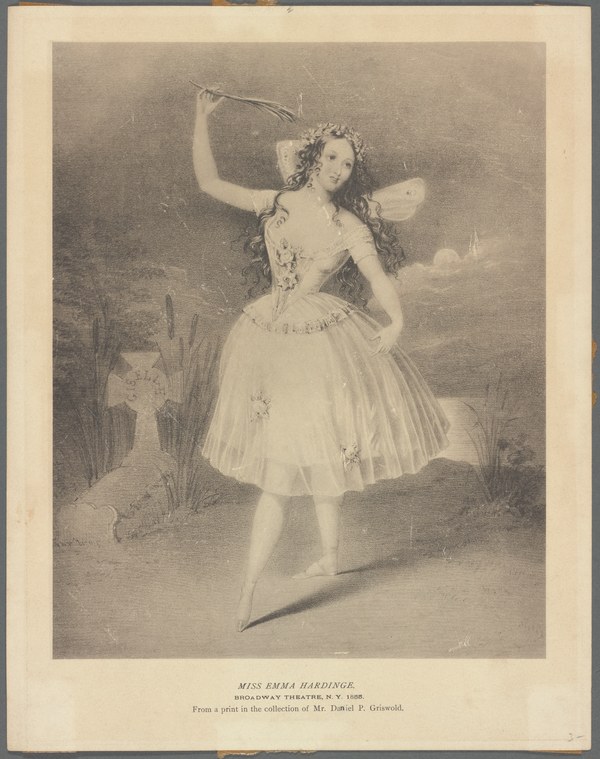
Miss Emma Hardinge
Unknown artist
- Collection:
- Prints depicting dance
- Source:
- New York Public Library
- Rights:
- Public domain — free to use, share and adapt.
- Recorded as:
- Public Domain
Theatrical prints like this one are among the few direct visual records of romantic-era ballet performance and the specific interpretations of celebrated dancers. They document costume, pose, and stage convention at a moment when dance notation was rudimentary and photography could not yet capture movement, making prints the primary visual archive of how these roles were embodied and presented.
What you are looking at
A young woman in romantic-era theatrical dress stands alone against a softly atmospheric background of muted grays and browns, suggesting a moonlit or dreamlike setting. She wears a white tulle skirt of mid-calf length, fitted waist, and a decorative bodice, with her long dark hair adorned with a floral crown or headdress. Her pose is elegant and contemplative: she stands with weight on one leg, the other subtly extended, one arm raised overhead in a graceful arc holding what appears to be a wand or baton, while the other rests at her side. A pair of translucent wings—characteristic of a fairy or sylph—extends from her shoulders. Delicate flowers or foliage emerge from the ground around her feet, reinforcing the otherworldly, botanical atmosphere. The image is rendered as a soft, tonal print with careful attention to drapery and the play of light across fabric.
The dancing
The dancer stands in a three-quarter pose that emphasizes verticality and lightness. Her supporting leg is nearly straight, her free leg pointed or extended slightly behind, creating the illusion of buoyancy. Her raised arm follows a gentle upward curve from shoulder to fingertips, creating an open, expansive frame typical of romantic-era ballet vocabulary. The head is held high with a contemplative gaze, and the overall carriage conveys airiness and ethereal delicacy rather than grounded weight. There is only one figure, the composition built entirely around her isolated, poised presence.
The dance depicted
This appears to be romantic-era ballet, most likely a representation of a fairy, sylph, or sylphide character from the 1830s–1850s theatrical repertory—works such as *La Sylphide* or *Giselle* Act II. The wings, the tulle skirt, the floral crown, and the weightless, upright stance are all signature elements of the romantic ballet vocabulary. The costume and pose speak to a moment of stillness or reverie rather than action, possibly a solo or tableau moment. The artist understood and depicted the characteristic silhouette and carriage of this style.
How it was made
This is a hand-colored or tinted lithographic print, evident from the soft tonal modeling, the subtle gradations of gray-brown, and the characteristic texture of stone-printed work. The technique allowed for relatively economical reproduction and wide circulation to a middle-class theater audience; such prints were commonly sold as souvenirs or theatrical ephemera. The softness of the medium suited the ethereal subject matter and permitted the artist to suggest atmosphere and mood through tone rather than sharp line alone.
About this work
This is a theatrical souvenir print documenting a romantic-era ballet performance by the dancer Emma Hardinge, likely from the 1830s–1850s. The image preserves a single moment of elevated, otherworldly femininity that defined the romantic ballet aesthetic: a lone female figure in wings and tulle, poised between earth and air, rendered in the soft, tonal language of lithographic print. Such prints were mass-produced for theater audiences and collectors, making them both documents of performance history and products of the emerging commercial culture of dance celebrity in the nineteenth century.
How to look at it
Observe the precise moment the artist chose: not mid-leap or mid-rotation, but a moment of poised stillness that reads as both balanced and floating. The raised arm and the extended leg create opposing vectors that suggest ongoing motion even in repose—a key romantic-era aesthetic. Note how the wings, costume, and setting work together to create an atmosphere of remove from the everyday world, and how the softness of the print technique itself—its lack of hard edges—reinforces that otherworldliness. The artist has rendered not a naturalistic body in motion but an idealized icon of romantic femininity.
The artist
The artist is not recorded. Such theatrical prints were typically produced by commercial lithographic workshops in London, Paris, and New York, often working from sketches or from live attendance at performances. The prints were sold through theater lobbies, print shops, and by mail, sometimes with printed captions identifying the performer and role. The absence of attribution was common for ephemeral theatrical merchandise.
The period
The romantic era of ballet (roughly 1830–1860) marked a decisive shift toward the supernatural and the feminine as central themes. Dancers like Marie Taglioni established the technical and aesthetic vocabulary of pointe work, weightlessness, and the tulle skirt as icons of ethereal femininity. Simultaneously, lithographic printing technology made theatrical imagery widely accessible, allowing dancers' likenesses and celebrated roles to circulate as affordable prints to a growing middle-class audience. This democratized dance celebrity and created a new genre of theatrical ephemera.
Where it lives
This print is held in the New York Public Library's collection of prints depicting dance. It comes from the collection of Daniel P. Grisworld. Such prints are classified as theatrical ephemera or souvenir prints, part of the broader commercial and documentary record of nineteenth-century stage performance.
Dance in this work
Questions about this work
Was Emma Hardinge a famous dancer?
Emma Hardinge (1823–1922) was a celebrated Anglo-American dancer and theatrical figure of the mid-nineteenth century, best known for her roles in romantic-era ballets and as a performer in both classical and popular theater. She had a long career spanning several decades and toured extensively in Europe and America, making her a recognizable name in theatrical circles.
What are the wings for?
The wings indicate that Hardinge is portraying a supernatural or mythical character—a fairy, sylph, or similar aerial being. In romantic-era ballet, wings were standard costume elements for such roles, visually communicating the character's otherworldly nature and justifying the illusion of weightlessness created by the dancer's technique.
Is this from a real performance?
Yes. This is a documentation of Hardinge in an actual role she performed, captured as a souvenir print. The caption identifies the theater (Broadway Theatre, N.Y., 1868) and the print was sold to audiences who had seen or heard of the performance, making it both a record and a marketing artifact.
What does the tulle skirt tell us?
The mid-calf length tulle skirt was the defining silhouette of romantic-era ballet. It allowed visibility of the dancer's legs and feet—essential for showing off pointe work and turnout—while creating an ethereal, floating visual effect. It became so strongly associated with ballet that it remains iconic today.
More dance artwork





