49 works in this view — arrow keys or swipe to move between them.
Dance in Art
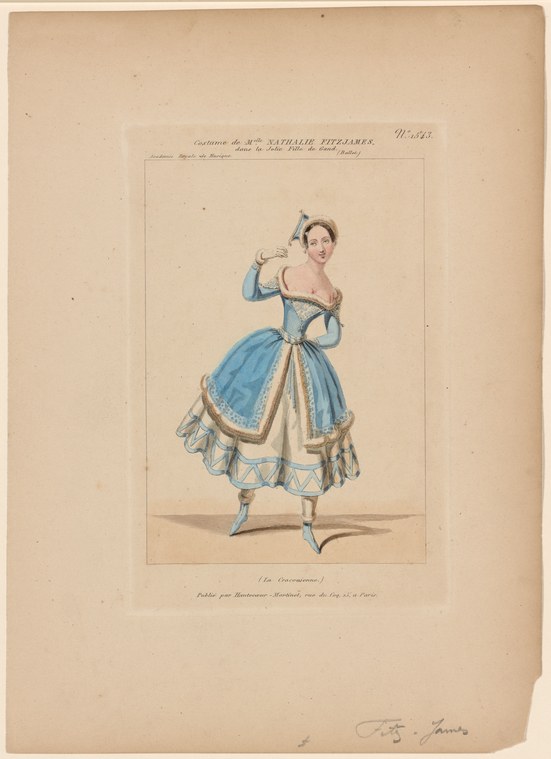
Costume de Melle. Nathalie Fitzjames, dans La jolie fille de Gand (Ballet), la Cracovienne
Unknown artist
- Collection:
- Prints depicting dance
- Source:
- New York Public Library
- Rights:
- Public domain — free to use, share and adapt.
- Recorded as:
- Public Domain
This print is direct evidence of how a celebrated dancer dressed for performance in the Romantic era—invaluable for costume historians and dancers studying the visual culture of mid-19th-century ballet. It also documents the celebrity economy of theatre: the fact that this image was engraved, hand-colored, and sold separately tells us that audiences did not just attend performances; they consumed and collected images of their favorite performers as merchandise, a practice that shaped how dancers understood themselves as public figures.
What you are looking at
A young female dancer stands alone against a plain background, posed in a moment of theatrical presentation. She wears a blue silk dress with a fitted bodice and off-shoulder sleeves, the skirt dramatically gathered and looped at the sides to reveal an ivory underskirt decorated with scalloped trim. Her hair is styled close to her head in the fashion of the 1830s–40s, and she gazes toward the viewer with a composed expression. Her posture is upright but relaxed, with one leg bearing weight and the other subtly extended, suggesting the instant before or after a movement. The figure is rendered in watercolor with delicate cross-hatching and sepia outlines, a costume study technique used to document the dress and appearance of performers for theatre archives or printed records.
The dancing
The dancer stands in an almost heraldic pose—weight on the right leg, left leg extended but not fully pointed, arms held naturally at the sides with the right hand resting at the hip. The posture is neither fully turned-out nor fully closed; it suggests the formal presentation stance of a performer at rest rather than the capture of balletic movement in progress. Her torso is upright and her frame open, characteristic of theatrical portraiture of the period, which prioritized legibility of costume over the documentation of technique.
The dance depicted
This is a costume study for Mademoiselle Nathalie Fitzjames in *La Jolie Fille de Gand* (The Pretty Girl of Ghent), a ballet performed in Paris in the 1840s. The piece appears to be documentary rather than narrative—a record of what the dancer wore on stage rather than a depiction of a specific choreographic moment. The work belongs to the tradition of Romantic ballet, when French and Italian dancers commanded international fame and their costumes were both markers of character and symbols of theatrical glamour. The dress itself—with its bell-shaped skirt, blue silk, and decorative looping—follows the aesthetic of Romantic-era tulle skirts, though this example appears daywear rather than pointe-based performance costume. Without visible evidence of pointe shoes or the characteristic lifted positions of ballet technique, the work functions primarily as a fashion and portrait document.
How it was made
This is a hand-colored engraving or lithograph, likely a tinted print of the type mass-produced in Paris during the 1830s–40s to satisfy demand for images of celebrated performers. The base layer is line-work in sepia or black ink; the color—primarily the blue of the dress and flesh tones—has been applied by hand afterward, a standard method for print circulation that allowed multiple copies to be colored individually. This technique meant the work was affordable enough for middle-class consumers and portable enough to circulate widely across Europe, making it an instrument of celebrity publicity and a record of what fashion-conscious theatre-goers would have seen.
About this work
This is a costume portrait of the Romantic-era dancer Nathalie Fitzjames, created to document her appearance in the ballet *La Jolie Fille de Gand*. It sits at the intersection of theatre documentation, fashion record, and celebrity portraiture—categories that overlapped in 1840s Paris, when ballerinas occupied the same cultural space as fashion icons and their likenesses were as commercial as their performances. The work is typical of the thousands of such prints produced across Europe to satisfy a hungry market for images of named dancers and the dramatic dress that was part of their appeal.
How to look at it
Look first at the dress: the engineer of the image is the costume, not the dancer's technique. The looping of the skirt, the shape and trim, the off-shoulder cut—these are the subjects. Then notice the pose: it is not a moment of maximum extension or expression, but a neutral presentation stance, the way an actor or model might stand to be measured for a dressmaker. This is the aesthetic of the costume study, which treats the human figure as a prop for fabric and design. The background is blank, isolating the figure and the dress as the sole focus—a convention of theatrical portraiture that also made the print easy to color by hand.
The artist
The artist is not recorded, which is common for colored theatrical prints of this era. Such works were often produced in workshops under a publisher's name rather than an individual artist's signature. The engraving technique and style are consistent with Parisian print production of the 1830s–40s, when houses like Martinet and others specialized in colored costume studies of theatre performers. These images were marketed directly to audiences at the stage door and through print sellers' shops.
The period
The 1830s–40s were the height of Romantic ballet in Europe, when the Parisian Opéra was the global center of the art form and dancers like Marie Taglioni, Fanny Elsler, and Carlotta Grisi achieved unprecedented fame and mobility. Theatregoers were intensely interested in the visual detail of performance—not just the dance itself but the costume, hair, and silhouette of the dancer. The printed costume study became a standard genre during this period, a way to extend the reach of a performance beyond the theatre and to create a collectible image of ephemeral moments on stage. At the same time, the technology of colored lithography and hand-tinting was perfected in Paris, making such prints affordable and fast to produce.
Where it lives
The work is held in the New York Public Library's collection of prints depicting dance. It is typical of the thousands of such hand-colored engravings and lithographs produced in Paris during the Romantic era and subsequently collected by theatre historians and dance enthusiasts in the 20th century.
Dance in this work
Questions about this work
Who was Nathalie Fitzjames?
Fitzjames was a celebrated ballerina active in Paris during the 1840s. She performed in major ballets of the Romantic era, including works at the Opéra. Like other dancers of her rank, she was the subject of multiple portraits and costume studies, which circulated as prints among theatre-goers. Little biographical detail survives in historical records, but the prints themselves are evidence of her fame at the time.
Why is the dress looped up on the sides like that?
The looped or swayed skirt was a fashion detail of the 1830s–40s, used to show the underskirt and the shape of the legs beneath. In theatrical costume, the device also made movement visible and prevented the skirt from entirely obscuring the dancer's legs during turns and jumps. The scalloped trim of the underskirt was both practical and decorative—it prevented fraying and added visual interest to the silhouette.
Is this a record of what she actually wore on stage?
Almost certainly yes. Costume studies were made from actual stage costumes or directly from what performers wore in dress rehearsals. They were then engraved and colored for sale to audiences. However, we cannot know whether this exact pose was chosen because it was dramatically significant or simply because it showed the dress most clearly.
Why is there no evidence of pointe shoes?
The image does not show the dancer's feet clearly enough to confirm whether she is in pointe shoes or flat slippers. The pose itself—upright and neutral—does not demand the lifted, turned-out line that would be visible in a dynamic ballet position. This is a portrait of the dancer as a fashionable figure, not a document of technical performance.
More dance artwork





