49 works in this view — arrow keys or swipe to move between them.
Dance in Art
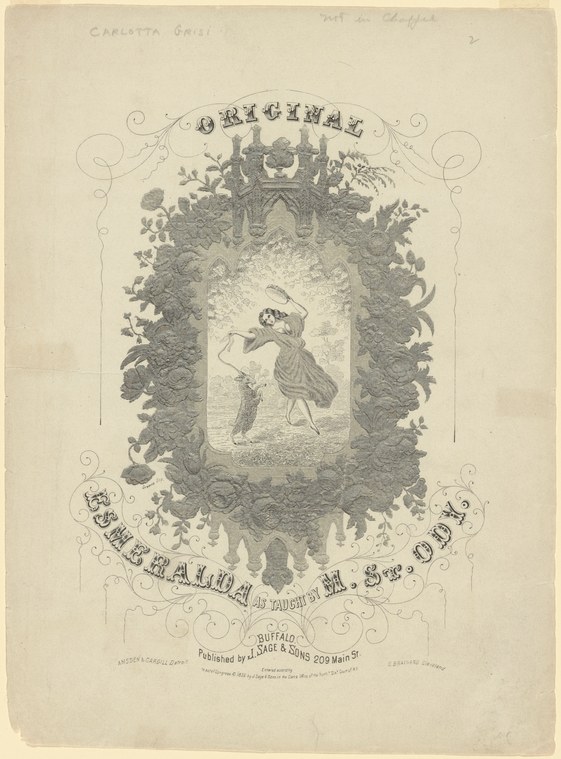
Original Esmeralda as taught by M. St. Ody
Unknown artist
- Collection:
- Prints depicting dance
- Source:
- New York Public Library
- Rights:
- Public domain — free to use, share and adapt.
- Recorded as:
- Public Domain
The inscription names a specific pedagogical authority ('as taught by M. St. Ody'), revealing the nineteenth-century ballet ecosystem in which choreographers and teachers claimed ownership of particular stagings and taught them to successive generations of dancers—a practice usually invisible in the historical record. It also documents the early commercial reproduction and mass marketing of ballet imagery, showing how theatrical dance became a consumer product distributed through prints and souvenirs.
What you are looking at
A young female dancer is poised in a classical ballet attitude, captured within an elaborate ornamental frame of dense foliage, flowers, and scrollwork. She wears a Romantic-era tutu with fitted bodice and wears pointe shoes, positioned in a graceful arabesque or attitude derrière with her arms raised in classical port de bras. The central vignette is rendered in fine engraving with careful attention to musculature and line. The heavy decorative border—composed of acanthus leaves, roses, morning glories, and rococo scrolls—frames this neoclassical figure with nineteenth-century theatrical glamour. The ornamental frame dominates the composition, suggesting this is a theatrical advertisement or souvenir rather than fine art.
The dancing
A single dancer stands in profile-three-quarter view with her weight primarily on her supporting leg, the working leg extended behind in a controlled turnout characteristic of classical ballet. Her arms frame the body in a formal classical position, and her posture demonstrates the upright carriage and elongated line essential to Romantic-era technique. The dancer's silhouette is slender and graceful, consistent with nineteenth-century ballet aesthetics. Her engagement with the frame suggests technical training rather than folk or social movement.
The dance depicted
This is ballet, almost certainly Romantic ballet of the early-to-mid nineteenth century. The inscription 'Original Esmeralda as taught by M. St. Ody' indicates this illustrates the Esmeralda ballet—most likely the 1836 work choreographed by Jean-Baptiste-Augustin Petipa to music by Cesare Pugni, or possibly an earlier adaptation. M. St. Ody may have been a notable teacher or choreographer who claimed proprietary authority over a particular staging. The pose, pointe work, and costume align precisely with Romantic ballet conventions, and the theatrical poster format suggests this was promotional material used to market a specific dancer or revival production.
How it was made
This is an engraving—a relief or intaglio print technique—as evidenced by the fine hatching lines, precise linear boundaries, and monochromatic rendering. The ornate frame was a common device in nineteenth-century theatrical souvenirs, sheet music covers, and dance advertisements, allowing manufacturers to add market appeal to images of celebrated dancers and ballets. The combination of technical precision and commercial decoration suggests this was produced by a commercial engraving house for a popular audience—dancers, theatregoers, and collectors of theatrical ephemera. The printing technique allowed multiple copies to be produced cheaply, making ballet imagery widely accessible.
About this work
This is a nineteenth-century engraved theatrical souvenir depicting a dancer performing the role of Esmeralda in the eponymous Romantic ballet. The image serves as promotional material for a specific choreographic interpretation taught by or attributed to an instructor named M. St. Ody. It documents both a celebrated dance work and the pedagogical practice of named ballet masters licensing or teaching particular stagings of popular ballets to students and companies.
The work belongs to the culture of Romantic ballet fandom that flourished from the 1830s onward, when celebrated dances and dancers were reproduced on prints, sheet music covers, and fan souvenirs. It records not just a single dancer or performance, but the existence of multiple authoritative stagings of the same ballet and the market for collectors' items bearing a dancer's image and credentials.
How to look at it
Observe the dancer's alignment: the vertical axis of the supporting leg, the extension and turnout of the working leg, the placement of the head and arms. These details show whether the engraver understood classical ballet technique or was merely copying a generic 'graceful female figure.' The ornamental frame, while decorative, should be read as a historical document too—its commercial elaborateness tells you how valuable ballet dancers had become as public figures and commodities. Notice that the frame and title are as prominent as the dancer herself, indicating this was sold as a named entertainment product rather than as art for art's sake.
The period
The Esmeralda ballet was created in 1836 by Jean-Baptiste-Augustin Petipa and became one of the most widely performed Romantic ballets of the nineteenth century. The style was part of the broader Romantic movement's fascination with exotic, medieval, and fantastical subjects; Esmeralda drew on Victor Hugo's novel *The Hunchback of Notre-Dame*. This print dates from the height of Romantic ballet popularity, when the form dominated European and American theatrical culture and reproductions of celebrated dancers and roles were avidly collected. The ornate engraved frame reflects the commercial sophistication of mid-nineteenth-century theatrical marketing.
Where it lives
This engraving is held in the New York Public Library's collection of prints depicting dance. It is a mass-produced theatrical souvenir, likely issued by a commercial publisher in Buffalo (as indicated by the imprint 'Buffalo, Published by J. Sage & Sons, 209 Main St'). This format—popular, commercial, widely distributed—makes it valuable evidence of dance history from the audience's and consumer's perspective rather than from archival or institutional records.
Dance in this work
Questions about this work
Who was M. St. Ody?
The catalogue record does not identify this person, and the inscription only indicates they taught or staged the Esmeralda ballet. M. St. Ody may have been a choreographer, ballet master, or teacher who claimed authority over a particular version of the Petipa choreography or an earlier adaptation. The naming of a specific teacher or choreographer was a selling point for theatrical souvenirs, assuring buyers they were purchasing an image of an 'authentic' or celebrated staging.
What ballet is this depicting?
Esmeralda, a Romantic ballet based on Victor Hugo's *The Hunchback of Notre-Dame*. The most famous choreography is the 1836 version by Jean-Baptiste-Augustin Petipa with music by Cesare Pugni. However, the ballet was staged and restaged by multiple choreographers, and this print documents one particular version as taught by M. St. Ody.
Why is the ornamental frame so elaborate?
The ornate frame was a standard commercial device in theatrical souvenirs and sheet music covers of the nineteenth century. It served to beautify and dignify the product, justify a higher price, and make the image collectible. The frame also allowed the printer to add decorative appeal without requiring a more skilled or expensive engraver; the dancer herself could be rendered more simply, with the frame doing the aesthetic work.
What can I learn about Romantic ballet from this image?
The dancer's pointe work, tutu, upright carriage, and extended leg position exemplify Romantic ballet aesthetics and technique. The costume and pose reflect the mid-nineteenth-century ideal of the female ballet dancer: slender, graceful, technically trained, and available as a visual commodity for mass consumption. The print also documents the pedagogy of ballet, showing how celebrated choreographic works were transmitted through named teachers and stagings.
More dance artwork





