49 works in this view — arrow keys or swipe to move between them.
Dance in Art
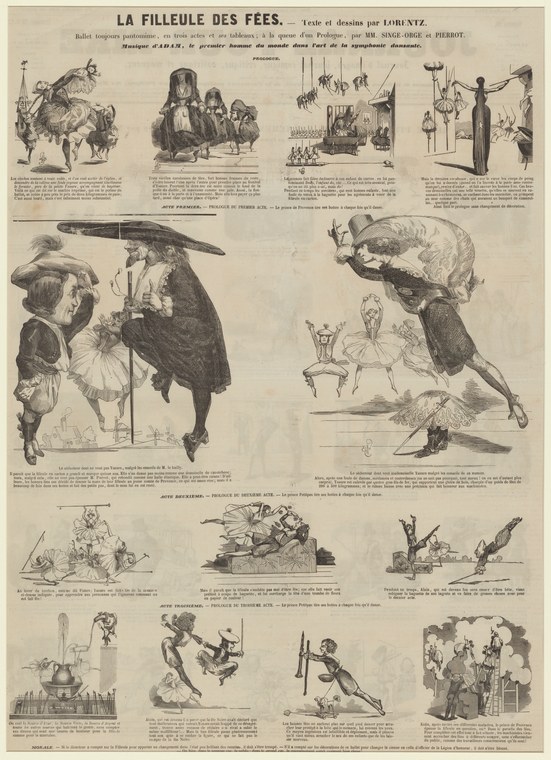
La filleule des fées: ballet toujours pantomime, en trois actes et ses tableaux; à la queue d'un prologue, par MM. Singe-Orge et Pierrot
Unknown artist
- Collection:
- Prints depicting dance
- Source:
- New York Public Library
- Rights:
- Public domain — free to use, share and adapt.
- Recorded as:
- Public Domain
Pantomime ballet is often overlooked in dance history in favour of Romantic ballet, yet it was the dominant theatrical dance form of its era and shaped how the public understood spectacle, transformation, and the possibilities of the stage. This print is a rare visual document of that lost tradition, showing us the grotesque characters, the flying effects, and the narrative-driven entertainment that preceded the plotless ballets and ethereal aesthetics of the later 19th century. For scholars of 19th-century theatre, dance, and visual culture, it is evidence of a parallel tradition that influenced everything from musical theatre to circus.
What you are looking at
This is a composite engraving presenting multiple scenes from a three-act pantomime ballet titled *La filleule des fées* (The Fairy's Godchild). The print is divided into approximately twelve vignettes arranged across the page, each depicting a different moment or tableau from the narrative. The upper register shows elaborate stage machinery and scenic effects: a palatial interior with hanging decorations, a figure suspended on wires or in an aerial apparatus, and various magical transformations. The middle and lower sections contain grotesque and fanciful character studies—witches, demons, fairy-tale figures, and enchanted beings—rendered in the exaggerated, satirical style typical of theatrical caricature. The figures wear elaborate costumes ranging from elegant court dress to monstrous or supernatural garb. The overall composition emphasizes visual spectacle and narrative progression through discrete, framed scenes rather than a single unified action, suggesting the episodic structure of pantomime ballet with its reliance on transformation, surprise, and magical effects.
The dancing
The dancers and characters are depicted in poses that emphasize theatrical extremity: twisted spines, elevated limbs, exaggerated arabesques, and impossible contortions that belong to pantomime and acrobatic spectacle rather than academic ballet technique. In several scenes, figures appear to be suspended or flying through the air—characteristic of the fairy-tale genre and the mechanical stage effects of the period. The costumes range from elaborate tutus and court dress to grotesque masks and supernatural attire. There is no single unified holding pattern or frame; instead, each vignette shows figures in isolation or small groups, often in attitudes of surprise, flight, or magical transformation. The rendering prioritizes character and narrative moment over technical precision of movement.
The dance depicted
This is a French pantomime ballet, a theatrical form that combines dance, acrobatics, mime, and spectacular scenery. Pantomime ballet was a dominant form in early 19th-century French theatre, designed for popular appeal and emphasizing narrative, magical spectacle, and comic characters over the refined technique that would come to define Romantic ballet. The title, *La filleule des fées* (with a prologue by Singe-Orge and Pierrot), suggests a fairy-tale narrative in which a mortal is protected or transformed by magical beings. The repeated imagery of flight, transformation, and supernatural beings confirms this as a work in the tradition of pantomime-ballet, which relied on elaborate machinery, trap doors, and flying rigs to create the illusion of magic. The exaggerated character work and grotesque figures suggest that humor and spectacle were central to the entertainment value.
How it was made
This is an engraving, a relief-printing technique that allowed for mass circulation and reproduction. The fine linework, subtle tonal variations achieved through cross-hatching, and the ability to capture precise detail and caricature are all characteristic of steel or wood engraving. As an engraving, this print would have been affordable and widely distributed to the theatre-going public, serving as a souvenir, advertisement, or critical commentary on the production. The technique's precision also allowed the artist to render the elaborate costumes, stage machinery, and fantastical imagery with clarity. The division of the composition into multiple framed vignettes is well suited to the engraving medium, which excels at narrative sequences and detailed figural work.
About this work
This engraving documents a French pantomime ballet from the early 19th century, a theatrical hybrid that combined acrobatics, mime, dance, and elaborate stage machinery to tell fairy-tale stories to popular audiences. *La filleule des fées* exemplifies the form through its emphasis on magical transformation, supernatural characters, and visual spectacle rather than academic ballet technique. The print preserves not only the narrative and visual style of the production but also the exaggerated character work and grotesque comic types that made pantomime ballet a distinct entertainment form, separate from the refined Romantic ballet tradition that was emerging in the same period. As an engraving, it demonstrates how theatrical productions were marketed and consumed: prints were sold as souvenirs, critical records, and advertisements, making theatre accessible to those who could not attend live performances.
How to look at it
Attend first to the overall structure: the print is a composite narrative rather than a single moment, which tells you that you are looking at a summary or selection of highlights rather than a representation of a live performance. Notice how the artist handles the fantastic and impossible: figures flying, suspended in mid-air, and contorted in ways that would be impossible without mechanical aid or artistic exaggeration. This is central to pantomime ballet's appeal—the machinery is part of the spectacle. Look also at the character studies, especially the grotesque masks and supernatural beings, which emphasize theatrical type and comic effect over individual psychology. Finally, trace the progression through the vignettes to understand how narrative was conveyed: through transformation, surprise, and the introduction of new fantastic characters.
The artist
The artists credited are Lorntz (the engraver) and Singe-Orge and Pierrot (the scenario or play authors). Beyond these names and credits on the print itself, no further information about their practice or biography is recorded. Singe-Orge and Pierrot may refer to character types rather than individual authors, which was not uncommon in theatre attribution of the period.
The period
This print dates from an era when French theatre was undergoing rapid change. The early 19th century saw the rise of Romantic ballet (exemplified by works like *La Sylphide*, 1832) with its emphasis on ethereal heroines, pointe work, and supernatural narratives told through refined technique. However, pantomime ballet remained a vigorous popular entertainment, especially in provincial theatres and lesser opera houses. The combination of acrobatics, comedy, fairy-tale narratives, and mechanical spectacle in *La filleule des fées* reflects the tastes of a broad, paying audience. Engraved theatre prints were a major form of visual culture and advertising in this period, and the caricatural style of the figures suggests a tradition of theatrical satire and social commentary through exaggeration.
Where it lives
This is an engraved print held in the Prints collection of the New York Public Library. It is a theatrical souvenir and record, one of thousands of such prints that documented live performances and were sold to audiences as mementos and advertising. As a print, it exists in multiple impressions and would have had relatively wide circulation among theatre-goers and print collectors.
Dance in this work
Questions about this work
What is pantomime ballet and how does it differ from ballet?
Pantomime ballet is a theatrical form that combines dance, acrobatics, mime, and spectacular stage machinery to tell fairy-tale or comedic stories. Unlike ballet, which emphasizes refined technique and often abstract movement, pantomime ballet prioritizes narrative clarity, character work, and visual spectacle. It was the dominant form of theatrical dance in early 19th-century popular theatre, appealing to broad audiences who wanted story, magic, and comedy rather than pure dance technique.
What are the flying effects shown in this print and how were they achieved?
The imagery of suspended and flying figures indicates the use of stage machinery—counterweights, rigs, and mechanical apparatus—that allowed performers to be lifted and moved through the air. This was a signature feature of pantomime ballet and fairy-tale theatre, creating the illusion of magic and transformation. The machinery itself was often visible or semi-visible to the audience and was part of the entertainment value, not something hidden behind a curtain.
Who were Singe-Orge and Pierrot, the credited authors?
Singe-Orge and Pierrot are credited as the scenario or play authors, but they may represent character archetypes or performance styles rather than individual historical figures. Pierrot was a stock character in French theatre and comedy, while Singe-Orge (Monkey-Ogre) suggests a grotesque or comic character type. Without further records, it is difficult to identify these as specific historical persons.
Why would someone buy an engraved print of a theatre performance?
Theatre prints served multiple purposes: as advertisements and announcements of upcoming productions, as souvenirs purchased by audience members who had seen the live show, and as critical or satirical commentary on performances and performers. They made theatre accessible to people who could not afford tickets and provided a record of the visual spectacle and costumes. Prints were collected and bound into albums or displayed in homes, making them a significant form of popular visual culture.
More dance artwork





