49 works in this view — arrow keys or swipe to move between them.
Dance in Art
Le Pas des fleurs
Unknown artist
- Collection:
- Prints depicting dance
- Source:
- New York Public Library
- Rights:
- Public domain — free to use, share and adapt.
- Recorded as:
- Public Domain
This print is crucial evidence of how Romantic ballet was performed, marketed, and understood by nineteenth-century audiences. It shows the corps de ballet as an aesthetic object—not a background to soloists, but a primary focus—and documents the international circulation of ballet practice, with Viennese dancers performing in London to advertise a new cosmopolitan dance culture. The work also reveals the visual technologies through which dance was preserved and disseminated before photography: the lithographic print allowed ballet to reach audiences beyond the theatre and created a visual archive of movement that would otherwise have vanished.
What you are looking at
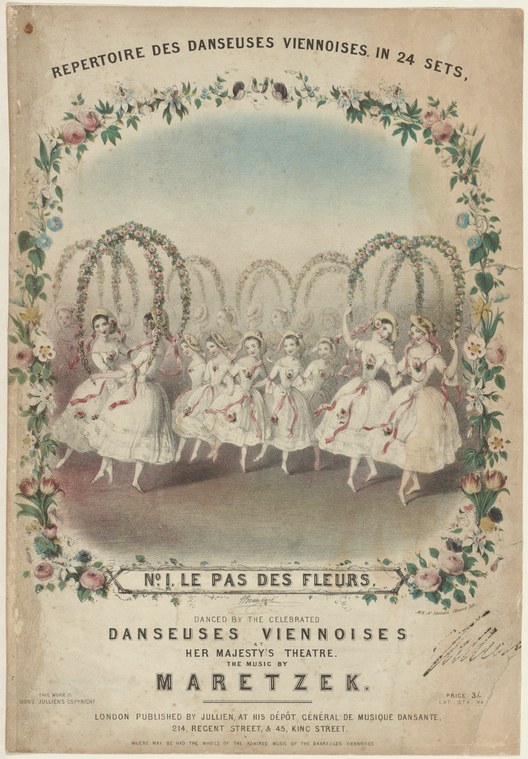
A theatrical stage scene populated by eight young female dancers in identical white tutus and pointe shoes, arranged in two rows beneath a series of graceful floral arches. The arches—constructed from flowering vines and greenery—dominate the composition and create a processional, garden-like setting that frames the dancers' movement. The dancers are captured mid-performance, bodies angled and positioned to suggest continuous, synchronized motion. The entire scene is enclosed within an ornamental border of painted flowers and foliage in soft pinks, greens, and naturalistic tones. The print itself is hand-colored, with pale washes establishing a luminous sky-blue backdrop that emphasizes the dancers' white costumes. The setting is clearly theatrical—a stage spectacle rather than a naturalistic garden—yet the abundant floral decoration creates an ethereal, romantic atmosphere.
The dancing
The dancers are positioned in informal groupings rather than rigid lines, with varied arm positions suggesting active movement through space. Most display the characteristic raised arms and lifted carriage of ballet dancers; several appear to be captured mid-step or mid-turn, with bodies inclined to suggest momentum. All wear the pointe shoes and full, layered white tutus standard to nineteenth-century Romantic ballet. The dancers' poses are not uniform—they are staggered and overlapping, creating depth and a sense of ensemble movement rather than parade-ground precision. The arches frame and contain the figures without constraining them, allowing the dancers' bodies to read as floating within the garden space.
The dance depicted
This is a Romantic ballet scene, most likely from a mid-nineteenth-century Parisian ballet. The title *Le Pas des fleurs* (The Flower Pas or Flower Step) and the printed inscription identify this as a scene from the repertory of the celebrated Viennese dancers (*Danseuses Viennoises*), performed at Her Majesty's Theatre in London under the direction of Maretzek. The work shows the characteristic vocabulary of Romantic ballet—ethereal, corps-de-ballet ensemble work set in an idealized natural setting—with the floral arches and garden aesthetic typical of ballets of the 1840s–1850s. The dancers' positioning and arm work suggest a pas d'ensemble or corps movement sequence rather than a soloist showcase, consistent with the democratic, floating quality of Romantic-era group choreography.
How it was made
This is a hand-colored lithographic print, a technique that allowed for the rapid, economical production of theatrical imagery for London audiences. The hand coloring—evident in the soft pastels and selective washes—was applied after printing and accounts for the luminosity and delicate tonal gradations. Lithography was the dominant technology for theatrical publicity and souvenirs in the 1840s–1850s, allowing artists to combine the drawn line with tonal effects and enabling quick reproduction of multiple copies. This print would have circulated as a souvenir, likely sold at the theatre itself, and as such captures an ephemeral performance moment for a paying public who had seen the work onstage.
About this work
This is a lithographic print documenting a scene from a mid-nineteenth-century Romantic ballet performed by a company of Viennese dancers in London. The work exemplifies the visual vocabulary of Romantic ballet—white tutus, pointe work, ethereal ensemble choreography set in an idealized natural world—while serving as a record of a specific historical performance and a commercial souvenir. The print's ornamental, hand-colored presentation speaks to the status of ballet as a fashionable urban entertainment and the commercial apparatus that surrounded it: theatrical prints were collected, displayed, and exchanged as objects of desire in their own right. The composition balances documentary specificity (the named dancers, the named theatre, the scene title) with romantic idealization, capturing both the historical fact of the performance and its emotional effect on the audience.
How to look at it
Observe the absence of a single focal point: the dancers are distributed across the composition in a way that asks the viewer to take in the ensemble as a unified aesthetic object rather than following individual dancers. Notice the play of the floral arches—they are purely decorative and do not frame individual dancers, but rather create a continuous architectural space that the dancers inhabit. The varied positioning of the dancers' bodies suggests movement in multiple directions and planes, a choreographic sophistication that resists the static formality of earlier theatrical imagery. The hand coloring is deliberate and restrained, allowing the white tutus to read as luminous against the pale background—an effect that emphasizes the dancers' bodies as the primary visual subject.
The artist
The print is credited to no individual artist in the inscription; instead it is attributed to the theatrical tradition and the dancer-celebrities it names. However, it was published by Julien in London, the major publisher of theatrical prints and music for the London stage in the 1840s–1850s. Julien's firm was the primary vehicle for disseminating images of celebrated performers and was instrumental in creating the visual culture of mid-Victorian theatre. The quality of the lithography and hand coloring suggests a professional workshop operation rather than amateur work.
The period
This print dates to the height of European Romantic ballet, when the genre had stabilized around a set of visual and choreographic conventions: the white tutu, pointe work, the corps de ballet as a unified aesthetic entity, and narratives set in idealized natural or supernatural worlds. The Romantic era (roughly 1830–1860) saw the international circulation of ballet companies and star dancers, and London was a major destination for continental performers. The presence of Viennese dancers performing in London speaks to the cosmopolitan nature of mid-nineteenth-century theatrical culture. Lithographic prints were the dominant visual medium for theatrical publicity and souvenirs during this period, before photography displaced them in the 1870s.
Where it lives
This print is part of the New York Public Library's collection of prints depicting dance, held in the Dance Division. It is a commercial theatrical souvenir, produced and sold in London for audiences who had seen or desired to see the performance.
Dance in this work
Questions about this work
Who were the Viennese dancers?
The 'Danseuses Viennoises' (Viennese dancers) were a company of primarily Austrian and German dancers who toured major European cities in the 1840s–1850s, performing repertory ballets and earning considerable celebrity. They represented a cosmopolitan, international approach to Romantic ballet and were celebrated for their technical accomplishment and ethereal style. The company was associated with Vienna's imperial ballet tradition and brought that training to London, Paris, and other major centres.
What is a pas?
In ballet terminology, a 'pas' is a step or combination of steps; a 'pas d'ensemble' is a dance for a group, typically the corps de ballet. 'Le Pas des fleurs' translates as 'The Flower Pas,' and likely refers to a group dance sequence set in a garden or flower-garden setting, a common motif in Romantic ballet. It is not a solo showcasing a single dancer's virtuosity.
What was Her Majesty's Theatre?
Her Majesty's Theatre (also known as the King's Theatre depending on the reigning monarch) was one of the two major opera houses in London in the nineteenth century, the other being Drury Lane. It was a fashionable venue for continental performers and was particularly associated with ballet and operatic spectacle. The inscription identifies this performance as having taken place there, establishing its significance as a major London theatrical event.
Why are they on their toes?
Pointe work—dancing on the tips of the toes in specially reinforced pointe shoes—became a standard technique in Romantic ballet, beginning in the 1820s. It allowed dancers to achieve an ethereal, weightless quality that was central to Romantic aesthetics, particularly the illusion of flight or supernatural presence. By the 1840s–1850s, when this print was made, pointe work was an expected and celebrated part of female ballet technique.
More dance artwork





