49 works in this view — arrow keys or swipe to move between them.
Dance in Art
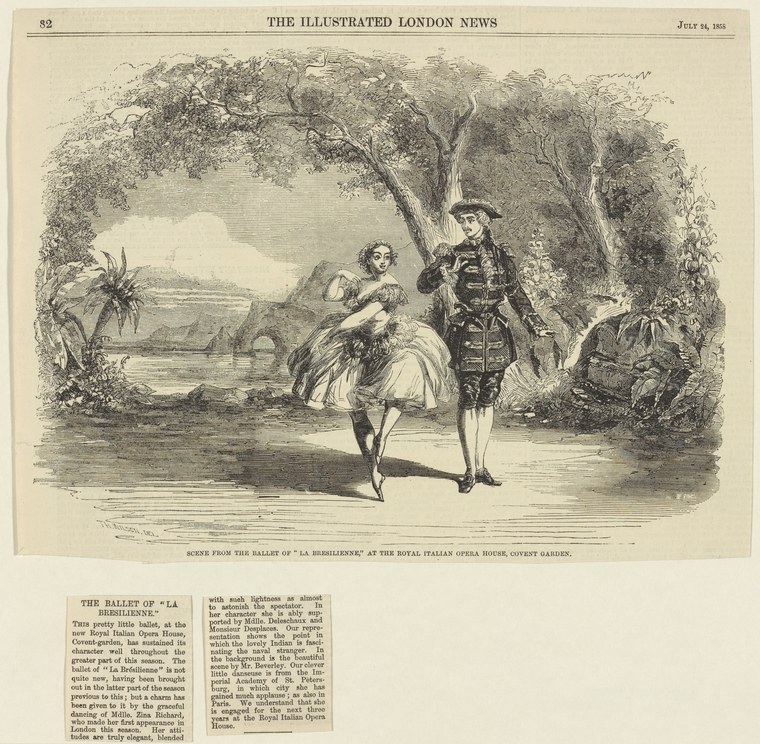
Scene from the ballet of La brésilienne, at the Royal Italian Opera House, Covent Garden
Unknown artist
- Collection:
- Prints depicting dance
- Source:
- New York Public Library
- Rights:
- Public domain — free to use, share and adapt.
- Recorded as:
- Public Domain
This image is a primary record of how Romantic ballet looked and felt to its contemporary audience, captured not by a theater historian but by the commercial press. It shows the conventions of the male-female pas de deux at a moment when those conventions were being standardized across European opera houses, and it documents the specific role of exoticism—the Brazilian setting—in Romantic ballet's appeal. For anyone studying nineteenth-century dance, gender, or theatrical spectacle, it is concrete evidence of what was performed, what was valued, and how it was seen.
What you are looking at
A wooded riverside setting with spreading trees and classical architectural elements suggests an idyllic pastoral or theatrical landscape. Two dancers occupy the center ground: a woman in a pale, voluminous skirt with dark corseting and a man in a dark military-style jacket with ornate frogging and a plumed hat. The woman is captured in a moment of dramatic motion—her body arches backward, weight on one leg, the other extended, her torso and arms flung open in a pose of theatrical abandon or distress. The man stands upright beside her, one arm extended toward or supporting her, his posture controlled and formal. The engraving's hatching creates deep shadow beneath the trees and luminous highlights on the dancers' bodies and costumes, drawing the eye to their central figures. The composition reads as a single moment of narrative intensity—a pas de deux frozen mid-gesture.
The dancing
The woman's frame shows the hallmarks of Romantic-era theatrical vocabulary: her body is hyperextended in a curve, one leg supporting her full weight while the other trails or extends, her upper body open and her arms spread in a gesture of emotional extremity—vulnerability, ecstasy, or theatrical distress. The man's posture is upright and attentive, his arm reaching toward his partner in a protective or supporting gesture characteristic of a male dancer's role in a pas de deux. There is no closed hold; instead, the relationship is one of spatial proximity and mutual engagement, with his body angled toward hers. The woman's costume allows full visibility of her leg position; the man's formal military dress suggests a noble or supernatural male character.
The dance depicted
This is a scene from a theatrical ballet of the Romantic period, most likely from the mid-nineteenth century. The subject is identified in the caption as *La brésilienne*, performed at the Royal Italian Opera House, Covent Garden. The engraving captures a pas de deux in which the male dancer attends to a female dancer in a state of emotional or physical extremity. The vocabulary—the woman's arched, weightless posture, the male dancer's supporting role, the exotic or fantastical costume—is consistent with the Romantic ballet aesthetic, in which female dancers were often portrayed as ethereal, vulnerable, or otherworldly beings, and male dancers as mortal or noble protectors. The Brazilian subject matter and the riverside setting suggest a narrative of exoticism or adventure, typical of Romantic-era ballet plots.
How it was made
This is an engraving or wood-engraving, identifiable by the fine parallel hatching lines used to create tone, shadow, and texture throughout the image. The technique allowed for precise rendering of fabric, musculature, and facial expression, and the dense hatching in the background creates atmospheric depth. As a reproductive print, this would have circulated widely in the illustrated press—it appears in *The Illustrated London News*, a prestigious weekly magazine with a large middle-class readership. The medium and venue indicate this was not a private record but a public document of a notable theatrical event, designed to give readers who did not attend the performance a sense of its spectacle and narrative content.
About this work
This is a mid-nineteenth-century engraving documenting a scene from *La brésilienne*, a ballet performed at London's Royal Italian Opera House during the height of the Romantic ballet era. It shows a pas de deux between a male dancer in military dress and a female dancer captured in a moment of dramatic physical and emotional extremity. The image is a record of theatrical spectacle aimed at a newspaper-reading public: it captures the exotic narrative, the formal vocabulary of Romantic ballet, and the sex role conventions of the period—the woman as a creature of emotion and physicality, the man as her stabilizing partner.
As a printed source rather than a manuscript or painting, it tells us how ballet was mediated and consumed by the Victorian middle class. The newspaper's editors selected this moment—not a static pose but a dramatic apex—as the image that would convey the essence of the performance to readers. It is evidence of how dance existed in the public imagination: as a narrative, as spectacle, as a vehicle for emotion and exoticism, and always as a relation between male and female bodies.
How to look at it
Attend first to the woman's body: the engraver has rendered her in a pose of extreme extension and emotional intensity—arched, weightless, her limbs arranged in a curve that reads as both technically demanding and dramatically vulnerable. This is the visual language of Romantic ballet: the female body as an instrument of feeling rather than power. Notice how the male dancer's body frames hers—his vertical posture and extended arm create a stable geometry against which her curve reads as disturbance or surrender. The military dress and plumed hat mark him as a social being from the 'real' world; her pale, elaborate costume and the riverside setting place her in a realm of fantasy or dream. The engraver chose to freeze the moment not at a moment of stillness but at maximum extension, maximum drama—the moment when the narrative and the movement are one.
The period
This engraving dates to the mid-nineteenth century, the height of the Romantic ballet movement in Europe. Romantic ballet, which flourished from approximately 1830 to 1870, centered on the female dancer as the primary vehicle of theatrical meaning and emotion. Male dancers played supporting roles; exotic or supernatural settings were standard; and the pointe shoe (then relatively new) became the signature technology of the female dancer's otherworldliness. London's Royal Italian Opera House was a major venue for European ballet and opera, and the staging of *La brésilienne*—with its exotic geographical reference—reflects the period's fascination with colonialism, travel, and the aesthetic potential of 'other' places and peoples. The engraving's publication in *The Illustrated London News* places it within a boom in illustrated journalism that brought theater, current events, and visual culture to a rapidly expanding literate middle class.
Where it lives
This engraving is held in the New York Public Library's collection of prints depicting dance. It was published in *The Illustrated London News*, a weekly magazine founded in 1842, which serialized images of cultural events, theater, and current affairs for a broad middle-class readership. Its presence in the NYPL's dance collection indicates its status as a document of theatrical history rather than fine art.
Dance in this work
Questions about this work
What was *La brésilienne*?
A ballet performed at the Royal Italian Opera House, Covent Garden, during the mid-nineteenth century. The title refers to a Brazilian subject or setting, reflecting the Romantic era's fascination with exoticism. No other record of this specific ballet is widely available, suggesting it may have had limited run or limited historical documentation. This engraving is one of the primary sources we have for what it looked like.
What is the male dancer doing?
He is playing the role of male partner in a pas de deux—a supporting role typical of mid-nineteenth-century ballet. His body is upright and stable; his arm is extended toward the female dancer in a gesture of support, protection, or attendance. In the vocabulary of Romantic ballet, the male dancer's job was to frame, support, and stabilize the female dancer's more theatrical and emotional movement.
Why does she look like she's falling backward?
This is likely an intentional pose in the choreography—a moment of dramatic extension, surrender, or emotional extremity that was central to Romantic ballet's aesthetic. The male dancer's presence and arm suggest he is supporting her or about to catch her. Such poses were designed to convey emotion and vulnerability while showcasing the female dancer's flexibility and control.
How was this image made?
This is an engraving or wood-engraving, a reproductive print technique that uses fine parallel lines (hatching) to create tone and texture. It was published in *The Illustrated London News*, a weekly magazine, which means it was created as a public document for a mass audience. The original drawing was likely made from a theater sketch or memory of the performance; the engraver then translated it into a medium suitable for printing and wide circulation.
More dance artwork





