49 works in this view — arrow keys or swipe to move between them.
Dance in Art
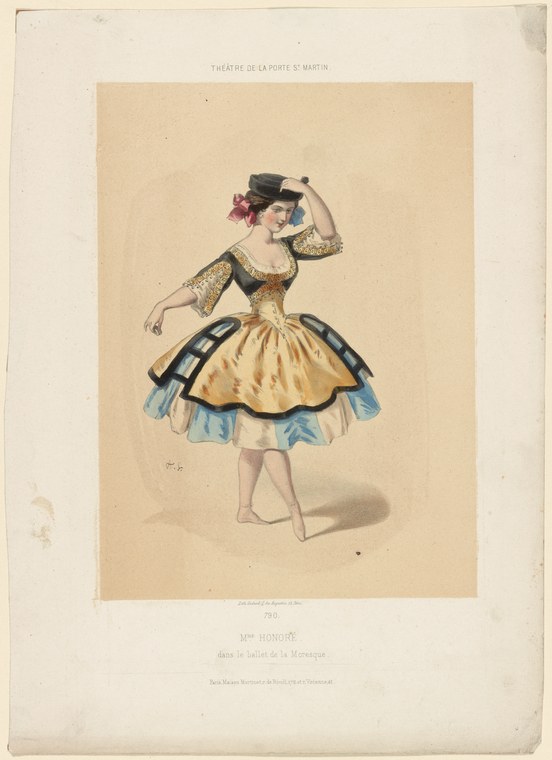
Théâtre de la Opera Porte St. Martin. Mme. Honoré dans le ballet de la Moresque
Unknown artist
- Collection:
- Prints depicting dance
- Source:
- New York Public Library
- Rights:
- Public domain — free to use, share and adapt.
- Recorded as:
- Public Domain
This print documents an otherwise obscure theatrical moment and performer, yet it captures exactly the kind of everyday commercial ballet and pantomime that audiences actually paid to see in the 1830s–1840s—not the canonical works of the classical repertory, but short divertissements and character dances woven into mixed-genre evenings. For historians of dance, costume, and popular theatre, it is a window into how orientalist fantasy, female celebrity, and stage costume created market demand and shaped the visual culture of early romantic dance.
What you are looking at
A young female dancer is shown in a three-quarter pose against a pale cream background, captured mid-movement. She wears a black corseted bodice with short sleeves trimmed in gold braid, paired with a voluminous skirt of golden-yellow silk with a deep navy-blue pleat or panel at the back, and a pale blue underskirt visible beneath. Her dark hair is styled up with a small black hat or cap and adorned with pink flowers. She holds her right arm raised to adjust or steady her hat, while her left arm rests naturally at her side. Her legs are bare or clad in pale stockings, with her weight shifted slightly forward in a light, balletic stance. The figure is rendered in hand-colored lithograph or engraving style, with careful attention to fabric texture and the play of light across the costume.
The dancing
A single female dancer occupies the composition, posed in a quasi-balletic attitude that suggests a moment of repose or a transition between movements rather than a culminating leap or turn. Her right arm is raised above her head with a graceful, casual gesture toward her hat—a living adjustment rather than a formal port de bras. Her weight is evenly distributed with a slight forward inclination of the torso, and her legs appear nearly straight, without the extreme turnout or the lifted calf line of classical ballet technique. The pose is youthful, informal, and suggests a lighter, more naturalistic movement vocabulary than the formal rigor of strict classical ballet.
The dance depicted
This is almost certainly a theatrical dance figure from the Paris Opéra Comique or a similar popular theatre of the 1830s–1840s, though the exact title 'le ballet de la Moresque' (the Moorish ballet) is not immediately recognizable in major repertory records. Mme. Honoré was a known stage dancer of the period, and the costume—the exotic juxtaposition of the corseted European bodice with the 'Moorish' silhouette and colour palette—suggests a romanticized orientalist number of the kind that proliferated in commercial ballet and pantomime of the July Monarchy. The dance appears to be a solo showpiece emphasizing the dancer's figure and costume rather than virtuosity, and was likely performed in a mixed-genre evening that combined ballet, vaudeville, and comic drama.
How it was made
This is a hand-colored lithographic print, characteristic of French theatrical publicity and dance documentation of the 1830s–1850s. The image shows the drawing, tonal gradation, and subtle color layering typical of lithography. The delicate hand-coloring and careful rendering of fabrics suggest this was a high-quality commercial print produced for sale to theatre-goers and collectors—not a simple playbill illustration. Such prints served as both documentation of costuming and movement for a particular production and as souvenirs that helped circulate the image and celebrity of the performer. The medium's capacity to render soft transitions and fabric texture made it ideal for capturing the effect of stage costume and lighting.
About this work
This is a theatrical dance print documenting Mme. Honoré in a solo character role from an early 19th-century Paris Opéra Comique production. The work is an artifact of the period when ballet and dance were a major draw of commercial theatre, and when the image of the dancer—in costume, posed for the print rather than in motion—became a commodity in its own right. The careful hand-coloring and the theatrical credit line at the top of the print indicate a professionally produced, high-circulation image intended for the fan and theatrical collector market. The costume and title suggest an orientalist ballet typical of the Romantic era's fascination with exotic lands and the corseted, light-limbed, graceful female body as the ideal vehicle for fantasy and spectacle.
How to look at it
Notice the unstudied quality of the pose—the hand raised to the hat is a moment of adjustment, not a formal ballet port de bras, which makes the figure feel human and momentary rather than statuesque. The costume is the real subject: observe how the artist has rendered the weight and sheen of the silk skirt, the precise embroidery and braid of the bodice, and the delicate play of the pale undergarment against the darker outer fabric. This is not an action scene but a portrait of a performer in character, designed to convey both the elegance of the dancer and the allure of the costume. The pale, neutral background throws the figure into sharp relief—a theatrical convention that mimics the isolation of a spotlight on a dark stage.
The period
This print dates to the height of the July Monarchy (1830–1848), when the Opéra and Opéra Comique in Paris were thriving centres of entertainment and innovation. Romantic ballet—with its emphasis on sylphs, spirits, and exotic locations—was at its peak, but alongside the great narrative ballets performed at the Opéra, the smaller commercial theatres like the Porte Saint-Martin offered lighter, shorter dance works integrated into vaudeville and comic-opera evenings. Orientalism was a dominant aesthetic across all the arts, and the 'Moorish' or 'Oriental' ballet was a stock genre, drawing on contemporary fantasy about North Africa and the Middle East. Female dancers were becoming increasingly famous as individuals and celebrities; their likenesses were circulated in prints that functioned as both theatrical advertising and collectible souvenirs. The hand-colored lithograph was the dominant medium for such celebrity portraiture before photography.
Where it lives
This is a hand-colored lithographic print held by the New York Public Library in its collection of prints depicting dance and theatrical performance. It bears a printed credit line identifying the Théâtre de la Porte Saint-Martin and the dancer Mme. Honoré. Such prints were produced in editions of hundreds to thousands and distributed through theatres, shops, and subscription collectors; this example, like many in institutional collections, was gathered as part of a broader archival effort to document dance, costume, and theatre history.
Dance in this work
Questions about this work
Who was Mme. Honoré?
Mme. Honoré was a known dancer and performer at the Paris Opéra Comique and other commercial theatres in the 1830s–1840s, but detailed biographical records are sparse. She appears to have specialized in lighter character and comic roles, including this 'Moorish' solo. Like many theatrical performers of her era, she is now known primarily through prints like this one that advertised her performances and circulated her image.
What is the 'ballet de la Moresque'?
The title translates as 'the Moorish ballet,' and refers to a short theatrical dance, probably a solo or small ensemble number, performed at the Porte Saint-Martin theatre. It is not a major work in the canonical history of ballet, but rather a typical example of the orientalist character dances that formed part of mixed-genre commercial theatre evenings. 'Moorish' dances were a common theatrical stereotype of the period, often performed to exotic-inflected music in costumes that blended European fashion with orientalist fantasy.
What is the Porte Saint-Martin theatre?
The Théâtre de la Porte Saint-Martin was one of Paris's most popular commercial theatres during the 1830s–1850s, located in the 3rd arrondissement. It specialized in vaudeville, pantomime, melodrama, and lighter comic operas and ballets, rather than the grand opera that dominated the Palais Garnier. It was a major draw for popular audiences and a training ground for performers like Mme. Honoré.
Is this a lithograph or an engraving?
This appears to be a lithograph—a print made from a drawn or painted image on stone. The soft tonal gradations, the capacity to render fine detail and delicate shading, and the evidence of hand-coloring afterward are all characteristic of 19th-century lithography. Lithography allowed for faster, cheaper production and finer detail than wood engraving, making it the medium of choice for theatrical and celebrity portraiture of the era.
More dance artwork





