49 works in this view — arrow keys or swipe to move between them.
Dance in Art
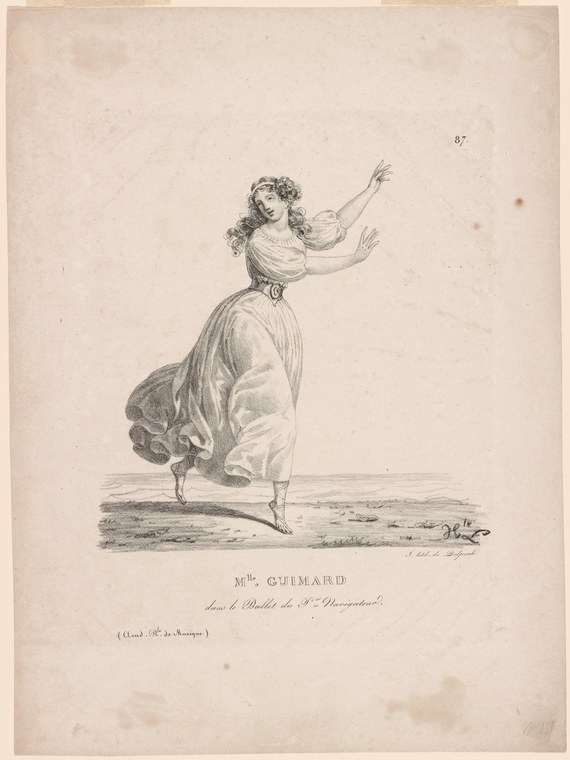
Mlle. Guimard dans le ballet du Per. navigateur
Unknown artist
- Collection:
- Prints depicting dance
- Source:
- New York Public Library
- Rights:
- Public domain — free to use, share and adapt.
- Recorded as:
- Public Domain
Named portraits of individual dancers in action are rare before photography, and this print documents a specific performer's style, role, and the expectations placed on theatrical dancers in the early 19th century. The extreme informality of Mlle. Guimard's pose—the abandon and asymmetry, the absence of a partner or formal frame—tells us how comic or demi-caractère dancers were expected to move and how they were celebrated, and reveals the gap between the geometric ideals of classical technique and the lived reality of stage performance.
What you are looking at
A young woman in Neoclassical dress stands alone on an empty stage or ground, captured mid-movement in a moment of theatrical abandon. Her body twists away from the viewer in a contrapposto pose, with her left arm raised expressively and her right hand gesturing outward, as if reaching or responding to something beyond the frame. Her costume is high-waisted in the Empire silhouette of the early 19th century, with a gathered skirt that billows around her legs—the fabric caught mid-swirl to suggest rapid movement. Her hair is loosely curled and piled atop her head. She wears what appears to be a decorative belt or sash at the waist. The background is bare and atmospheric, rendered in light washes that do not compete with the figure. The composition emphasizes the dancer's body as the sole focus, with no stage furniture, musicians, or other performers visible.
The dancing
The dancer's posture is fluid and off-balance, with weight shifted onto one leg while the torso rotates sharply away from the hips. Both arms are raised and extended, the upper body opened to the viewer's left while the head turns to follow the movement. The gesture reads as spontaneous rather than formally structured—there is no closed position, no visible partner, and no rigid frame. The skirt's movement suggests rapid weight transfers and turning; the body language conveys joy, freedom, or intoxication rather than classical discipline. This is a moment of personal expression rather than geometric precision.
The dance depicted
This is pantomime or theatrical dance of the Romantic era, most likely from a ballet or comic opera. The inscription identifies the performer as Mlle. Guimard dancing in 'le ballet du Per. navigateur' (The Pilot's Ballet, or possibly a garbled title). The pose and costume are consistent with early 19th-century pantomime or demi-caractère roles—roles that blended classical technique with comic or character gesture. The extreme informality of the pose, the absence of a partner, and the emphasis on emotional or comic gesture rather than technical display suggest this depicts a moment from a narrative ballet or vaudeville scene rather than a classical dance. The style of dress and movement is compatible with French theatrical dance of the 1810s–1830s.
How it was made
This is a lithograph or engraving, rendered in black ink on cream paper with fine linear work in the print tradition. The technique allows for the capture of a fleeting moment in theatrical performance with clarity and directness; the medium was well suited to theatrical portraiture and the promotion of individual performers. The artist has used white paper and selective shading to model the figure's volume and the fabric's weight, with particular attention to the play of light on the dancer's torso and skirt. The signature or mark in the lower right suggests this was a commercial print, likely issued for sale or as a souvenir of a particular performance.
About this work
This is a portrait of a named theatrical dancer, Mlle. Guimard, captured in a moment of uninhibited movement on stage. The print documents a specific performance or role in what appears to be a early 19th-century Parisian ballet, preserving both the dancer's likeness and the character of her performance style. It belongs in the archive of dance imagery both as a record of individual performance practice and as evidence of how pantomime and theatrical gesture were understood and depicted in this period. The work sits at the intersection of portraiture, theatrical promotion, and the visual documentation of dance—a category of imagery that was central to how performers, choreography, and style were circulated and remembered before the age of photography.
How to look at it
Attend to the asymmetry and dynamism of the pose: this is not a formal classical position but a moment caught in the middle of turning or responding to an offstage presence. The artist chose to freeze the dancer at the peak of expression—arms fully extended, body twisted, skirt billowing—rather than at a moment of stability or repose. Notice how the composition isolates the figure against empty space, making her body and gesture the only subject. This technique of capture emphasizes the performer's individual charm and the character of her movement style rather than the technical virtuosity of classical ballet.
The period
This print was made during or shortly after the Romantic era in European dance, when ballet was moving away from the Neoclassical formality of the late 18th century toward greater emotional expression, narrative complexity, and the celebration of the individual dancer's personality. Mlle. Guimard was performing in a period when French theatrical culture was dominated by operas, ballets, and pantomimes staged at theaters like the Opéra and the Opéra-Comique. The style of dress—the high waistline, the simple gathering of the skirt—dates the performance to somewhere between 1810 and 1835. Lithography and engraving were the primary means of circulating images of performers and spreading knowledge of new dances and roles across Europe.
Where it lives
This print is held in the New York Public Library's collection of prints depicting dance. It is a commercial theatrical print, likely issued in France in the early 19th century and distributed to theater patrons and collectors as a record of a notable performance.
Dance in this work
Questions about this work
Who was Mlle. Guimard?
The catalogue record does not identify Mlle. Guimard beyond the inscription on the print. She was a performer in early 19th-century Paris, likely a dancer in comic or demi-caractère roles. Without additional research, it is not possible to establish her full identity or career from the print alone.
What is 'le ballet du Per. navigateur'?
The title is abbreviated or possibly garbled. 'Per. navigateur' may refer to 'Le Pilote navigateur' (The Pilot Navigator) or a similar nautical or comic ballet. Such works were common in early 19th-century French theater, often featuring elaborate pantomime and character dances. The full title and plot cannot be confirmed from the print alone.
What dance style is this?
This depicts pantomime or theatrical dance of the Romantic era, likely a comic or demi-caractère role within a larger ballet or opera. It is not pure classical ballet—the informality and asymmetry of the pose mark it as character or comic dance, in which emotional expression and personality were valued alongside technical skill.
Why is the dancer alone?
The print isolates the named performer as the subject of celebration and portraiture. In theater prints of this era, it was common to depict a single dancer in a characteristic or celebrated moment rather than to show the full stage scene. This format allowed the performer's individuality and the character of their style to be the focus.
More dance artwork





