49 works in this view — arrow keys or swipe to move between them.
Dance in Art
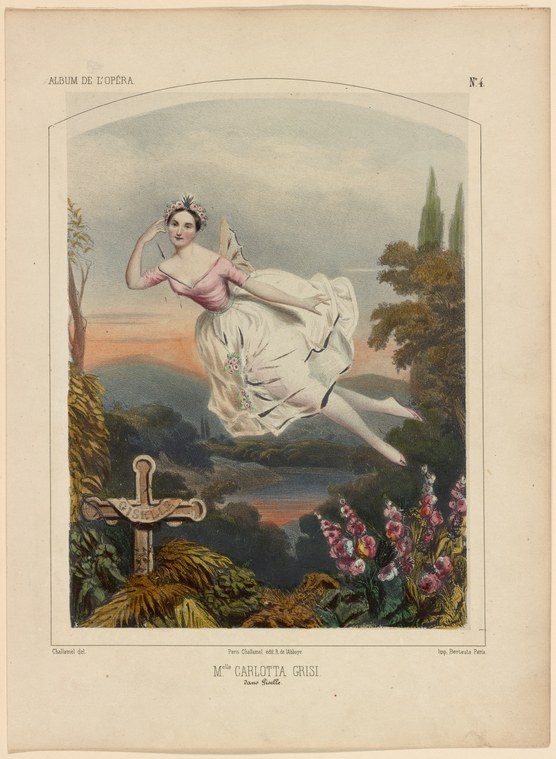
M'elle Carlotta Grisi dans Giselle
Unknown artist
- Collection:
- Prints depicting dance
- Source:
- New York Public Library
- Rights:
- Public domain — free to use, share and adapt.
- Recorded as:
- Public Domain
Carlotta Grisi's performance in *Giselle* (Paris, 1841) established the archetype of the Romantic ballerina—a figure of pathos, supernatural beauty, and emotional depth rather than technical showmanship. This print, circulated widely among the theatre-going public, codified that image and made it iconic. For historians of ballet and Romantic culture, it is primary evidence of how the era understood and visualized the female dancer's role.
What you are looking at
A young woman in a white Romantic-era tutu and pink bodice reclines in mid-air against a mountainous Italianate landscape, her body arched and weightless as though suspended in supernatural flight. She wears a tiara and looks downward with a serene expression, one arm raised gracefully to her head. Below her, a stone cross stands at the left edge of a dark lake or river, while flowering plants (likely roses) bloom in the foreground; cypress trees frame the right margin, and misty mountains recede toward a warm sunset. The composition is vertically oriented within an arched frame, creating an ethereal, otherworldly mood. This is a hand-colored engraving or lithograph from the *Album de l'Opéra*, and the scene captures the moment of supernatural transcendence that defines the second act of *Giselle*.
The dancing
A single female figure dominates the composition, depicted in an impossible attitude of weightless repose: the body is nearly horizontal, the torso slightly arched backward, the legs extended and relaxed. One arm curves up to frame the face; the other lies across the torso. The pose communicates neither the active extension of a classical line nor the grounded weight of naturalistic movement, but rather a dreaming or possessed state—the body of someone absent from herself, floating. The costume and the framing suggest classical ballet technique, but the emotional register is Romantic melancholy rather than virtuosic display.
The dance depicted
*Giselle*, the cornerstone of Romantic ballet, premiered in Paris in 1841 with Carlotta Grisi in the title role. This image shows the second act, when Giselle's spirit returns as a *wili*—a vengeful maiden who has died of a broken heart and now dances the living to their deaths. Grisi was renowned for her technical brilliance in the first act (the betrayal and madness of the living Giselle) and her ethereal, mournful presence in the second, when Giselle floats above the earth as a phantom. The artist has chosen the moment that most perfectly expresses the Romantic ballet's obsession with the supernatural and with the female dancer as a creature of otherworldly beauty and pathos—weightless, innocent, and doomed.
How it was made
A hand-colored engraving or lithograph, likely from the 1840s or shortly after, part of the *Album de l'Opéra*, a commercial publication that documented the great operatic and ballet performances of Paris. The soft coloration, the delicate line work, and the romantic landscape background are characteristic of mid-19th-century theatrical prints created to commemorate and publicize famous roles. These were mass-produced and circulated among the theatre-going public, making celebrated dancers like Grisi familiar to those who could not attend performances. The hand-coloring process gave each print a unique variation, and the technique allowed for detailed rendering of costume and setting that photography could not yet match.
About this work
This is a portrait of Carlotta Grisi as the spirit of Giselle, the titular ghost of the most famous Romantic ballet ever created. It captures not a moment of active dancing but rather the suspended, melancholic presence that made the second act of *Giselle* revolutionary: the image of a female dancer as a supernatural being, weightless and tragic, floating above a moonlit landscape. The print is both a record of Grisi's performance and a manifesto of Romantic ballet aesthetics—the rejection of classical virtuosity in favor of emotional transcendence and supernatural beauty. For any history of dance in visual culture, this image is foundational: it shows how the Romantic era reimagined the dancing body as something ethereal, even inhuman.
How to look at it
Notice the artist's choice to depict not the active leap or turn that would demonstrate Grisi's technical skill, but rather the moment of suspension—the pause between effort and earth-bound reality. The arched back, the upturned face, the relaxed limbs: all convey a state of trance or possession rather than conscious control. The landscape, with its religious symbolism (the cross), its Italianate nostalgia (the cypress, the lake), and its melancholic color (the dim sky), is not mere background but a visual equivalent of the ballet's emotional world. The engraver has rendered Grisi's costume with precision—the white tulle, the pink bodice, the tiara—to authenticate her as the performer, yet the pose itself is almost impossible, inviting the viewer to suspend disbelief and accept the supernatural conceit.
The artist
The artist is not recorded. The print comes from the *Album de l'Opéra*, an important Paris-based publication of the 1840s-1860s that documented major operatic and ballet performances through hand-colored engravings and lithographs. Such albums were commercial ventures aimed at middle-class audiences who wished to possess images of celebrated performers and famous scenes. The prints were often based on sketches made at the theatre or from costume designs, and they played a crucial role in creating a visual archive of 19th-century performance.
The period
The 1840s saw the flowering of Romantic ballet across Europe, with Paris as its epicenter. *Giselle* (1841, choreography by Jean Coralli and Jules Perrot) was a landmark: it crystallized the Romantic obsession with the supernatural, with doomed love, and with the female dancer as a creature of otherworldly beauty. Carlotta Grisi was an Italian ballerina who became a star of the Paris Opéra and was the original Giselle; her interpretation set the standard for the role across Europe. The aesthetics of Romantic painting—the emphasis on landscape, emotion, nocturnal mood, and the fragile beauty of women—directly shaped both the choreography of *Giselle* and the visual culture that documented it. This print is one of dozens produced to capitalize on the ballet's immense popularity.
Where it lives
The print is part of the *Album de l'Opéra*, a series published in Paris in the mid-19th century to document major theatrical performances. It is held in the New York Public Library's collection of prints depicting dance. The *Album* was a commercial publication with broad circulation among Paris's theatre-going public and became an important visual record of Romantic-era performance.
Dance in this work
Questions about this work
Was this a real pose Grisi could perform?
No. This is an artistic interpretation of Grisi's presence as a spirit in the second act. The artist has exaggerated the weightlessness and supernatural quality to evoke the ballet's emotional truth rather than documentary accuracy. In the actual choreography, Giselle would have danced on pointe, leapt, and turned—but the engraver chose to freeze her in a moment of ethereal repose to capture her otherworldly essence.
What is the significance of *Giselle* in ballet history?
*Giselle* (1841) is the most celebrated work of Romantic ballet. It introduced the two-act structure that became standard, featured the *wili* (ghostly maiden) as a leading character, and established the prototype of the Romantic ballerina—a figure of emotional depth and supernatural beauty rather than mere technical display. It remains in the repertory of nearly every major ballet company today.
Who was Carlotta Grisi?
Carlotta Grisi (1819–1899) was an Italian ballerina who became a star of the Paris Opéra in the 1840s. She was the original Giselle and was renowned for her combination of technical brilliance and emotional expressiveness. She danced across Europe and was a key figure in the dissemination of Romantic ballet.
What does 'Album de l'Opéra' mean?
The *Album de l'Opéra* was a Paris-based publication series that circulated hand-colored prints of famous operatic and ballet scenes and performers. It functioned as a form of celebrity merchandise and visual documentation, allowing theatre-goers to own images of their favorite performers and scenes. These albums were important in creating a mass visual culture of performance in the 19th century.
More dance artwork





