49 works in this view — arrow keys or swipe to move between them.
Dance in Art
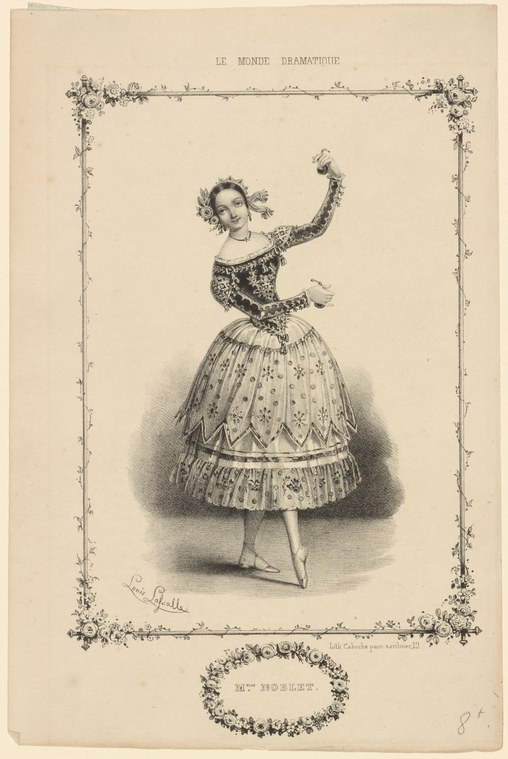
Melle. Noblet
Unknown artist
- Collection:
- Prints depicting dance
- Source:
- New York Public Library
- Rights:
- Public domain — free to use, share and adapt.
- Recorded as:
- Public Domain
This image is vital evidence of Romantic ballet as a historical practice: it shows the actual costume, the silhouette, the physical ideal, and the specific moment in a performance that the artist chose to immortalize. For dancers and historians, it answers questions about how these works looked in their own time, what the bodies were actually doing, and what aesthetic values shaped the movement. The fact that such prints were mass-produced and collected tells us how dance was consumed as popular entertainment and how celebrity dancers built their reputations.
What you are looking at
A young female dancer in mid-performance, captured in a formal engraved portrait. She wears an elaborate Romantic-era costume: a fitted dark bodice heavily embellished with sequins or beadwork, and a voluminous skirt with a scalloped hemline decorated with stars or floral motifs, worn over multiple petticoats. Her hair is crowned with a wreath of flowers or leaves. The dancer is shown in profile, one arm raised gracefully overhead in an arabesque or attitude position, the other arm extended to balance the pose. Her body is elongated and weightless, captured mid-leap or in sustained elevation. The composition is formal and theatrical: the figure is centered within an ornate decorative border of flowers and flourishes, typical of 19th-century theatrical prints. The background is plain, focusing all attention on the performer and her costume. A banner at the base reads 'Mlle NOBLET', identifying the subject. The overall presentation is that of a souvenir print of a celebrated dancer, disseminated to admirers or theatre patrons.
The dancing
A single female dancer shown in a moment of apparent weightlessness—the body is fully extended with the supporting leg either en pointe or in a high lift, while the raised arm curves overhead in a romantic, ethereal line. The dancer's frame is elongated and graceful, with the torso held upright and the extended leg creating a diagonal line of energy. The pose suggests a highly trained performer working in the idiom of classical ballet, with the emphasis on elevation, lightness, and the illusion of defying gravity. The dancer's posture and the positioning of the limbs demonstrate technical control and the aesthetic ideal of the Romantic period.
The dance depicted
This is almost certainly a depiction of Romantic ballet, the dominant theatrical dance form of the early-to-mid 19th century. The costume—the tutu, the floral crown, the decorative bodice—and the ethereal, weightless pose are signature elements of the Romantic ballet aesthetic. Mlle Noblet is likely a professional ballerina of the 1830s–1850s, possibly one of the Noblet sisters who were celebrated performers at the Paris Opéra during this period. The elevation and line suggest a dancer trained in the newly codified technique of ballet d'école, performed en pointe. The image presents the dancer as a celestial or supernatural being, which was central to Romantic ballet's thematics of the unattainable ideal. The pose is frozen at a moment of apparent suspension, a key convention of how ballet's technical achievements were marketed to the public.
How it was made
This is a lithograph or steel-engraved print, created by hand-drawing or engraving a stone or metal plate that was then transferred to paper. The technique allowed for precise lines and fine detail in the border and the figure itself, while the subtle shading in the background and on the skirt was achieved through careful cross-hatching or stone work. The signature 'L. Isbelle' visible at bottom left indicates the printmaker. This was a cheap and reproducible form of theatrical promotion—a single engraved plate could generate hundreds of copies for sale at the theatre or through print shops, making these images accessible to middle-class admirers and dancers themselves. The ornamental border frames the dancer as a precious object, elevating her status while the reproducibility of the medium democratized access to her image.
About this work
This is a theatrical souvenir print of a celebrated Romantic-era ballerina, created to commemorate a star performer and disseminate her image to the public. Mlle Noblet, identifiable from the inscription, is shown in costume at the height of the Romantic ballet era, when the aesthetic ideal was one of ethereal weightlessness, supernatural beauty, and technical virtuosity. The print is both a work of art history—a record of how Romantic ballerinas looked, how they moved, and how they were marketed—and a material artifact of 19th-century theatrical culture, when prints like this were bought and collected by dancers, patrons, and enthusiasts. It belongs in a dance archive because it is primary evidence of how the most prestigious dance form of the era was performed, costumed, and celebrated.
How to look at it
The viewer should attend to the precise moment the engraver chose to freeze: not a flat, static pose, but a captured instant of flight or supreme balance, when the dancer appears to defy gravity. Notice the attention to the costume detail—the beadwork, the scalloped hem, the floral crown—which was as much a part of the spectacle as the movement itself. The ornamental border frames the dancer as a precious, almost sacred object, elevating her status above the spectator. The formal composition and the fineness of the line work indicate that this was a high-quality, expensive print meant for a cultivated audience. The dancer's expression is serene and otherworldly, reinforcing the Romantic ideal of the ballerina as an ethereal being.
The artist
The printmaker L. Isbelle is not well-documented in surviving records, but the style and execution are consistent with mid-19th-century Parisian theatrical prints. Artists who specialized in these souvenir portraits worked quickly and at volume, often based on sketches from life or from staged portraits. They were commercial operatives in the theatre business—their work was part of the marketing apparatus that made certain dancers into celebrities. Such prints were often bound into folios or sold individually at the theatre lobby, making them accessible to a wide audience and a major channel through which dancers built their public personas.
The period
The Romantic era (roughly 1830–1870) transformed ballet into a form centered on the female dancer as a weightless, ethereal being—the ballerina became a symbol of the unattainable ideal, often portrayed as a sylph, naiad, or spirit. Pointe work and the tutu became standard during this period. Paris was the capital of ballet, and the Opéra was the most prestigious stage in Europe. Mlle Noblet danced during the height of this aesthetic, when works like *La Sylphide* (1832) and *Giselle* (1841) defined the repertory. Theatrical prints were a booming commercial industry, and stars like Marie Taglioni became the first truly international dance celebrities, their images sold and collected across Europe and America. This print is an artifact of that celebrity culture and the techniques of mass reproduction that enabled it.
Where it lives
This is a theatrical souvenir print from the NYPL's collection of prints depicting dance. It is a commercial object produced for sale to audiences and collected as a memento of a celebrated performance or performer. The print was likely sold at the theatre or through print shops in Paris, making it both an artistic object and a commodity of popular culture.
Dance in this work
Questions about this work
Who was Mlle Noblet?
The Noblet family produced several celebrated ballerinas in 19th-century Paris. A Mlle Noblet (first name Lise or Claudine) was a soloist at the Paris Opéra during the 1830s–1840s and is known from period accounts and prints. However, the catalogue record does not identify which family member this is, and biographical records are sparse. What is certain is that she was prominent enough to merit a theatrical print, which indicates she was a well-known and admired performer.
What is she dancing?
The print does not depict a scene from a specific ballet, but rather a souvenir portrait of the dancer in costume. The costume and pose are consistent with Romantic ballet roles, which often cast the female dancer as a supernatural or ethereal being—a sylph, spirit, or fairy. Without a specific scene, we cannot say which ballet this represents, but the aesthetic and technique suggest roles from the major Romantic repertory of the era.
How was this print made?
This is a lithograph or steel engraving, created by drawing or engraving an image onto a stone or metal plate, which was then inked and printed on paper. The fine lines and shading show the skill of the engraver, L. Isbelle. The technique allowed hundreds of copies to be made from a single plate, making theatrical prints an affordable and widely distributed form of celebrity promotion.
What does the pose tell us about Romantic ballet technique?
The elevated, weightless pose and the extended line of the body show that Romantic-era ballerinas were trained in pointe work and were prized for their ability to create the illusion of effortless flight. The arm position—curved overhead in a graceful arc—and the elongated frame are signature elements of the classical vocabulary that developed during this period. The frozen moment captures a technique that required years of training to achieve.
More dance artwork





