49 works in this view — arrow keys or swipe to move between them.
Dance in Art
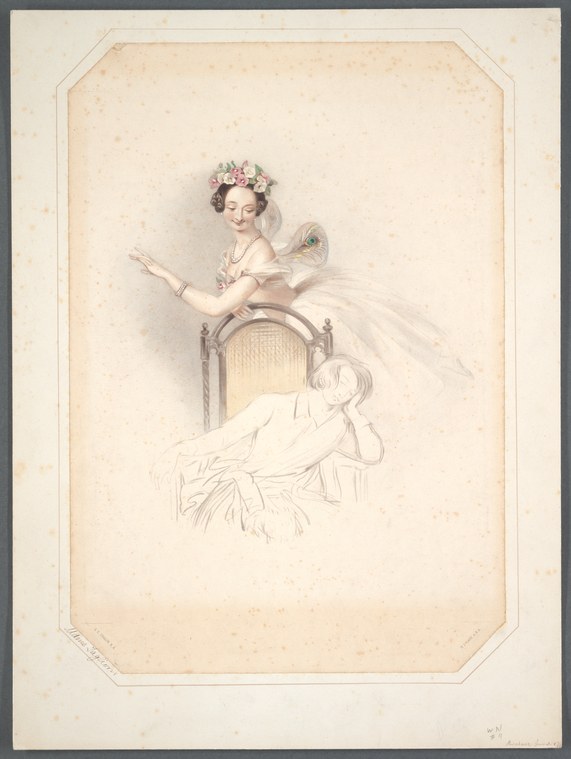
La sylphide, Souvenir d'adieu, Marie Taglioni
Unknown artist
- Collection:
- Prints depicting dance
- Source:
- New York Public Library
- Rights:
- Public domain — free to use, share and adapt.
- Recorded as:
- Public Domain
Taglioni defined Romantic ballet and the aesthetic of weightlessness and otherworldly grace that still structures classical ballet today. This image is one of the few surviving artistic records of her performance, and it captures the theatrical vision—the Sylph as magical, fleeting, and untouchable—that made her a legend.
What you are looking at
A colored engraving depicting a young woman in classical ballet costume poised gracefully on the back of an ornate chair. She wears a fitted bodice with short puffed sleeves and a voluminous tulle skirt, her dark hair crowned with a wreath of flowers. In her right hand she holds a long feathered fan or plume, extended in a gesture of farewell. Her left arm curves naturally at her side, and her body leans forward slightly as if captured mid-gesture or mid-movement. Below her, rendered in lighter sketch lines, lies a reclining male figure in classical drapery, positioned as if prone or sleeping. The composition is intimate and theatrical, with soft shading that suggests the volume of the tulle and the delicate modeling of the woman's face and upper body. The work has the refined quality of early 19th-century French theater imagery: elegant, sentimental, and designed to commemorate a specific performance or farewell.
The dancing
The female dancer stands en relevé or with weight slightly forward on the chair, her spine extended vertically, her posture upright and dignified. Her head is held high, her gaze directed outward. The extended arm with the fan reads as a theatrical gesture of farewell or benediction rather than a functional dance movement—it is a pose frozen for effect. The lower figure, barely indicated in light pencil lines, appears to be part of a narrative moment rather than an active dancer. The composition emphasizes the woman's isolation and elevation above the reclining figure below.
The dance depicted
This is a souvenir image commemorating Marie Taglioni, the legendary Romantic-era ballerina, likely in the role of the Sylph from La Sylphide (1832), the ballet most closely associated with her career. The wreath, the ethereal tulle skirt, the delicate port de bras, and the classical costume are all hallmarks of Romantic ballet. The title indicates this is a 'souvenir d'adieu'—a farewell memento—suggesting it may commemorate her retirement or a final performance. The artist captures not a specific choreographic movement but rather a theatrical tableau: the Sylph poised in a moment of departure or magical intervention, hovering above the male character (the mortal James) below. This was not documentation of technique but rather a sentimental artistic record of a celebrated dancer in a celebrated role.
How it was made
This is a hand-colored engraving or possibly a lithograph with hand coloring, typical of early 19th-century theatrical prints. The upper figure is rendered in full color with delicate washes and fine line work; the lower figure is left in light pencil sketch, a compositional choice that emphasizes the Sylph's presence while the mortal remains ghostly and incomplete. The technique was suited to rapid reproduction and wide circulation among theatergoers and ballet enthusiasts of the period. The refined execution and careful hand-coloring suggest this was a mid-market print—affordable to theater patrons but not a mass-produced broadside.
About this work
This is a commemorative portrait-print of the legendary ballerina Marie Taglioni, likely in her signature role as the Sylph in La Sylphide, the defining ballet of the Romantic era. The image freezes a theatrical moment of ethereal beauty and farewell, capturing not technique but the poetic and sentimental vision of Romantic ballet that made Taglioni an international star. The work belongs to the tradition of theater portraiture and dance memorabilia—the means by which 19th-century ballet was circulated, remembered, and celebrated in the era before photography.
How to look at it
Observe the pose of elevation and isolation: Taglioni stands on the furniture, literally raised above the mortal world. Her costume—wreath, fitted bodice, tulle—is the visual vocabulary of Romantic ballet: fragile, ethereal, artificial in the most beautiful sense. Notice the artist's choice to leave the male figure in sketch: the Sylph is the only fully realized presence in the composition. The extended arm with the fan reads as a theatrical gesture of farewell or magic rather than a moment of pure movement. This is not how a ballet dancer looks in motion; it is how Romantic imagination wished her to look—suspended, perfect, already vanishing.
The artist
The artist is not recorded in the catalogue. The style and execution are consistent with the workshop of theatrical print-makers active in Paris and London in the 1830s–1840s, a period when demand for ballet imagery was at its height. Such prints were often unsigned or bore only a publisher's mark.
The period
La Sylphide premiered in Paris in 1832 and became the cornerstone of Romantic ballet, a movement that privileged ethereality, yearning, and the supernatural over virtuosity. Taglioni's performance was revolutionary: she was said to dance en pointe (though not in pointe shoes as later understood) and to move with an almost weightless quality that audiences found almost eerie. The 1830s–1840s were the golden age of lithographic and engraved theater portraiture; such images were collected by theater patrons, and they shaped how dancers and roles were remembered and imagined by a public that could not see films or videos of performances. Taglioni's image became an icon of the Romantic ideal of femininity itself—ethereal, pure, melancholic, and ultimately tragic (in the ballet, the Sylph dies).
Where it lives
The print is held by the New York Public Library's collection of theatrical and dance imagery. It is labeled a souvenir of Taglioni's farewell, though the exact date and circumstances of publication are not recorded. Such prints were produced by theatrical publishers and sold at the stage door and in print shops, making them among the most widely circulated images of 19th-century ballet.
Dance in this work
Questions about this work
Who was Marie Taglioni?
Marie Taglioni (1804–1884) was a Swedish-born dancer who became the most celebrated ballerina of the Romantic era. She starred in La Sylphide (1832), which revolutionized ballet by shifting focus from virtuosity to an illusion of weightlessness and otherworldliness. She was an international star and her image became iconic across Europe.
What is La Sylphide?
La Sylphide (1832) is a two-act ballet choreographed by Filippo Taglioni (Marie's father) to music by Jean-Madeleine Schneitzhoeffer. It tells the story of a young man (James) who falls in love with a magical forest spirit (the Sylph) and, under the witch's curse, accidentally kills her. It is the foundational work of Romantic ballet and remains in the repertory today.
Why is the male figure drawn so lightly?
The compositional choice to render the male figure in light sketch emphasizes Taglioni's presence and otherworldliness. She is the fully realized, living figure; he is dimmed, almost ghostly. This reflects the Romantic ballet narrative: the Sylph is the supernatural subject, the mortal male is secondary and doomed.
Is this a painting or a print?
This is a hand-colored engraving or lithograph, not a painting. The technique allowed for mass production and wide circulation. Hand-coloring made each print unique, but the base image could be reproduced hundreds of times. This made it affordable to ordinary theater patrons.
More dance artwork





