49 works in this view — arrow keys or swipe to move between them.
Dance in Art
Carlotta Grisi
Unknown artist
- Collection:
- Prints depicting dance
- Source:
- New York Public Library
- Rights:
- Public domain — free to use, share and adapt.
- Recorded as:
- Public Domain
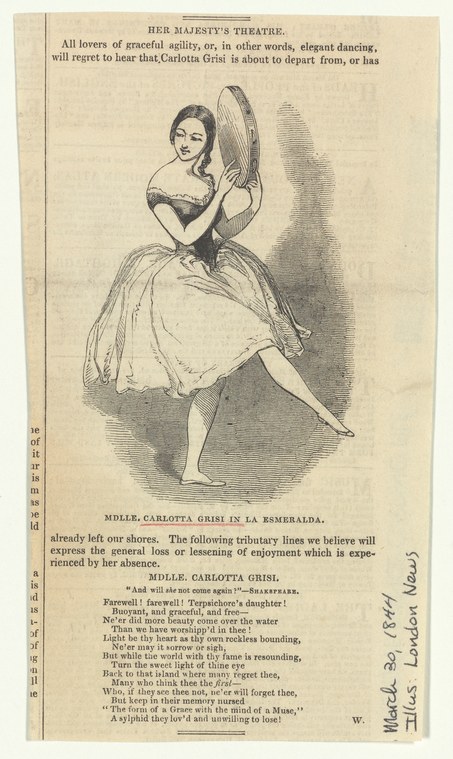
Grisi was one of the finest ballet technicians of her era, and this portrait is material evidence of how she was marketed and remembered. The engraving preserves the costume grammar of Romantic ballet—the short tutu, the ethereal aesthetic—at a moment when that vocabulary was defining the art form itself. For historians, the work is a primary record of how a superstar dancer was publicly visualized and circulated.
What you are looking at
A three-quarter-length portrait of a young woman in theatrical dress, posed against a plain background. She wears a white tulle skirt of the Romantic era, cut short to mid-calf and gathered at the waist, with a dark off-the-shoulder bodice. Her hair is styled close to her head, covered partially by a light veil or headdress. She holds a large circular mirror or reflective object in both hands at chest height, gazing into it with a composed expression. Her posture is upright but relaxed, with one leg slightly forward, suggesting a moment of rest or contemplation rather than active movement. The engraving is delicately shaded to suggest the texture of tulle and the play of light on her face and limbs. The image carries the aesthetic conventions of mid-19th-century theatrical portraiture.
The dancing
A single standing figure in a composed, stationary pose. Her weight is evenly distributed, with a subtle shift to one side. Her arms are raised to frame the mirror, elbows softly bent, creating a vertical line through the torso. The posture is balletic—shoulders back, neck extended—but the moment is one of stillness and self-regard, not active dancing. Her legs are straight and close together, with the supporting foot barely visible beneath the voluminous skirt. The overall frame suggests grace and training, consistent with Romantic-era ballet.
The dance depicted
This is a portrait of Carlotta Grisi (1819–1899), the celebrated Italian-Swedish ballerina and muse of Jules Perrot. The inscribed text identifies her in the title role of *La Esmeralda*, a major Romantic-era ballet choreographed by Perrot in 1844 with a libretto by Théophile Gautier. While the image captures her in repose rather than in motion, her costume—the characteristic Romantic tutu and the mirror as a narrative prop—directly references the ballet's plot. Grisi was one of the greatest technical virtuosos of the Romantic era, known for her brilliant execution in pointe work and her dramatic presence.
How it was made
This is a wood engraving or steel engraving, recognizable from the fine parallel hatching lines used to model form and shadow, and the crisp black-and-white contrast typical of the medium. The technique allowed for precise reproduction and wide circulation; such engravings were commonly sold as theatrical souvenirs and appeared in illustrated periodicals and annuals. The print preserves the image on aged paper, showing the patina of age. Engraving was the standard medium for theatrical portraiture in the 1840s–1850s, reaching middle-class households and theater-goers who could not attend live performances.
About this work
This is a celebrity portrait of one of the 19th century's most celebrated ballerinas, Carlotta Grisi, depicted in her most famous role. The engraving captures the aesthetic and costume conventions of Romantic ballet at its height, presenting Grisi in a moment of theatrical repose that emphasizes her elegance and training. The work belongs to a large body of theatrical portraiture produced for mass circulation in the 1840s–1850s, when lithography and engraving made the images of celebrated performers accessible to the theater-going public. It documents both Grisi's iconic status and the visual codes through which Romantic ballet was understood and consumed.
How to look at it
The viewer should attend to the costume details: the short tulle skirt, the bare shoulders, and the pointe-ready stance are all signatures of Romantic-era ballet. The mirror is not merely an accessory but a narrative prop tied to *La Esmeralda*'s plot. Notice how the engraver has used fine hatching to suggest the translucency and movement potential of the tulle, even in a static pose. The composed, almost introspective gaze suggests a moment between actions—a convention of theatrical portraiture designed to show the dancer's beauty and poise without the blur of motion.
The period
This engraving dates to the height of the Romantic ballet movement (roughly 1830s–1850s), when the genre dominated European and American theaters. Carlotta Grisi was one of the "great four" ballerinas of the Romantic era, alongside Marie Taglioni, Fanny Elssler, and Lucile Grahn. *La Esmeralda*, in which she is portrayed here, premiered at the Théâtre de la Renaissance in Paris in 1844 and was one of the era's signature vehicles, showcasing both technical virtuosity and dramatic character. During this period, theatrical portraiture in engraved form was a booming commercial enterprise, feeding the fan culture that surrounded celebrated performers. The inscription's elegiac tone—noting that the "lovers of graceful agility" will regret her departure—suggests the print may have been issued around the time of a significant engagement or retirement from a particular theater.
Where it lives
The work is held in the New York Public Library's print collection, which specializes in theatrical and dance ephemera. It was likely a commercial print, possibly published in London or Paris, and distributed as a souvenir to theater attendees and collectors of theatrical portraiture.
Dance in this work
Questions about this work
Who was Carlotta Grisi?
Carlotta Grisi (1819–1899) was an Italian-Swedish ballerina and one of the greatest dancers of the Romantic era. She was known for her brilliant technique, especially in pointe work and jumps, and for her dramatic presence on stage. She was closely associated with choreographer Jules Perrot and created many roles in his ballets, including *Giselle* (1841) and *La Esmeralda* (1844).
What is *La Esmeralda*?
*La Esmeralda* is a Romantic-era ballet choreographed by Jules Perrot, with a libretto by Théophile Gautier, based on Victor Hugo's novel *The Hunchback of Notre-Dame*. It premiered in 1844 and became one of the signature roles of the Romantic ballet, showcasing both technical virtuosity and dramatic character.
Why was Grisi so important to ballet history?
Grisi was a virtuoso technician at a time when Romantic ballet was defining itself aesthetically and physically. She created leading roles in major ballets by Jules Perrot, one of the era's greatest choreographers, and her performances helped establish the artistic standards of the Romantic era. She was also a crucial influence on the development of pointe technique and the expressivity of the genre.
What does the inscription say?
The text at the top announces that lovers of graceful dancing will regret that Carlotta Grisi has departed or is about to depart. The verses below are a tribute to her talent and the memory of her performances, noting her beauty and the sorrow felt by her absence from the stage.
More dance artwork





