49 works in this view — arrow keys or swipe to move between them.
Dance in Art
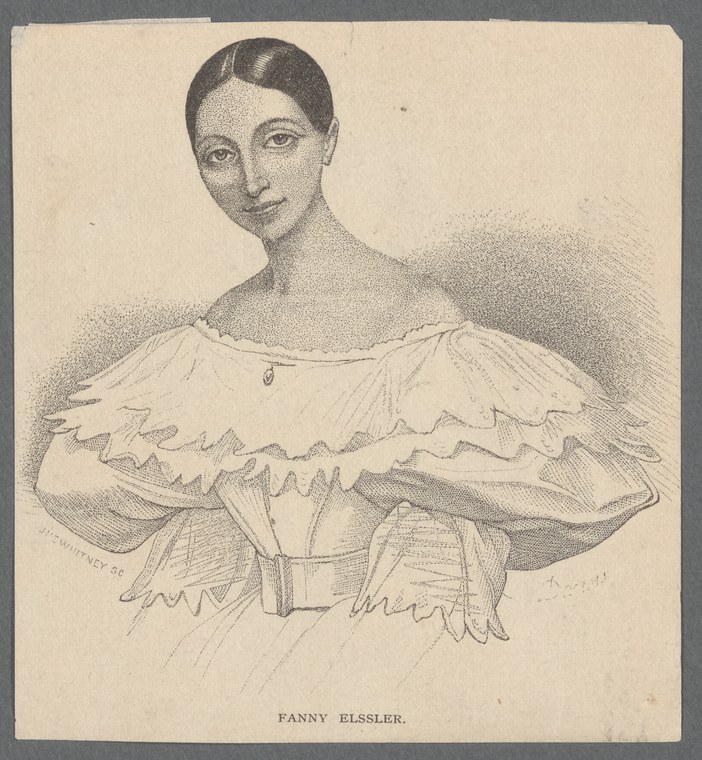
Fanny Elssler
Unknown artist
- Collection:
- Prints depicting dance
- Source:
- New York Public Library
- Rights:
- Public domain — free to use, share and adapt.
- Recorded as:
- Public Domain
Elssler was a defining figure in Romantic ballet and a rival to Marie Taglioni; this portrait is evidence of how she was promoted and consumed as a theatrical celebrity. The image shows the exact costume conventions of mid-19th-century ballet at the moment Romantic style was at its peak, offering historians and dancers concrete detail about silhouette, construction, and aesthetics that no written description alone can provide.
What you are looking at
A half-length portrait of a woman in Romantic-era theatrical costume, rendered in fine stippled engraving. She is shown bare-shouldered, wearing an off-the-shoulder bodice with a dramatically gathered and ruffled skirt in multiple tiers of fabric that extends across the lower portion of the composition. A small pendant hangs at her neckline. Her dark hair is parted in the center and smoothed back in the style of the 1840s. The figure is posed three-quarter length against a plain background, with delicate cross-hatching suggesting volume and shadow around the shoulders and upper body. The technical refinement and intimate scale suggest this is a portrait print made for circulation among theater-goers or in the popular press.
The dancing
The dancer is shown in a standing, neutral pose rather than mid-movement—a convention of theatrical portraiture from this period. Her posture is upright and dignified, shoulders relaxed, with arms held at her sides or partially obscured by the voluminous skirt. The pose prioritizes display of the costume, especially the characteristic Romantic tutu with its layered, flounced construction, over the capture of active dance movement.
The dance depicted
This is a portrait of Fanny Elssler, the celebrated Romantic ballet dancer of the 1830s–1840s. Elssler was known for her technical precision and dramatic presence, contrasting with the ethereal style of her contemporary Marie Taglioni. The off-the-shoulder bodice and tiered skirt are hallmarks of Romantic-era ballet costume, though the length and construction here suggest theatrical dress worn in pas de deux or character roles rather than the longer, weightless tutus of full Romantic ballets. The costume and presentation confirm her identity as a major stage figure of the period.
How it was made
This is a steel or copper engraving, identified by the fine parallel line work (hatching and cross-hatching) that models form and create tonal variation across the image. The technique allowed for precise reproduction and widespread distribution through printing, making it the primary medium for theater celebrity portraiture in the 19th century. Such prints were sold individually or in collections, circulating among ballet enthusiasts, theatergoers, and the general public. The delicate stippling and fine detail suggest skilled professional engraving, likely published by a major theatrical print house.
About this work
This is a portrait engraving of Fanny Elssler, one of the most celebrated ballet dancers of the Romantic era. She is shown in theatrical costume—the off-shoulder bodice and layered tutu characteristic of 1840s ballet—posed for formal display rather than in active movement. The work belongs in a dance gallery as a document of Romantic ballet aesthetics and celebrity, and as evidence of how dancers were represented in popular visual culture. Elssler's fame and the technical quality of this print indicate it was made for wide circulation during or shortly after her performing career, making it a primary source for understanding both the dress and the public image of Romantic ballet.
How to look at it
Look closely at the construction of the costume: the fitted bodice, the precise tiers of the skirt with their individual ruffles, and the small pendant that anchors the composition. Notice how the engraver has used fine parallel lines to suggest the translucency and weight of the fabric—a technical achievement that demonstrates both the skill of the printmaker and the sophistication of ballet costume design. The neutral pose is typical of the era and should not be read as evidence of stiffness; instead, it reflects the convention that a theatrical portrait should display the dancer's beauty and the costume's elegance rather than capture movement.
The artist
The artist is not recorded in the catalogue. However, the engraving's technical quality and subject matter suggest it was the work of a professional theatrical print publisher, likely working in London or Paris in the 1840s. Fanny Elssler toured extensively through both cities and was a favorite subject for portrait engravers serving the theater-going public. The style and execution are consistent with the work of established theatrical print houses of the period.
The period
This portrait dates to the height of the Romantic era in ballet, a period (roughly 1830–1850) that saw the rise of the ethereal female dancer, exotic settings, and supernatural narratives. Fanny Elssler's career peaked during this time; unlike Taglioni, Elssler was celebrated for technical brilliance and character roles as much as for weightless, poetic presence. The 1840s saw enormous public appetite for theatrical imagery, and engraved portraits of star dancers were among the most popular prints of the day, sold in galleries, theaters, and print shops. This was the period before photography displaced engraving as the primary medium for celebrity portraiture.
Where it lives
This work is held in the Prints depicting dance collection at the New York Public Library. It is a single-sheet theatrical portrait engraving, one of thousands produced during the Romantic era for public sale and collection.
Dance in this work
Questions about this work
Who was Fanny Elssler?
Fanny Elssler (1810–1884) was an Austrian ballet dancer and one of the two supreme stars of Romantic ballet, rivaling Marie Taglioni in fame and influence. She was celebrated for technical precision, dramatic range, and the execution of character dances like the cachucha, and toured internationally with great success. Her career spanned from the 1820s through the 1850s, making her one of the most visible performers of the age.
What is the off-the-shoulder costume in this portrait?
This is Romantic-era ballet dress, characteristic of the 1830s–1840s. The off-shoulder neckline and fitted bodice were designed to display the dancer's upper body and neck, while the layered, flounced skirt—usually made of silk tulle or gauze—allowed freedom of movement in turns and jumps. This particular example suggests a costume worn in a pas de deux or character role rather than a full-length narrative ballet.
Why was Elssler represented in engraving rather than painting?
Engraving allowed for mass production and affordable distribution, making it the ideal medium for theater publicity and popular celebrity portraiture in the 19th century. A single engraved plate could be printed hundreds of times and sold for modest prices, reaching a wide audience of theatergoers. Oil paintings were expensive and unique; engravings made dancers' images accessible to the general public.
How can I tell this is an engraving and not a photograph?
The entire image is composed of fine parallel lines (hatching and cross-hatching) that build tone and form. Photograph prints produce continuous tones and photographic detail; engravings use discrete line work, which creates a characteristic linear texture visible across the whole surface. The technique predates photographic reproduction and reflects the state of printing technology in the 1840s.
More dance artwork





