49 works in this view — arrow keys or swipe to move between them.
Dance in Art
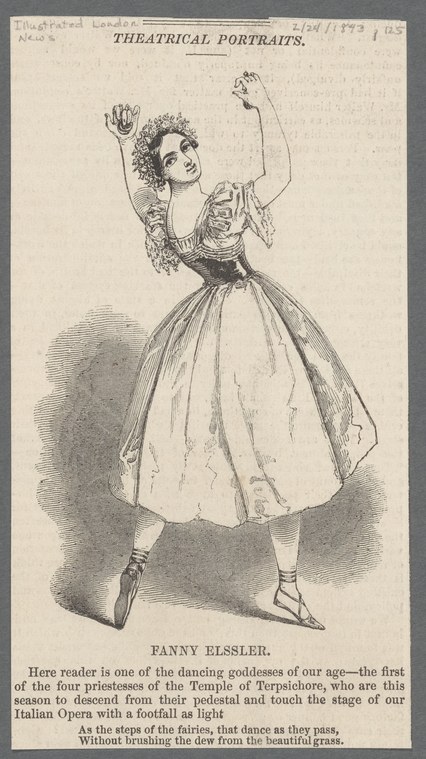
Fanny Elssler depicted in costume, with castanets
Unknown artist
- Collection:
- Prints depicting dance
- Source:
- New York Public Library
- Rights:
- Public domain — free to use, share and adapt.
- Recorded as:
- Public Domain
Fanny Elssler was a bridge between the technical rigor of Classical ballet and the poetic imagination of Romanticism, and she was one of the first international dance superstars whose fame was amplified by printed portraiture. This engraving is a primary document of how a nineteenth-century audience understood and remembered one of history's greatest dancers.
What you are looking at
A single female dancer is depicted in a three-quarter pose against a plain background, captured mid-movement with both arms raised in an exuberant gesture. She wears a white or pale tulle skirt with a fitted bodice trimmed with decorative elements, her hair adorned with a wreath or crown of flowers. The skirt is voluminous and caught in motion, suggesting lightness and elevation. She stands en pointe or nearly so on her left leg, with her right leg extended, and her upward gaze and open posture convey joy and theatrical presence. The engraving technique creates strong contrasts between the figure and the pale background, emphasizing the dancer's form and the delicate fabric of her costume.
The dancing
The dancer's weight appears to be supported on her left leg in a lifted position, with her right leg extended in a gesture suggesting either a développé or grand battement. Both arms are raised to approximately shoulder height or slightly above, creating an open, welcoming frame. Her head is tilted back slightly and turned upward, and her facial expression registers delight or rapture. The extended leg and lifted torso suggest balletic training and the aesthetic of 1830s–1850s Romantic ballet.
The dance depicted
This is almost certainly Romantic ballet of the mid-nineteenth century, most likely a work designed to showcase the technical and ethereal qualities prized in that era. The inscription confirms this is Fanny Elssler, one of the era's most celebrated ballerinas, known for both technical virtuosity and dramatic presence. Elssler was renowned for her roles in works such as *La Sylphide* and *Giselle*, and for introducing Spanish and character dances to the ballet repertoire. The costume and pose are consistent with the aerial, weightless ideal of Romantic ballet, though Elssler was equally famous for her earthier, more sensual interpretation of dance.
How it was made
This is a wood or steel engraving, a reproductive print technique that allowed for mass circulation and made theatrical portraiture affordable and widely accessible. The fine lines and careful modeling of light and shade are characteristic of nineteenth-century theatrical prints. The engraving technique permitted precise rendering of fabric texture and facial detail, making such prints valuable documents of how dancers appeared in performance and how they wished to be remembered. The print would have been sold as a souvenir and distributed to audiences and admirers throughout Europe and America.
About this work
This is a mid-nineteenth-century engraved portrait of the celebrated Romantic ballerina Fanny Elssler, one of the two or three most famous dancers of her age. The print captures her in a moment of ethereal elevation, dressed in the pale tulle skirt and floral crown of Romantic ballet, with both arms raised in exuberant gesture. It belongs in a gallery of dance as both a technical document of Romantic ballet aesthetics and as evidence of how the era's greatest dancers presented themselves to their public: weightless, joyful, and entirely committed to the illusion of transcendence.
How to look at it
Notice the artist's choices in pose and expression: the upward gaze and open arms convey joy and spiritual elevation rather than technical display, yet the extended leg and lifted bearing demonstrate balletic training and strength. The costume is rendered with particular attention to the texture of the tulle and the delicacy of the wreath. The engraving technique allows the artist to suggest movement and lightness through the contrast between the dancer's illuminated figure and the plain background. This is a moment of peak emotion captured and held for the viewer—the very heart of Romantic ballet aesthetics.
The artist
The artist is unrecorded on the print. Theatrical portraiture of this era was often produced by teams of engravers working from sketches or paintings made during or after performances. Such prints were typically published by theatrical print dealers and distributed through bookshops and at the theatre itself. The quality of this engraving suggests a professional hand accustomed to portrait work.
The period
This print dates to the 1840s–1850s at the height of the Romantic ballet era, when dancers such as Elssler, Marie Taglioni, and Carlotta Grisi dominated European and American stages. The period saw the refinement of pointe work, the rise of the tutu and gas lighting, and the development of the ballerina as the central figure in ballet. Theatrical prints became a major medium for disseminating images of performers and for creating fan culture and celebrity. Elssler's career spanned the transition from Classical to Romantic ballet, and she was celebrated both in Europe and during her celebrated American tour (1840–1842).
Where it lives
This print is held in the Prints depicting dance collection of the New York Public Library, a major repository of theatrical portraiture and dance documentation. It is one of thousands of such theatrical prints circulated during the nineteenth century to promote dancers and to satisfy public demand for images of celebrated performers.
Dance in this work
Questions about this work
Who was Fanny Elssler and why was she famous?
Fanny Elssler (1810–1884) was an Austrian dancer who became one of the most celebrated performers of the Romantic era, rivaled only by Marie Taglioni. She was known for her technical brilliance, her dramatic presence, and her ability to perform both ethereal Romantic roles and earthy character dances. She danced in most of the major European capitals and made a celebrated two-year tour of the United States (1840–1842), where she was received as a cultural phenomenon.
What is Romantic ballet and how did it differ from earlier ballet?
Romantic ballet, which dominated the 1830s–1850s, emphasized poetry, emotion, and the supernatural over technical display. Ballerinas rose onto the tips of their toes (en pointe), wore pale tulle skirts, and danced as sylphs, spirits, and otherworldly beings. It valued the appearance of weightlessness and effortlessness, though it required unprecedented physical training and strength. Romantic ballet was both a reaction against the artifice of Classical ballet and an expression of the era's fascination with the mysterious and the unreachable.
How were these theatrical prints made and distributed?
Theatrical prints were made by skilled engravers working from sketches or paintings, often created during or immediately after performances. They were published by theater print dealers and sold at theaters, bookshops, and print shops. They were inexpensive enough for ordinary theater-goers to purchase as souvenirs, and they created a form of celebrity culture by distributing images of famous performers. Such prints were a major revenue stream for both publishers and dancers.
More dance artwork





